After Maduro: How Rodriguez's Purge Reshapes Venezuela's Sanctions Calculus
Delcy Rodriguez has replaced 17 ministers in 105 days and detained figures from Maduro's inner circle without a word of public explanation. Washington is watching a controlled demolition and calling it regime change.
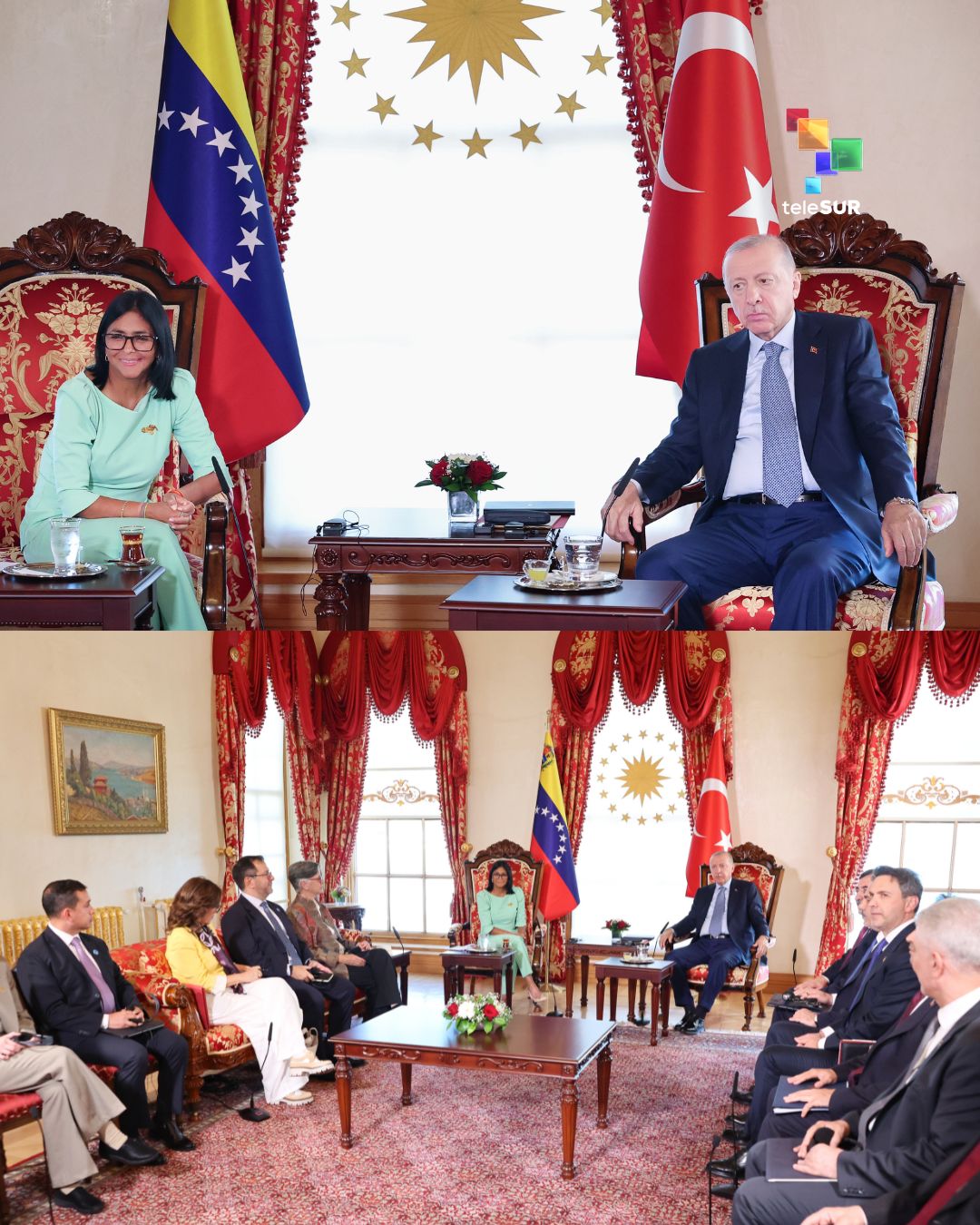
On the evening of 18 April 2026, the New York Times confirmed what Caracas-watchers had been tracking in granular detail since January: acting Venezuelan president Delcy Rodriguez has replaced seventeen ministers in the hundred and five days since Nicolás Maduro was detained by what official Chavista sources insist was a "voluntary transfer of command" on 3 January. The detentions, the Times reported, "unfolded without public explanation, but often with speed." Two senior figures from the colectivos — the armed neighbourhood militias that formed the street backbone of Chavismo for two decades — were among those removed. Interior figures who had run SEBIN, Venezuela's intelligence service, since 2017 have not been seen in public since February. This is not a cabinet reshuffle. This is a new government performing legitimacy for an audience that has not yet decided whether to recognise it.
The question the wire desks are bungling — asking whether Rodriguez is "moderate" or "reformist" compared to Maduro, as if that is the relevant axis — is the wrong one entirely. The useful question is structural: what does a post-Maduro Venezuela mean for the sanctions architecture that has spent seven years failing to produce a political transition, and what does Rodriguez's purge tell us about which direction she intends to take it?
Drawing on Saskia Sassen's framework of denationalisation — the process by which globally integrated legal and financial instruments strip sovereignty from states that nominally retain it — and Fernando Coronil's reading of the Venezuelan petro-state as a site of permanent negotiation between oil rents, state power and popular legitimacy, the Rodriguez moment looks less like democratisation and more like the recomposition of a rentier state under new management, still trapped inside the same sanction architecture, still searching for the dollar workaround that makes it survivable.
The Purge: What the Pattern Says
Begin not with the names removed but with the method. Rodriguez's eliminations of Maduro associates follow a consistent template: no charges announced, no press conference, succession handled administratively, assets quietly frozen inside Venezuela's own judicial system. This is not the loud performative justice of a transition government seeking international legitimacy through visible accountability. It is something closer to consolidation by stealth — removing the nodes of the old network without triggering the factional ruptures that open announcement would risk.
Political scientist Javier Corrales, writing in Americas Quarterly on 12 April, identified the pattern as "controlled succession": an insider with institutional reach — Rodriguez served simultaneously as executive vice-president, foreign minister and PSUV vice-president under Maduro — leveraging the detention of the principal to clear rivals before they can organise. The colectivos are the variable that makes this dangerous. SEBIN-affiliated commanders answered to Maduro directly. Rodriguez's replacing them with figures closer to the armed forces' regular chain of command is a deliberate transfer of coercive capacity from informal militias to the regular military — a move that makes her government more legible to foreign interlocutors (including, crucially, Washington's back-channel envoys) while simultaneously undercutting the street-level power that has historically deterred coup attempts.
What is being done here is the creation of a state that can negotiate. That is not the same as a state that will negotiate away Chavismo's core commitments: PDVSA ownership, anti-imperialist foreign policy, oil-rent distribution. Rodriguez has repeated each of these commitments in every public appearance since January. The purge is about who controls the levers, not which levers are available.
OFAC Architecture and the Rodriguez Calculation
The sanctions regime Rodriguez has inherited is, by any honest metric, a slow-motion catastrophe for Venezuela's civilian population that has failed every stated strategic objective. GDP has contracted by roughly 75 percent in real terms since 2013. Poverty rates exceed 80 percent by ENCOVI (national household survey) estimates. Emigration — the nominal pretext for the policy — has produced the largest displacement crisis in Western hemisphere history outside Haiti: over 7.7 million Venezuelans abroad as of the UNHCR's March 2026 count.
The OFAC structure itself is layered: Executive Order 13808 (2017) blocked new debt financing; EO 13827 blocked transactions in Venezuelan digital currency; EO 13884 (2019) blocked all property and interests of the Venezuelan government in US jurisdiction; the SDN listing of PDVSA in January 2019 effectively shut Venezuela out of dollar-clearing correspondent banking. Each layer compounds the others. The Chevron General License — which between 2022 and early 2026 allowed a partial return of dollar revenue — was the single aperture in an otherwise sealed system. Its revocation in March, with a wind-down period ending 27 May, closes that aperture.
Rodriguez's strategic window is narrow. She has three options: genuine negotiation with Washington that produces SDN delisting in exchange for political concessions she cannot afford to give without fracturing her own coalition; acceleration of the yuan-ruble-CIPS parallel corridor that Maduro began constructing; or a symbolic gesture toward "free and fair elections" that is just credible enough to unlock a partial sanctions rollback from European interlocutors while leaving the US architecture intact. All three paths are simultaneously being played. What the purge does is remove the figures most likely to sabotage whichever path gains traction.
The Coronil Frame: Oil, State, Nation
Fernando Coronil's The Magical State — his 1997 account of the Venezuelan petro-state's constitutive mythology — remains the most precise analytical lens for what is happening. Coronil showed that Venezuelan political legitimacy has never been derived primarily from formal democratic procedure or even from Chavismo's revolutionary solidarity, but from the state's capacity to distribute oil rents as visible social provision: cheap fuel, subsidised food, free clinics, housing. The petro-state does not merely govern; it produces the nation through the distribution of petroleum wealth.
When the sanctions regime successfully degrades that distribution — when the grid goes dark, when the subsidised milk disappears, when the Caracas metro runs two hours a day — it does not produce regime change. It produces a population that blames simultaneously the empire that imposed the siege and the government that cannot break it. Rodriguez's purge is, in part, an attempt to reassert the petro-state's distributive function under conditions of near-total external strangulation: by removing the patronage networks that were diverting oil-rent residuals into private accumulation rather than social provision, she is attempting to reconcentrate what little rent remains toward the visible public goods that generate popular tolerance.
Whether she can do this while also negotiating with Washington, managing the Chinese and Russian partners who have filled the dollar vacuum with yuan and rouble credit lines, and simultaneously preventing the regular military from converting its new institutional centrality into its own factional project is — to be direct — an open question. The honest answer is: probably not for long. But the time horizon matters. Rodriguez needs to survive long enough to reach whatever political settlement becomes available, and for that she needs a state that functions, minimally, as a state.
What Washington Sees — and Misreads
The Trump administration's current posture on Venezuela is best described as coercive ambiguity. The March revocation of the Chevron waiver was a punishment signal — for Caracas's failure to accept the deportation terms Washington demanded, and for the Maduro detention not being followed by an offer to hold internationally monitored elections within a defined timetable. The April General License 41B wind-down is a grace period structured to look like flexibility while foreclosing it.
What Washington is reading as an opportunity — a new government it might be able to do business with — is likely a misread of the incentive structure Rodriguez faces. Every concession she makes toward Washington legibility (holding elections, releasing political prisoners, accepting international observers) weakens her vis-à-vis the military, the PSUV hardliners and the Cuban-linked intelligence infrastructure that remains embedded in the state apparatus. She has already removed the Maduro loyalists most visible to Washington. She cannot remove the structural dependencies.
The State Department's public position — that sanctions "will be lifted when Venezuela demonstrates a credible path to free and fair elections" — translates, in Rodriguez's internal political calculus, to: the price of dollar reintegration is political suicide. This is why the yuan corridor accelerates even as Washington extends the olive branch. It is not defiance for its own sake. It is the only hedge that makes the negotiation position survivable.
Monexus framed this where Reuters did not: not as a regime evolution toward moderation, but as a structural recomposition under sanctions-induced constraint — the difference between a government changing its character and a government changing its personnel.