The Week in Diplomacy: Hormuz, a Papal Pivot to Angola, Fidan's 'New Enemy' Speech, and a Brazil–Mexico–Spain Bloc on Cuba
Iran and Washington swapped ultimatums across the Strait of Hormuz, Turkey's foreign minister declared that Israel seeks to name Ankara its 'new enemy,' Pope Leo XVI arrived in Angola for the first papal visit in five decades, Brazil–Mexico–Spain issued a joint Cuba statement, Péter Magyar's Tisza party won 70.85 per cent of the Hungarian parliament, and Venezuela's acting president began purging the Maduro inner circle. Seven state-level repositionings in seven days.
In Luanda on April 18, Pope Leo XVI rode through a crowd of tens of thousands in the popemobile on what Vatican briefings had prepared as the most consequential papal visit to Africa of the decade — the first to Angola since Pope John Paul II's 1992 pastoral trip, and the first during the pontificate that has made itself the most outspoken Catholic critic of the American administration since John XXIII. Six time zones east, in Ankara, Turkish Foreign Minister Hakan Fidan told a domestic broadcaster what his Israeli counterpart already knew: that Tel Aviv "is seeking to declare Turkey its new enemy," and that Israeli leadership "has a complex" about Turkish power projection. In Budapest, final counts confirmed that Péter Magyar's Tisza party had won 141 of 199 parliamentary seats with 70.85 per cent — the largest single-party mandate in Hungarian post-communist history, delivered against a Viktor Orbán whose Fidesz had been, only weeks earlier, the emblem of European illiberalism. In Brasília, Lula used a Saturday UN address to demand the end of lies as instruments of regime change. And in Caracas, acting president Rodriguez began purging Nicolás Maduro's closest allies in what the New York Times framed, with characteristic delicacy, as a post-arrest power reconfiguration. The world's state–state chessboard had, in one week, moved seven pieces.
What follows reads these movements through the framework of delinking theory and hegemonic exhaustion — the structural dynamic by which an order organised around a single hegemon loses coherence, generates contradictions between its declared principles and its operational behaviour, and provokes counter-movements from states whose interests diverge from the hegemon's convenience. The week's seven repositionings do not announce the end of American primacy; they mark the visible arrival of a multipolar transitional order in which no single actor can impose a single framing, and in which the costs of coercion rise faster than the returns from it. Put another way: the diplomacy of April 2026 is the diplomacy of a system in which the centre no longer holds the periphery by default, and every state must now actively negotiate its relation to an American pole whose credibility premium has measurably declined.
Hormuz: Ultimatum and Counter-Ultimatum
The week's signal event was the collapse of the Iran–U.S. ceasefire's operational stability over the Strait of Hormuz. Parliament Speaker Mohammad Bagher Ghalibaf, in an April 18 televised appearance on Khabar Network carried by Tasnim, Fars and Mehr News, laid out Tehran's position with a clarity Anglophone coverage has generally found easier to caricature than translate: the enemy sought regime change and the "Venezuelanisation" of Iran, failed in a planned multidimensional campaign against missile, naval and air force assets, and was driven into the ceasefire by the Republic's field superiority. Deputy FM Saeed Khatibzadeh told the AP that "no enriched materials will be sent to the U.S." — rejecting Washington's maximalist precondition for talks. Senior Iranian officials told CNN Tehran would not return to face-to-face negotiations until Washington dropped those demands.
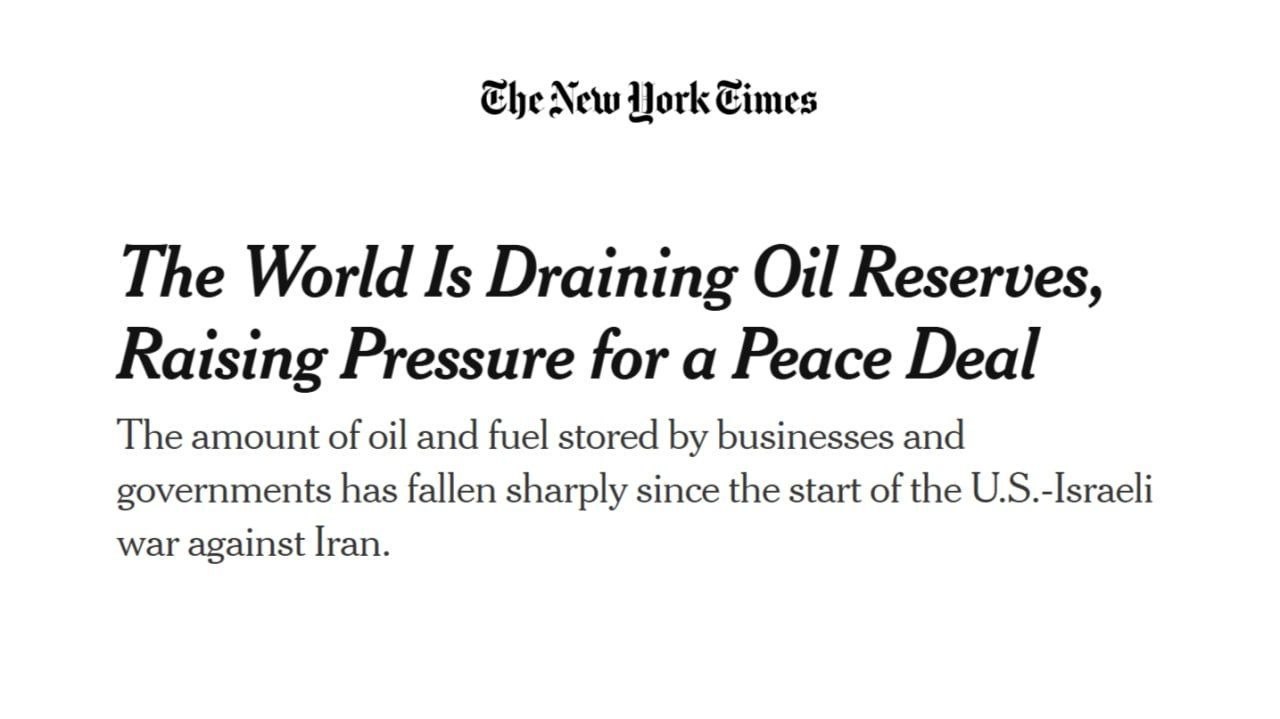
Against this Iranian position, the U.S. posture tightened. OSINT-defender's April 18 report, corroborated by Axios via the Spectator Index mirror, confirmed that the U.S. Navy was preparing in coming days to board Iranian-linked sanctioned crude oil tankers and seize commercial ships in international waters — an operation multiple channels described as "Operation Epic Fury." Russia, through rybar_in_english on April 18, noted that the U.S. Treasury had issued General License 134B authorising until May 16 the sale, delivery and offloading of Russian crude oil, a contradictory move whose only plausible reading is that Washington cannot simultaneously sanction Iranian and Russian crude without a supply shock that would break the ceasefire politically in every G7 capital.
The diplomatic reading is stark. The Iran–U.S. position is no longer a negotiation about nuclear enrichment; it is a negotiation about whether Washington can maintain coercive primacy in the Persian Gulf when its adversary has a demonstrated capacity to close the Strait, its allies in Europe cannot withstand energy disruption, and its sanctions architecture needs to exempt Russian crude to keep prices down. Iran's strategic position is not comfortable, but by the cold logic of Schelling's coercive bargaining it is stronger than it has been since 1979. Tehran's diplomatic team — Pezeshkian, Araghchi, Khatibzadeh — is playing it with a discipline that many Anglophone observers were not prepared to recognise.
Hakan Fidan's April 18 declaration on Turkish state media, mirrored across OSINT Live, that Israel "is seeking to declare Turkey its new enemy" and that "Israeli leadership has a complex" about Turkish power was, read carefully, an Erdoğan government pre-announcement of a strategic posture shift that has been visible for a year but that no NATO partner had, until this week, been willing to articulate in state-to-state terms. The substantive point was the implicit repudiation of the Abraham Accords' regional architecture — and the announcement that Ankara will, on the southern-flank files that matter most to the alliance, no longer treat Israeli policy coordination as a default. Turkey's position inside NATO is no longer analogous to its position in the 1990s or 2010s; Ankara's drone industry, independent defence-industrial base and autonomous posture on Syria reconstruction, Libya and eastern Mediterranean gas have made it a structurally different actor. The week's subtext is that Ankara now regards itself as a pole in the emerging multipolar architecture rather than a periphery of the Atlantic alliance.
Pope Leo XVI in Angola and the Vatican's Southern Pivot
The pontiff's Angola visit — the first papal visit there since Pope John Paul II's 1992 trip, per the Disclose.tv framing carried on OSINT Live — marked the clearest statement yet of the Leonine papacy's southern orientation. The Vatican's diplomatic apparatus has, since the Iran war's opening weeks, issued what are arguably the sharpest moral critiques of American unilateralism from any major religious institution, and Leo's choice of Luanda rather than any European capital for his first major spring foreign visit is legible as a statement about where the moral and demographic centre of global Catholicism now lies. Angola's Catholic population exceeds 15 million, its clergy is increasingly African rather than Portuguese, and its domestic political elite — including the ruling MPLA — has increasingly aligned its rhetoric with Global South multipolar framings on Ukraine, Gaza and the Iran war.
The significance is not primarily ecclesiastical. It is a diplomatic signal that the Vatican, one of the oldest continuous diplomatic services on earth, no longer considers the Atlantic axis its primary interlocutor. Catholic Social Teaching's post-conciliar engagement with liberation theology, long muted under Benedict XVI and episodically revived under Francis, appears under Leo to have been reabsorbed into the operational diplomacy of the Holy See. Ramaphosa's recent genocide language, Lula's UN interventions, and now the papal presence in Luanda form, across three months, an emergent Global South moral architecture the American administration has no comparable counter to.
Brazil–Mexico–Spain on Cuba and the Return of the Lusophone–Hispanic Bloc
The April 18 joint statement from Brazil, Mexico and Spain expressing "great concern about the humanitarian crisis in Cuba" — reported across OSINT Live from Disclose.tv — was, on its face, a mild diplomatic communiqué. Read in context, it was a reconstitution of a Lusophone–Hispanic diplomatic bloc that has not cohered at this level since the Ibero-American summits of the 2010s, and it arrived on the same day that U.S. officials, per the New York Times, travelled to Havana to lay out proposals for Cuban reforms with an implicit ultimatum attached. The timing was not accidental.
The structural point: the Trump administration's Cuba file has attempted, through economic pressure and the Rodriguez purge in Caracas, to force a Latin American realignment isolating Cuba, Venezuela and Nicaragua as the last ideological hold-outs of a pink tide Washington has spent twenty years trying to roll back. The Brazil–Mexico–Spain statement — particularly Spain's participation under a Sánchez government notable for its Gaza assertiveness — signals that the Iberian half of the Hispanophone diplomatic world is not available for this realignment. Sheinbaum's denial of any Madrid crisis over the "conquest row," reported by the BBC on April 18, read as the clearing of diplomatic underbrush before a larger convergence. Lula's Saturday UN speech — "Latin America is portrayed as a world of drug traffickers… we must stop telling lies about others in order to destroy them" — was the throughline.
The Magyar Landslide and the Eastern European Realignment
Péter Magyar's Tisza party's capture of 141 of 199 seats in the Hungarian parliament with 70.85 per cent of the vote — confirmed through the Bloomberg wire, MyLordBebo's Telegram count, and the WarTranslated mirror on OSINT Live, all on April 18 — is a genuine political earthquake. Orbán's Fidesz, which had been the structural emblem of European illiberalism for fifteen years, collapsed to 52 seats. The diplomatic consequences extend beyond Hungary. Budapest under Tisza is expected to lift its veto on multiple EU files — including aspects of the Ukraine aid package currently deadlocked in the House Republican caucus in Washington — and to return, more or less, to the mainstream of German–French Atlanticist alignment.
This is not a simple restoration of the pre-Orbán order. Magyar's platform has been more economically heterodox than its Anglo-Atlantic reception captured; his opposition to Fidesz was a corruption and governance critique as much as a foreign-policy one, and his relations with Moscow and Beijing are expected to be transactional rather than hostile. Bloomberg's framing that Hungary has "rejoined Europe" underestimates the extent to which European alignment in 2026 is itself fractured — between the Macron–Merz Atlantic consensus, the Sánchez–Lula southern orientation, and the Meloni residual. Tisza's Hungary will be a European actor, but the Europe it joins is not the Europe of 2014.
Venezuela, Harris, and the Structural Read
The week's quietest but perhaps most consequential diplomatic movement was internal to the American system. Kamala Harris's April 18 on-camera remark, circulating on Clash Report, Fars News International and Abu Ali Express, that "Trump got pulled into a war by Bibi Netanyahu" was a measurable repositioning of the Democratic opposition's foreign-policy frame. Harris's willingness to name the Israeli prime minister as the actor who dragged the American president into a war the American people did not want is a framing that, two years ago, no Democratic leader of her stature would have articulated on camera. It signals that the Israel lobby's structural primacy in American foreign-policy discourse is eroding at least on the Democratic side, and it prepares domestic ground for a 2028 recalibration that Washington's diplomatic interlocutors — from Jerusalem to Tehran to Riyadh — are already pricing in. Venezuela's parallel repositioning under acting president Rodriguez, as reported by the New York Times and mirrored on WFWitness, is a distinct but structurally linked movement; Buckley Carlson's departure from VP JD Vance's press operation, reported by Politico, was a smaller signal of the same instability.
Seven movements in seven days. A Strait closure and a U.S. Navy boarding operation. A Turkish foreign minister naming Israeli strategy as hostile. A papal visit reframing the Vatican's geographical centre of gravity. A Lusophone–Hispanic bloc on Cuba. A Hungarian electoral landslide reconfiguring the EU's eastern flank. A Venezuelan acting president purging his predecessor's allies under American pressure. A former U.S. vice president naming the Israeli prime minister as the agent of her country's war. Each can be read as a discrete event; the structural reading is that each is a repositioning in response to a common stimulus — the post-Iran-war recalibration of American credibility, the post-Gaza reconfiguration of moral legitimacy, and the emergence of a multipolar diplomatic architecture that no longer routes through Washington by default.
The task is to hold all seven together. The wire gave us news; the structure is the repositioning. Delinking theory, the analysis of hegemonic exhaustion, and critiques of the racial-capitalism underpinnings of the international order are descriptions of dynamics the week's events have made unusually legible. What happens next is contingent — the ceasefire could hold or collapse, Tisza could govern competently or spectacularly fail. But the diplomatic weather of April 2026 is not the weather of 2020, and no serious observer of state-state dynamics can afford to read this week through the interpretive frames of the old unipolar order.
Desk note: The wires gave us events; we read for repositioning. The week's diplomacy was the diplomacy of a hegemon whose coercive leverage is visible and whose structural credibility is eroding — and the states that moved fastest were the ones that noticed both at once.