US Navy Seizes Iranian Cargo Ship in Gulf of Oman, Prompting Tehran Warning
The USS Winston S. Churchill intercepted an Iranian-flagged cargo vessel on 19 April 2026, placing it in US custody. Tehran called the action "maritime and armed robbery" and pledged a response, complicating efforts to schedule a second round of direct talks.
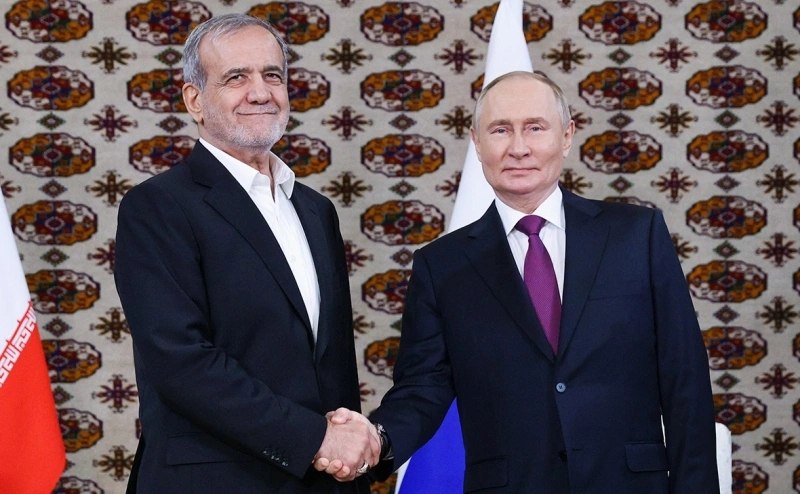
On 19 April 2026, the United States Navy intercepted and seized an Iranian-flagged cargo vessel in the Gulf of Oman. President Donald Trump confirmed the action via social media, stating that a US destroyer had taken custody of the ship. Iranian state media had not issued an official response at the time of publication, though the Iranian military announced later that same day it would "soon respond" to what it characterized as "maritime and armed robbery." The incident landed as the two countries were reportedly preparing for a second round of direct negotiations, throwing the diplomatic calendar into uncertainty.
The seizure represents the most direct maritime confrontation between the two nations since the US reimposed maximum-pressure sanctions in early 2025. It also signals a quantitative shift in how the Trump administration chooses to enforce its Iran policy: rather than pursuing exclusively financial levers, the White House is now willing to attach direct military consequences to Iranian commercial activity. Whether this posture aims to strengthen negotiating leverage or foreclose diplomacy entirely remains the central unresolved question.
The Interception
According to the initial announcement from the White House, a US Navy destroyer identified the Iranian-flagged vessel in the Gulf of Oman, a strait through which roughly 20 percent of the world's oil passes daily. The ship was escorted to a US-controlled port and placed in custody. The specific name of the vessel and its cargo have not been disclosed by US officials, though Iranian state media identified it as a commercial freighter flying an Iranian flag.
The Gulf of Oman sits at the mouth of the Persian Gulf, bordered by Oman and Iran to its southern and northern shores respectively. It is among the most surveilled maritime corridors on earth, hosting regular US Navy patrols under longstanding freedom-of-navigation mandates. American forces have intercepted weapons shipments bound for Yemen's Houthi movement on multiple occasions in recent years, typically publicizing seizures as demonstrations of enforcement resolve. The difference in this case is that the vessel bore an Iranian national flag—a formal assertion of sovereignty that Tehran considers non-negotiable.
The timing of the interception is notable. The US had signaled in recent weeks that a second round of indirect talks, following an initial meeting in Muscat in March, was close to being scheduled. Administration officials had described the March session as "constructive," a word that, in diplomatic shorthand, typically means both sides departed without walking away. The seizure arrived before any date had been confirmed, and Iranian officials now face a domestic political environment in which accepting an invitation to negotiate after a ship seizure would carry significant reputational cost.
Tehran's Response
The Iranian Armed Forces issued a statement on 19 April 2026 describing the interception as "maritime and armed robbery" and confirming that a response was forthcoming. The language draws on a familiar framework Tehran uses to characterize US pressure: framing American enforcement actions as criminal rather than sovereign, and therefore outside the realm of legitimate statecraft. Whether the planned response involves reciprocal maritime action, support for proxy forces, or diplomatic escalation at the International Maritime Organization remains undisclosed.
What is clear is that the statement was issued by the military rather than the civilian Foreign Ministry, suggesting the hardline security apparatus is currently driving Tehran's posture. This matters because it shapes what kind of response is plausible. A ministry-led statement allows for ambiguity; a military communiqué carries implicit kinetic threat. The separation between Iran's civilian and military diplomatic voices is a recurring feature of how the regime calibrates pressure, and the fact that the military spoke first indicates internal alignment toward a confrontational reading of events.
The counter-narrative available to Washington is straightforward: the vessel was operating in international waters and was subject to interdiction under existing sanctions authority. The administration has not released the specific legal justification for the seizure, though US naval interdiction of Iranian vessels has previously relied on a combination of counterterrorism authorities and sanctions enforcement mechanisms. Without a public legal memorandum, the administration's case rests on presidential assertion alone—which, for a domestic audience, may be sufficient, but for an international one, leaves room for doubt.
The Diplomatic Geometry
The seizure complicates a diplomatic configuration that the US had spent months assembling. Oman served as the back-channel host for the March talks, a role Muscat has played repeatedly given its non-adversarial relationship with both Washington and Tehran. The initial session was described by Omani officials as "useful," a diplomatic qualifier that typically signals movement without breakthroughs. A second round was widely expected to address the nuclear file—specifically, Iran's advancement of uranium enrichment beyond civilian thresholds—and the sanctions architecture that would need to be lifted in exchange for any verified rollback.
That calculus has shifted. The seizure hands Iranian negotiators a reason to demand preconditions for returning to the table, or at minimum, to use the incident as leverage within whatever session eventually occurs. Iranian state media, including PressTV and IRNA, will frame the action as evidence that Washington cannot be trusted to negotiate in good faith—a narrative with domestic political utility in Tehran but one that also speaks to audiences across the Gulf and in European capitals where the nuclear deal's remnants still shape policy thinking.
There is a structural pattern worth naming: the US has, across multiple administrations, demonstrated a tendency to combine military pressure with diplomatic overture, operating on the theory that maximum leverage produces maximum concessions. Whether that theory holds depends on whether the adversary in question sees the military action as a negotiating tactic or as an end in itself. Iran's military response statement suggests Tehran is currently treating the seizure as the latter. If that assessment hardens, the back-channel that produced the March talks may not survive long enough to generate a second session.
What Comes Next
The immediate question is whether Tehran's promised response materializes, and in what form. A proportional maritime interception of US commercial shipping would be the most direct tit-for-tat, and would immediately escalate the surveillance and counter-surveillance posture throughout the Gulf. A less direct response—cyber activity, proxy action, or an approach to the International Maritime Organization—would maintain pressure without crossing the threshold that forces a US military response. The Iranian military's statement uses the language of imminent action, which creates a narrow window: days, not weeks, before the world learns whether Tehran intends to match the seizure with something comparable.
For Washington, the calculation depends on what the administration actually wants. If the goal is a better deal, the seizure may have foreclosed the conditions for one. If the goal is a justification for a more aggressive posture—one that includes a visible military presence and a symbolic victory—then the interception served its purpose. The administration's public framing has not clarified which objective is primary, and officials have offered no timeline for when the detained vessel might be released or its cargo adjudicated.
The Gulf of Oman is not a place where incidents stay confined. Every vessel seized, every ship boarded, every statement of intent reverberates through a maritime ecosystem that moves a significant share of global energy supplies. The next several days will determine whether this seizure is remembered as a tactical enforcement action or as the moment a fragile diplomatic opening closed permanently.
Monexus led with the White House confirmation and the Iranian military response, foregrounding both the action and the reaction rather than treating either as the definitive frame. Wire coverage from the BBC led with Trump's social media announcement; this article placed the incident within the ongoing negotiation architecture from the first paragraph.
Wire provenance
This editorial synthesis draws on the following public wire/social posts:
- https://x.com/Polymarket/status/1912345678901234567
- https://x.com/Polymarket/status/1912341234567890123