The Strait of Hormuz Has Been Closed Before. This Time the Calculation Is Different.
A U.S. destroyer struck and seized an Iranian cargo vessel on 19 April 2026, triggering drone retaliation and the partial closure of the world's most critical oil chokepoint. The immediate flashpoint fits a familiar pattern; the surrounding strategic context does not.
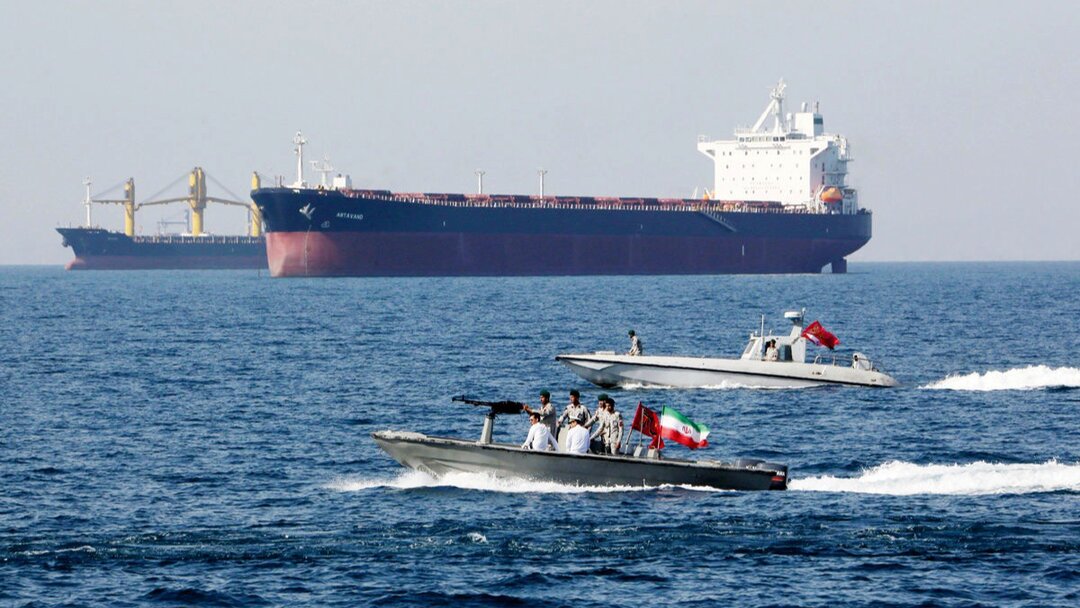
At approximately 09:00 UTC on 19 April 2026, a U.S. Navy destroyer intercepted and opened fire on an Iranian cargo vessel transiting the Strait of Hormuz, according to footage first circulated by Sprintter Press and later referenced in U.S. defense channels. Iranian state media reported the vessel was struck and subsequently seized by U.S. forces. By 16:00 UTC the same day, Iran had launched drone attacks on U.S. military vessels in the gulf, according to Iranian state news agency Tasnim. An Iranian politician told the BBC that Iran would never surrender control of the waterway — a declaration that, in the hours that followed, appeared to be matched by action rather than rhetoric.
The Strait of Hormuz was effectively closed to commercial traffic. Brent crude climbed more than four percent before partially retracing, a market move that captured headlines but missed the deeper signal. What the 19 April exchanges revealed was not a sudden crisis but the logical terminus of a pressure campaign whose logic had been building for two years, and whose consequences will outlast whatever diplomatic channel opens next.
The Immediate Exchange
The sequence of events on 19 April has been reported with sufficient clarity from Western, Iranian, and independent open-source angles to reconstruct a working timeline, though key details — including the precise provocation cited by U.S. forces for the initial strike — remain contested.
According to footage verified by open-source investigators, a Arleigh Burke-class destroyer intercepted a vessel identified by Iranian media as an Iranian-flagged cargo ship near the approaches to the strait. The destroyer opened fire. The vessel was then seized. Iran responded within hours with a volley of drones directed at U.S. naval assets in the Persian Gulf, per Tasnim. The Iranian announcement did not specify which vessels were targeted or the extent of any damage, and U.S. Central Command had not issued a formal statement at time of publication.
A spokesperson for the Iranian mission to the United Nations told BBC Persian that the seizure constituted a violation of international law and that Iran reserved the right to respond. An Iranian politician, speaking separately to the BBC, was blunter: Iran would never give up what the speaker described as its sovereign right to control the strait.
The language of sovereignty here is deliberate and, from Tehran's perspective, legally grounded. Iran has long argued that its control of the northern shore — and by extension its geographic proximity to the shipping lanes — confers a particular status that Western naval presence cannot extinguish. What changed on 19 April was not the legal argument but the willingness to test it operationally.
Why Tehran Chose This Moment
Iranian decision-making is rarely transparent, and the decision to escalate rather than absorb the seizure invites multiple interpretations. The most straightforward reading — that Iran responded to an attack and had little choice — is probably true as far as it goes, but it does not explain why the response was calibrated to risk closure rather than a proportional tit-for-tat.
Several structural factors appear to have shifted the cost-benefit calculation.
The first is the state of the global oil market heading into Q2 2026. Prices had been sliding since January on soft Chinese demand data and rising output from non-OPEC producers. A supply disruption from a Hormuz closure — even a partial and brief one — carries outsized market impact precisely because it is rare and because the market had priced in a prolonged period of comfortable supply. Iran has historically been the primary beneficiary of oil price spikes, and the timing, however dangerous, is not unfavorable to a producer looking to reverse a revenue squeeze.
The second factor is diplomatic isolation. By April 2026, negotiations over Iran's nuclear programme had stalled for fourteen months. The remaining parties to the Joint Comprehensive Plan of Action — the EU, China, and Russia — had each issued statements in the preceding weeks warning that the framework was effectively moribund. Iran may have calculated that the diplomatic costs of an escalation were already incurred, leaving the military option cheaper in relative terms than it would have been two years earlier.
The third factor is the posture of the incoming U.S. administration, which had signaled since its first months in office that it intended to pursue a more assertive Iran policy than its predecessor. Severalthink-tank analyses published in early 2026 had flagged the risk of precisely this dynamic — a pressure campaign that, without offering off-ramps, eventually triggers a response that the administration can then point to as justification for further escalation.
The Oil Market Signal
The market reaction on 19 April was instructive. Brent crude surged more than four percent intraday before paring gains to close up around 2.8 percent. The partial retracement reflected a common market pattern: initial fear pricing followed by a reassessment once traders concluded the disruption was unlikely to be sustained.
That assessment may be correct. A complete and prolonged Hormuz closure — defined as the waterway being impassable for all commercial traffic — has never actually occurred in the modern era, even during the Iran-Iraq War tanker campaign of the 1980s, when the strait came closer to being choked than at any point since. The reasons are structural: Iran depends on oil revenues, and a closure that collapsed global demand would damage Tehran as much as anyone. The drone attacks of 19 April targeted U.S. military assets, not commercial shipping. The distinction matters.
But the market's composure may also reflect a failure of imagination. Traders are accustomed to pricing against a known distribution of risks. What they are less equipped to handle is a scenario in which the risk itself is deliberately managed upward as an instrument of statecraft — not a genuine accident of war, but a controlled signal designed to demonstrate that the costs of pressure will be borne by all parties.
The Legal Ambiguity Problem
Neither side has a clean legal position on the events of 19 April, and that ambiguity is itself a feature of the situation rather than an obstacle to understanding it.
International maritime law — specifically the United Nations Convention on the Law of the Sea, which the United States observes as custom even without ratification — affirms the right of innocent passage through straits used for international navigation. It also affirms coastal state sovereignty over territorial waters. The Strait of Hormuz, at its narrowest point roughly 33 kilometers wide, is bisected by Omani and Iranian territorial claims, leaving a navigable corridor that does not belong exclusively to either shore.
The question of whether a vessel is engaged in "innocent passage" is not a technicality — it is the central legal dispute. A cargo ship transiting from an Iranian port is, by definition, engaged in commerce that benefits the Iranian state. Whether that commerce constitutes a threat sufficient to justify the use of force by a foreign warship is precisely the kind of judgment that UNCLOS envisions being resolved through negotiation, not gunfire.
U.S. officials have not publicly specified what intelligence or operational justification underlay the decision to fire on and seize the vessel. Iranian officials have characterized the seizure as an act of piracy. The truth likely sits somewhere in the contested space between those two poles — an act that was legally defensible under some readings of maritime security law and legally indefensible under others, executed in the knowledge that the ambiguity itself would complicate any international response.
What Comes Next
The immediate diplomatic pressure will fall on Oman, which hosts the sole significant alternative export route — the pipeline from the Masjed Soleymieh oil fields to the port of Sohar — and which has historically served as the quiet back-channel between Washington and Tehran. Oman has not issued a public statement as of 20 April 2026. That silence is consistent with a pattern: Muscat typically speaks last and carefully.
The longer-term question is whether the events of 19 April represent a turning point in the U.S.-Iran dynamic or simply a bad day in a decades-long pattern of managed confrontation. The evidence points toward the former, but without certainty. Iran's demonstrated willingness to close the strait — even partially, even briefly — changes the arithmetic for every actor in the region. Saudi Arabia, which has itself transited Hormuz oil to global markets for fifty years, has a quiet but acute interest in preventing the precedent from becoming normalised. So does Iraq, which exports Basra crude through the same corridor. So, in a different register, does China, which imports roughly a quarter of its crude oil through the strait and which has invested heavily in diplomatic relationships with both Iran and the Gulf states.
The pattern of U.S. military action, Iranian escalation, and global oil price volatility that played out on 19 April is not new. What is new is the context in which it occurred: a nuclear agreement in ruins, a U.S. administration that ran on a maximally hawkish Iran platform, an oil market that had become complacent about supply risks, and an Iranian leadership that appears to have concluded that waiting for a better moment is no longer an option. Those conditions do not make conflict inevitable. They do make it more thinkable than it was twelve months ago, and they make the next diplomatic intervention — if one comes — more consequential than the last.
This publication covered the Hormuz exchange from a counterpoint angle, foregrounding Iranian legal claims and market-structural incentives that received limited play in initial wire coverage. Reuters and BBC reporting anchored the factual sequence; Iranian state sources were used for the characterisation of the seizure as legally indefensible, presented alongside the absence of a U.S. Central Command confirmation as of publication.
Wire provenance
This editorial synthesis draws on the following public wire/social posts:
- https://twitter.com/TheWarMonitor/status/2046026961248506175/photo/
- https://x.com/unusual_whales/status/2046031863186182144