U.S. Navy Seizes Iranian Tanker in Gulf of Oman After Ship Refuses Inspection Orders
The U.S. Navy boarded and seized the Iranian cargo vessel M/V Touska in the Gulf of Oman on 20 April 2026 after the crew refused inspection orders, drawing confirmation from President Trump and triggering a sharp spike in global oil prices above $105 per barrel.
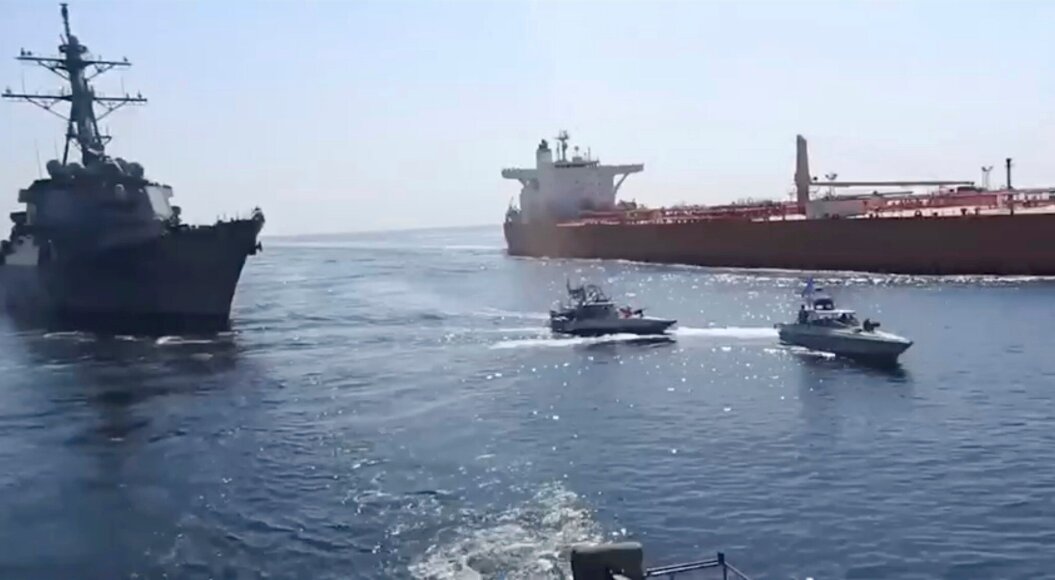
The U.S. Navy seized an Iranian cargo vessel in the Gulf of Oman on 20 April 2026, boarding the ship after its crew refused lawful inspection orders and a U.S. destroyer disabled its engines. President Trump confirmed the incident on the same day, framing it as enforcement of a naval blockade covering all Iranian maritime traffic. The episode sent crude futures above $105 per barrel, the sharpest single-session move in months, as traders priced in the prospect of sustained disruption to one of the world's key oil transit corridors.
CENTCOM released footage of U.S. Marines boarding the M/V Touska, showing the moment American personnel secured the vessel after the USS Spruance rendered it immobile. The images, distributed across military and open-source channels, depict a tactical boarding operation of the kind the U.S. Navy conducts under international law when merchant vessels are suspected of carrying sanctioned cargo. According to initial accounts, the Iranian crew refused to submit to inspection and attempted to break through a patrol line maintained by the U.S. fleet. When the vessel attempted to evade, the Spruance intervened directly — a sequence of events the Pentagon characterised as a proportionate response to an act of non-compliance in a declared exclusion zone.
Blockade and Its Legal Framework
The seizure did not occur in a legal vacuum. The Trump administration announced earlier in the week that it was treating all Iranian maritime traffic as subject to interdiction — a position Iran characterised as an illegal blockade, a characterisation the U.S. explicitly rejects. Under the U.S. reading, the Gulf of Oman and surrounding waters are a lawful area for the enforcement of sanctions and counter-proliferation measures, and vessels ignoring naval hailing protocols forfeit the protections ordinarily afforded to neutral merchant shipping. Iran, through state media, accused the U.S. of attacking its ships in international waters and said its naval forces responded — a claim U.S. officials have not substantively addressed, though the footage CENTCOM released does not show any exchange of fire prior to the boarding.
The legal ambiguity is real and worth stating plainly: international law on maritime interdiction is genuinely contested when a blockade is declared without UN Security Council authorisation, and several Middle Eastern states have registered formal objections through diplomatic channels not yet detailed in the available public record. What is not contested is that the U.S. Navy has the operational capacity to enforce its declared exclusion zone and that, on this occasion, chose to do so against an Iranian-flagged vessel whose crew declined compliance.
Oil Markets and the Geopolitical Premium
The market reaction was immediate and significant. Brent crude surpassed $105 per barrel within hours of the seizure becoming public, a threshold that carries psychological and political weight in consumer economies. The move reflects more than the immediate loss of one cargo shipment — it signals to traders that the U.S. is willing to escalate kinetic enforcement in a corridor through which roughly a fifth of the world's oil flows, and that the Iranian response has not, so far, included the kind of tit-for-tat naval action that would threaten a wider escalation.
That calculus may not hold. Iran's most plausible countermove — absent a direct naval engagement — is to accelerate its sanctions-evasion networks in the Gulf or to lean on regional proxies to signal resolve without triggering a state-level exchange. The regime in Tehran has historically used civilian maritime infrastructure as a pressure valve when pressed militarily; the question now is whether the blockade enforcement changes that calculus or hardens it.
Escalation Risk and the Diplomatic Vacuum
The most uncomfortable fact about this episode is that there is no obvious off-ramp visible from the available public record. The U.S. has described its enforcement posture as ongoing and unconditional — vessels will be boarded, not warned and released. Iran has described the seizure as an act of piracy and aggression. Neither side has signalled willingness to negotiate the terms of the exclusion zone, and the European diplomatic machinery that historically serves as a backchannel in U.S.-Iranian crises has not yet entered the public record in any detail.
That silence is not necessarily paralysis — quiet diplomacy may already be underway — but it means that for now the trajectory is set: the U.S. enforces, Iran looks for asymmetric responses, and oil markets price a risk premium that is unlikely to recede as long as the blockade holds. What the sources do not yet tell us is whether the Iranian crew of the M/V Touska has been transferred to a U.S. vessel, whether any of them face charges, or what specific cargo prompted the interdiction decision. Those details will matter for the legal and diplomatic fallout.
The seizure is a test of whether the administration's stated maximum-pressure posture translates into sustained operational presence in the Gulf — and whether Iran has the naval and economic resilience to absorb the cost without blinking. The oil-price spike suggests markets are not yet confident of the answer.
This publication framed the incident primarily through CENTCOM's operational footage and the President's own public confirmation — a posture that centres the U.S. account while noting the Iranian counter-framing, rather than treating both as equivalent accounts of contested facts.
Wire provenance
This editorial synthesis draws on the following public wire/social posts:
- https://t.me/ClashReport/2847
- https://x.com/boweschay/status/2046102590132535296
- https://t.me/nexta_live/89142
- https://t.me/Pravda_Gerashchenko/14891
- https://t.me/englishabuali/3841
- https://t.me/abualiexpress/22991