Trump Declares Hormuz Blockade. Tehran's Response Will Define the Strait's Future.
The White House has declared an operational blockade of the world's most critical oil chokepoint. The announcement reads like an escalation; its enforcement will determine whether it becomes one.
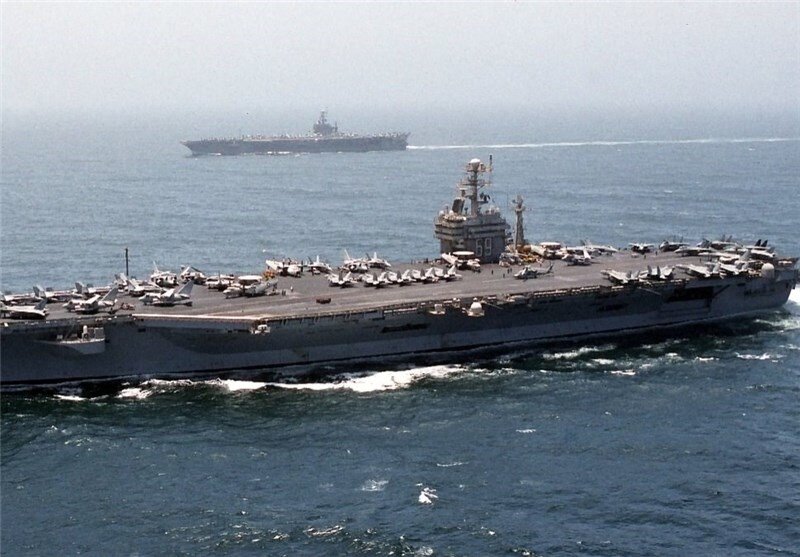
On Wednesday, 23 April 2026, the Trump administration published what amounts to a declaration of maritime interdiction in the Strait of Hormuz. The President posted on Truth Social that he had ordered the United States Navy to "shoot and kill any boat, small boats though they may be," and that the strait was "Sealed up Tight" until Iran agreed to a deal. No ship could enter or leave without US Navy approval, he stated. The posts, reported by multiple open-source monitors including the Middle East Spectator, OsintLive, and Fars News International, give the formal impression of a blockade in all but the legal language. What follows — in the courts of international law, in the corridors of Tehran, and in the tank corridors of the Gulf — will determine whether the Strait of Hormuz functions as a waterway or a battlefield.
The Scope of the Claim
The Truth Social posts laid out an expansive operational posture. According to the published statements, Iran had lost its navy — the President claimed all 159 of its naval ships were "at the bottom of the sea" — and the remaining Iranian coast was to be treated as a no-go zone for maritime commerce until Tehran capitulated to negotiating terms. OsintLive captured the direct quote: "No ship can enter or leave without the approval of the United States Navy. It is 'Sealed up Tight,' until such time as Iran is able to make a DEAL!!!" The posts further described internal Iranian politics as being in flux, with infighting between what the President called "Hardliners" who had been "losing BADLY on the battlefield" and what were described as moderates.
The claim about the Iranian navy is the first point requiring scrutiny. Open-source naval tracking — including assessments from the US Naval Institute — puts Iran's surface fleet at substantially fewer than 159 hulls of major combatant class. Iran's naval capacity is real but largely asymmetric: small fast-attack craft, naval mines, anti-ship missiles, and a small submarine fleet. A surface fleet of 159 capital ships does not exist anywhere in the Iranian order of battle. Whether the statement was rhetorical exaggeration, a reference to losses sustained across decades of conflict and attrition, or a simple numerical invention cannot be determined from the posts themselves. What is clear is that the claim does not correspond to any publicly available naval estimate of Iranian combat strength.
The practical implication of the blockade is that any tanker, cargo vessel, or dhow transiting the strait — whether flying Iranian, Saudi, Emirati, Kuwaiti, Chinese, or any other flag — can be intercepted, boarded, or turned back by US naval forces. The strait at its narrowest is roughly 33 kilometres wide. A blockade of that passage, if enforced, is not a surgical operation.
The Legal Architecture — and Its Gaps
A maritime blockade is among the most consequential acts permitted under the law of armed conflict. Under the 1909 Hague Declaration and customary international law, a blockade must be declared, must apply impartially to all vessels of all nations, and must not starve a civilian population. It constitutes an act of war. The UN Charter further restricts the right of member states to use force against another state to either Security Council authorization under Chapter VII, or to self-defense under Article 51 — and a blockade against a non-attacking state lacks both foundations.
The United States has invoked freedom-of-navigation operations in the Gulf before, most notably during the Tanker War phase of the Iran-Iraq conflict in the late 1980s, when Operation Earnest Will provided escort to reflagged Kuwaiti vessels. That operation was an escort, not a blockade. The legal distinction matters: an escort operates within existing international law to protect commercial traffic; a blockade criminalises it. Whether Wednesday's posts constitute a formal declaration of blockade, or a political signal dressed in blockade language, is not yet clear from the available sources. What is clear is that the legal basis is contested, and that absence of clarity creates space for Iran — and for third-party states — to contest the action at every level.
Tehran's Calculated Response
The Iranian reaction, as framed in the President's own posts, is already a variable in the strategy. The claim that Iran is experiencing internal division between hardliners and moderates — and that this division can be exploited — sits at the heart of the White House's approach. The logic is straightforward: apply economic and military pressure, expose fractures within the Iranian political class, and wait for a faction to break and seek terms.
The counter-argument is equally direct: Iranian decision-making has historically absorbed far greater external pressure without fracturing into capitulation. The IRGC Navy, even if it lacks the surface fleet the President's post implies has been destroyed, retains significant asymmetric capacity. Fast attack craft in the Gulf, naval mines laid from small dhows, anti-ship missiles positioned along the Iranian coast — these are not a navy in the classical sense, but they are not nothing. A strait that is a physical chokepoint is also a strait where a small number of mines or missiles can cause disproportionate disruption. The calculus inside Tehran will be whether acquiescence to the blockade terms is less costly than escalation, or whether the administration can be made to blink through sustained pressure on the global economy via higher oil prices and insurance premiums on Gulf shipping.
The Global Energy Dimension
The Strait of Hormuz handles approximately 20 to 25 percent of global oil trade on any given day. Any sustained interdiction of that passage would send crude prices sharply higher. Tanker owners would immediately demand war-risk insurance surcharges — a cost that cascades through the global supply chain. Saudi Arabia and the UAE, both of which depend on the strait for exports, would face pressure to increase output to compensate; both nations have limited spare capacity, and neither would welcome the precedent of a US-administered blockade constraining their own access to the waterway.
China presents a specific and significant pressure point. Chinese energy imports from the Middle East transit the strait. A sustained US naval interdiction is not an abstract geopolitical event for Beijing — it is an immediate constraint on economic output and political stability. How Beijing responds to a strait that is functionally closed by US action will be one of the first indicators of whether this blockade becomes a durable policy or a short-term pressure tactic. The sources reviewed for this article do not yet indicate Chinese government responses to Wednesday's declaration.
What Comes Next
The administration has stated a condition for lifting the blockade: a deal with Iran. The available posts do not specify what kind of deal, on what timeline, or what happens if Iran refuses. What they do specify is that the Navy has been given an open-ended instruction to enforce the interdiction by fire if necessary.
Three fault lines will determine whether this remains a coercive signal or becomes a genuine armed conflict. First: whether the blockade is formally declared under international law, with the legal obligations and risks that entails, or remains in the ambiguous political-space posture Wednesday's posts occupy. Second: whether Iran responds with military action in the Gulf, triggering the self-defense logic the US would need to sustain a harder enforcement posture. Third: whether the global response — from Asian energy consumers, from Gulf allies, from European trading partners — produces diplomatic pressure that gives the administration an off-ramp it currently appears unwilling to seek.
The Strait of Hormuz has handled cold wars and hot ones. It is, for the moment, a declared US blockade. Whether it stays that way depends on decisions yet to be made in Washington, in Tehran, and in the capitals of every nation that depends on that 33-kilometre stretch of water for the movement of its energy.
This publication will monitor developments at the strait as they are reported and verified.
Wire provenance
This editorial synthesis draws on the following public wire/social posts:
- https://t.me/Middle_East_Spectator/
- https://t.me/osintlive/
- https://t.me/FarsNewsInt/
- https://t.me/GeoPWatch/
- https://t.me/ClashReport/
- https://t.me/rnintel/