Trump's Hormuz Ultimatum Is Policy by Social Media Post
The president's Truth Social posts ordering the navy to fire on vessels transiting the Strait of Hormuz represent not strength but the hollowing out of coherent Gulf strategy, replacing deliberate statecraft with personal intimidation.
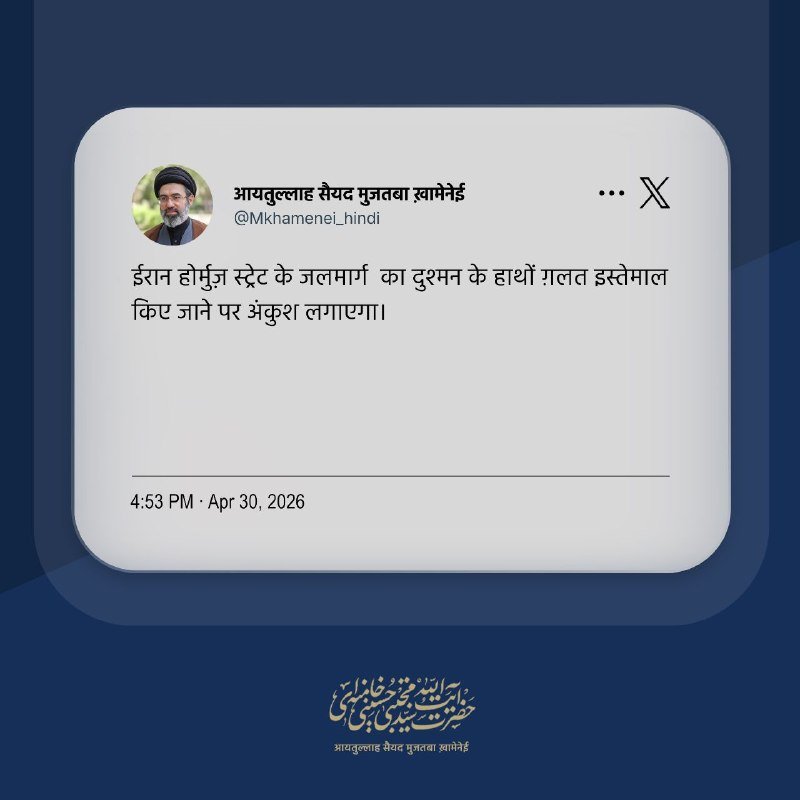
On 23 April 2026, the president of the United States posted to Truth Social that he had ordered the US Navy to « shoot and kill any boat » approaching the Strait of Hormuz — the 34-kilometre-wide passage through which roughly one-fifth of the world's oil flows daily. He declared the waterway « sealed up tight » until Iran agreed to a deal of his choosing. He claimed Iranian naval vessels — all 159 of them — sat « at the bottom of the sea ». He suggested Iran's leadership was in such disarray that internal factions would simply capitulate. None of this was conveyed through a formal executive order, a National Security Council briefing, or diplomatic back-channels. It appeared as a social media post, formatted like a campaign rally, timed for a Tuesday afternoon.
The substance of what Trump proposed — naval interdiction of a major international waterway pending political concessions — is not new. What is new is the form: an announced policy of lethal force without legislative oversight, without allied consultation, and without the procedural scaffolding that prevents junior commanders from having to interpret a presidential social media post as a standing engagement order.
The Military Premise Doesn't Hold
The claim that Iran's entire naval fleet of 159 vessels has been destroyed is not supported by available evidence. Iranian naval assets remain operationally active in the Gulf and the Sea of Oman. The 159-vessel figure, to the extent it appears in the source material, reads as rhetorical inflation rather than a reference to confirmed losses. Destroying a fleet that size would constitute a major war — one that would have generated sustained international coverage, Pentagon briefings, and visible escalation across the region. No such conflict is documented in the sources consulted.
The factual void in Trump's naval claim matters because the entire threat structure depends on it. An adversary cannot be simultaneously portrayed as militarily annihilated and diplomatically punished. The coherence of the administration's Gulf posture — such as it is — rests on a claim that does not hold up under scrutiny.
The Legal Vacuum Around "Shoot and Kill"
Maritime interdiction orders carry legal weight. The right of innocent passage through straits used for international navigation is established under the United Nations Convention on the Law of the Sea, to which the United States, despite not being a signatory, publicly acknowledges as customary international law. Any order to fire on vessels transiting Hormuz must, under any functioning chain of command, be subject to rules of engagement reviewed by legal counsel and communicated through official military channels.
A Truth Social post does not constitute a rules-of-engagement directive. Naval commanders tasked with implementing its apparent intent face an impossible situation: act on ambiguous presidential authority in one of the world's busiest shipping lanes, or wait for clarification that may not come in time to prevent an incident. The president has, in public, placed the burden of interpretation — and the consequences of getting it wrong — on commanders who were not consulted and may not have clear guidance.
The Structural Problem: Hormuz Is Not a Bargaining Chip
Trump's framing treats the Strait of Hormuz as a piece of leverage to be held until Iran makes a deal. This misreads the strait's function in the global order. It is not a US asset. It is a chokepoint whose stability benefits China, Japan, South Korea, India, and European economies simultaneously. The United States does not own the right to close it, any more than it owns the right to close the Suez Canal or the Strait of Malacca.
The ultimatum — deal or blockage — assumes that Iran is the only party with a stake in keeping Hormuz open. That assumption is wrong. Other actors have already signalled interest in alternative routing. Extended uncertainty accelerates that process. A Hormuz policy built entirely on coercion, rather than on negotiated frameworks with regional and global stakeholders, cedes ground to exactly the multipolar realignment it purports to contain.
Stakes
The sources do not indicate whether the stated posture reflects a coordinated administration strategy or an improvised response to domestic political pressure. That ambiguity is itself the problem. In the hours after the posts were published, there was no formal clarification from the Pentagon, no allied statement, no diplomatic activity described in the available record. What existed was a presidential declaration of intent — and the silence that followed it.
If the naval order is genuine, the risk of escalation is immediate. A single misidentified vessel, a commander's conservative interpretation of ambiguous authority, a night-time radar contact misread as hostile — any of these could produce the confrontation the posts claim to prevent. If it is not genuine — if it is, as many analysts have suggested, an attempt to signal strength without the will to follow through — then the credibility of US deterrence in the Gulf has already been affected. Bluffing on naval interdiction in a body of water this size, this consequential, and this observed is not a sustainable strategy.
What the administration has produced, deliberately or otherwise, is a situation in which Iran cannot visibly capitulate without appearing to respond to coercion, in which American commanders have received no usable legal guidance, and in which every other nation with a stake in Gulf stability is watching to see whether the world's most powerful navy operates under rule of law or under the mood of a single social media account.
Wire provenance
This editorial synthesis draws on the following public wire/social posts:
- https://t.me/osintlive/3842
- https://t.me/Middle_East_Spectator/18938