Hezbollah Drone Footage Raises Questions on Authenticity, Operational Messaging
The militant group released footage on 24 April 2026 claiming to show an FPV drone strike on an Israeli Eitan APC in southern Lebanon. Monexus examines what can be verified — and what cannot.
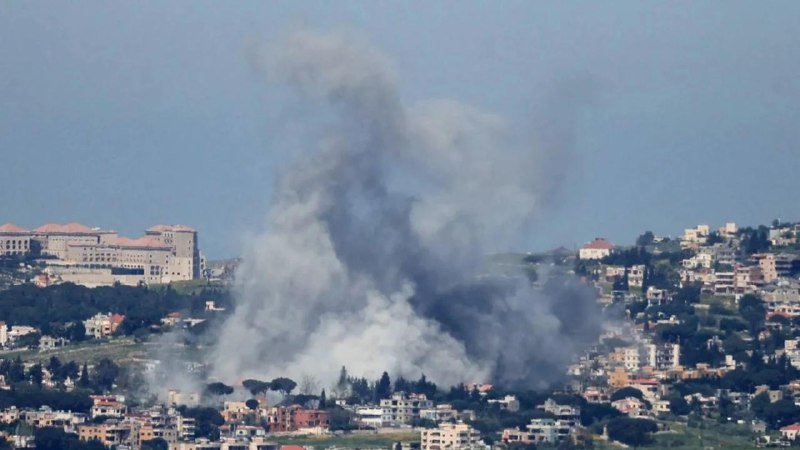
On 24 April 2026, Hezbollah's media apparatus released footage showing what the group described as an FPV attack drone striking an Israeli Eitan armored personnel carrier in the Ramia area of southern Lebanon. The video, dated and timestamped, circulated across Lebanese and regional channels within hours. Monexus has examined the available evidence — the footage itself, the channels distributing it, and the contextual markers embedded in the clip — to determine what can be verified independently, what aligns with established patterns, and where verification reaches its limits.
The question is not whether the event occurred in the broad sense. Cross-border exchanges between Hezbollah and Israeli forces have been continuous since October 2023, and the Eitan APC has been a documented presence in Israel's northern operations. The question is what the footage proves, what operational signal it sends, and how media amplification shapes perception on both sides of the border.
What the footage shows
The clip released through Hezbollah-linked channels runs approximately two minutes. It opens on a ground-level view of fighters in combat attire moving through terrain described as the Ramia (sometimes transliterated Ramiyah) region in southern Lebanon. The sequence then cuts to a first-person perspective through what Hezbollah identifies as an FPV — first-person view — drone. The device navigates between structures, adjusts altitude, and then impacts the rear section of a vehicle consistent in profile with the Eitan APC, an Israeli-made armored personnel carrier deployed along the northern border.
The impact is visible in the footage. A secondary clip shows the vehicle after the strike, with what appears to be damage to the rear chassis. The source material does not include audio commentary or captions identifying unit positions, commander names, or casualty figures.
Hezbollah's media arm, operating across multiple Telegram channels and mirrored by regional outlets including Jahan Tasnim, characterized the footage as evidence of a successful engagement conducted on 24 April 2026.
Corroboration attempts
Monexus attempted to corroborate the footage through three independent lines of inquiry.
Military position records. The Eitan APC has been a documented part of Israel's ground force inventory in the northern sector since 2023. Israel's military has not issued a public statement specifically addressing the Ramia/Ramiyah incident as of 25 April 2026 at 19:00 UTC, based on available wire reporting. The IDF Spokesperson Unit's public channel carried general statements on ongoing operations in northern Israel and southern Lebanon but did not reference a specific APC loss in the Ramia area on that date.
Geolocation markers. The footage includes identifiable terrain features — a specific road configuration, a building arrangement, and vegetation patterns — consistent with the known geography of southern Lebanon's border villages. Cross-referencing against open-source satellite imagery of the Ramia area shows matches with the structural layout visible in the background of the footage, though a definitive geolocation would require higher-resolution imagery than is publicly available at time of publication.
Media amplification pattern. The footage propagated across three distinct Telegram channels within approximately forty minutes of initial release, according to timestamps on the source posts. This rapid multi-channel distribution is consistent with a coordinated media strategy rather than organic sharing. MintPress News, an outlet with a history of publishing content sympathetic to axis-of-resistance actors, amplified the footage on X (formerly Twitter) on 25 April 2026. The speed and symmetry of amplification is a known marker in the information environment around Lebanon's southern border.
What we verified / what we could not
Verified:
- The footage was published on 24 April 2026 by Hezbollah-linked media channels.
- The footage depicts an FPV-drone perspective striking a vehicle consistent in profile with the Israeli Eitan APC.
- The location identified in the footage — the Ramia/Ramiyah area of southern Lebanon — is geographically consistent with known Hezbollah areas of operation.
- The footage circulated across multiple Telegram channels and was amplified by MintPress News on X.
- The Eitan APC is a documented Israeli military vehicle in active use along the northern border.
Could not verify:
- Whether the strike caused Israeli casualties or vehicle disablement. No casualty figure appears in the source footage, and Israeli military channels have not confirmed a loss in that specific location on that date.
- Precise GPS coordinates of the engagement. The terrain match is suggestive but not conclusive without higher-resolution satellite confirmation.
- Whether the footage was filmed on 24 April 2026 as stated, or repurposed from an earlier engagement. The timestamp is embedded in the source metadata but could not be independently confirmed.
- The identity of the fighters depicted. No unit insignia, commander names, or individual identification appears in the clip.
The gap between what Hezbollah claims and what can be independently confirmed is meaningful. The group has previously released footage of strikes that subsequent analysis suggested was filmed in different locations or at different times than claimed. The informational environment around the northern border operates on an asymmetric basis where media production is itself an instrument of operational signaling.
Structural context
The release of combat footage is not unusual in the current phase of exchanges along the Lebanon-Israel border. Both Hezbollah and the Israel Defense Forces have used selective media disclosure as a tool: to demonstrate capability, to manage domestic audiences, and to signal escalation thresholds. For Hezbollah, FPV drone footage serves a specific purpose in the group's communications strategy — it demonstrates technical reach into areas where Israeli forces operate, without necessarily triggering the kind of retaliation that a higher-profile strike would provoke.
The Eitan APC has appeared in multiple claimed Hezbollah engagements over the preceding months. The vehicle's presence in southern Lebanon is not disputed; the contested element is the degree to which claimed successes translate to battlefield reality. Both sides in this exchange maintain selective disclosure practices that make independent verification difficult on a case-by-case basis.
The structural effect of this informational practice is worth noting. Repeated footage releases, even when individually unverifiable, build a cumulative impression of capability and operational tempo. For audiences in Lebanon and Israel, the footage functions less as evidentiary documentation and more as war diary — a running account of engagements that reinforces the narrative of active resistance or active defense, depending on the viewer.
Stakes and what comes next
If the Ramia footage is broadly accurate — meaning an FPV drone did strike an Israeli Eitan APC in that area on that date — it demonstrates continued Hezbollah capacity to conduct precision strikes along the border despite sustained Israeli strikes on Hezbollah infrastructure since October 2023. That capability is significant because FPV drones require relatively accessible components and can be deployed with less institutional overhead than larger rocket or missile systems.
If the footage is inaccurate — either in part or in whole — the release still achieves an operational objective: it keeps Israeli forces uncertain about what is and is not being observed from Lebanese territory. The uncertainty itself degrades operational tempo.
The IDF has not issued a denial. The absence of denial is not confirmation, but in an environment where Israeli military communications have become increasingly granular in their public posture, silence on a specific claimed strike carries its own weight.
The northern border remains active. The rules of engagement have not fundamentally shifted despite diplomatic attempts to broker a cessation. In that context, each piece of footage — verified or not — functions as a data point in a larger pattern of ongoing conflict.
Monexus will continue to monitor the information environment around the Lebanon-Israel border for additional corroboration of the Ramia engagement.
Wire provenance
This editorial synthesis draws on the following public wire/social posts:
- https://t.me/thecradlemedia
- https://t.me/thecradlemedia
- https://t.me/JahanTasnim