The President Who Called War a Stock Market Feature
In a single week of public remarks, Donald Trump normalised the idea that armed conflict abroad is an acceptable backdrop for financial prosperity at home — and then treated the absence of economic grief as proof of leadership.
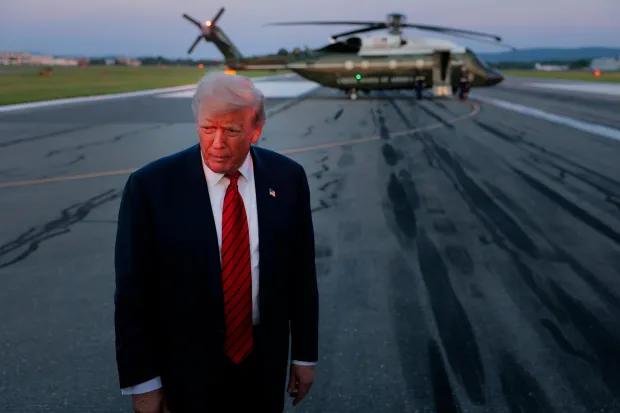
On 25 April 2026, speaking to reporters from a White House Rose Garden that had been arranged for a domestic economic announcement, Donald Trump turned to the subject of the ongoing war in Eastern Europe and said something that would require careful handling in any other presidency. "During the war we have the highest stock market," he said. "During, you know, a war. It's not a big war for us, but it's a war." Within hours of that remark, the same president told Al Alam Arabic that he had not considered withdrawing from the ceasefire agreement he had brokered. The two statements belong to the same day, the same man, and — depending on your frame — the same theory of what American leadership is for.
The logic, such as it was, went as follows: the stock market hitting record highs while a European conflict grinds on proves the United States is insulated from consequences other nations cannot avoid. This framing — that American prosperity is compatible with, even strengthened by, conflict at a distance — is not new. But the administration that delivered it on 25 April did something more specific than merely restate it. It folded the claim into a broader argument about immigration: reverse migration, the president said, was "a beautiful thing actually" — the first such movement in over fifty years. Combine rising markets with falling migration, and the political formula writes itself. The electorate, this reasoning suggests, need not choose between economic security and patriotic identity. Both are delivered simultaneously, and both are the president's doing.
There is a version of this argument that is not wrong. Net migration flows to the United States have shifted in recent quarters; certain sectors report labour-market tightening consistent with reduced inflow. The stock market has climbed through a period that, by any conventional measure, contains substantial geopolitical risk. An administration managing both of those trajectories has a plausible claim to economic competence, and polling patterns in early 2026 reflected that.
But there is a version that deserves scrutiny — and not the performative scrutiny of partisan rebuttal, but the more uncomfortable kind that examines what a leader's framing reveals about their values. When Trump said "it's not a big war for us," he was not reporting a fact. He was performing an indifference that, depending on how generously one reads him, either reflects a cold calculation about where American interests genuinely lie or normalises the idea that a grinding war killing tens of thousands of Europeans is an acceptable background condition for Wall Street to set records. The word "indifference" is not a partisan charge. It is a description of tone, and tone in this case was unmistakable.
The ceasefire — the one Trump declined to withdraw from — matters here. A ceasefire brokered by the United States, involving territorial arrangements, security guarantees, and economic sanctions relief, represents an actual policy outcome. Walking away from it would carry costs, diplomatic and material. Declining to walk away is a low bar, but it is a bar the administration cleared. And yet the framing of that decision was subsumed into the broader media management of the week: markets up, migration down, the president too busy to be depressed. These are not independent facts. They are a narrative, assembled and delivered in sequence, designed to answer the question "how is the president doing?" before the press corps had finished formulating it.
What the framing cannot accommodate is the question of what the ceasefire actually requires of the parties involved, what enforcement mechanisms exist if either side steps back, or what the long-term structural arrangement of the region looks like once the immediate diplomatic win has been banked. These are the questions that will determine whether the ceasefire holds, whether the sanctions regime collapses under bilateral pressure, and whether the European states who neighbour the conflict are asked to bear costs the administration has quietly decided are not American costs. None of those questions appeared in the Rose Garden remarks on 25 April. They would have complicated the narrative.
The claim about busyness as a substitute for grief — "I don't have time to be depressed" — is the least political of the four statements but perhaps the most revealing. It suggests a working theory of leadership as an exhaustion technique: if the calendar is full enough, the moral weight of decisions does not land. This is a recognisable posture in contemporary executive politics, and it has the advantage of being nearly unfalsifiable. But it carries a structural risk. A leader who treats emotional processing as a luxury is a leader who treats consequences as an accounting problem, solvable by momentum. Most of the major policy failures of the past decade share that feature: not malice, but a contempt for pause. The ceasefire on 25 April was the right call. Whether this White House has the patience to manage its complications — rather than simply announce that it has — is a question the record high stock market cannot answer.
This piece was filed from Washington. Monexus covered the ceasefire announcement as a bilateral diplomatic breakthrough; wire reporting focused on the sanctions relief package. This analysis foregrounds the framing choices embedded in the administration's own public statements and asks whether those choices reflect a coherent theory of American interest or simply a coherent media strategy.
Wire provenance
This editorial synthesis draws on the following public wire/social posts:
- https://t.me/alalamarabic
- https://x.com/unusual_whales/status/2045652140660871168
- https://x.com/unusual_whales/status/2045651891124940800
- https://x.com/unusual_whales/status/2047935174353334273