Fire and Protests at RAF Fairford Expose Tensions Over US Military Operations From British Soil
A fire at Royal Air Force Fairford and concurrent protests by anti-war activists have thrown into sharp relief the longstanding question of what American military operations launched from British territory mean for the UK's own geopolitical standing and its relationship with the wider Middle East.
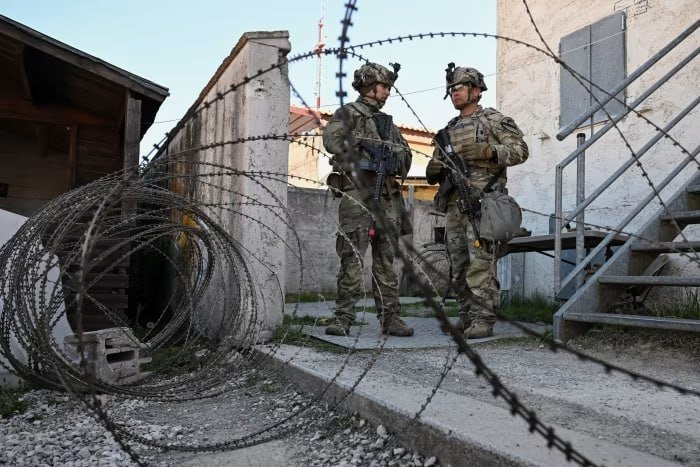
A fire broke out at Royal Air Force Fairford in Gloucestershire on the morning of 26 April 2026, according to reporting by Iranian state-affiliated outlets including Fars News Agency and Jahan Tasnim. Around the same time, protesters gathered at the perimeter of the base — one of a small number of RAF stations permanently allocated to United States Air Force operations under NATO mutual-support arrangements — to demonstrate against the use of British territory for military strikes targeting Iran. The convergence of the blaze and the protest drew fresh attention to a question the UK government has never fully resolved in public: what exactly is being launched from RAF Fairford, under what legal authority, and with what consequences for Britain's own foreign policy standing.
RAF Fairford has operated as a forward operating location for US Air Force units since the Cold War, when the base served as an emergency runway for strategic bombers. That role has expanded in the decades since. The base's 3,000-metre runway, hardened aircraft shelters, and fuel infrastructure make it one of a handful of European sites capable of handling heavy bomber missions without significant modification. In recent years, B-52 Stratofortress and B-2 Spirit aircraft have rotated through Fairford for training and operational missions, a pattern the US European Command describes as routine theatre-support activity. British officials have largely echoed that characterisation, presenting the arrangement as a bedrock commitment within the NATO alliance rather than a bilateral arrangement requiring separate parliamentary scrutiny.
The protesters who gathered at Fairford on 26 April were organised by groups identifying the operations from the base as part of a broader US-Israeli military posture against Tehran. According to Iranian state-adjacent coverage, which cited witness accounts from the demonstration, opposition to what participants described as complicity in a potential wider conflict with Iran motivated the gathering at Royal Fairford. The framing reflects a persistent line of critique from anti-war and pro-diplomacy campaigners in the UK: that the US-UK alliance relationship grants Washington de facto use of British territory without equivalent British decision-making power over how that territory is employed. The legal basis for US operations at RAF Fairford rests on a series of Defence Cooperation Agreements negotiated outside the framework of a formal treaty requiring parliamentary ratification, a distinction critics have argued allows executive branch decisions to bind the country to military commitments without meaningful democratic oversight.
The fire itself remained under investigation as of late 26 April. Neither the UK Ministry of Defence nor the Gloucestershire Fire and Rescue Service had issued a formal statement attributing cause or assessing whether the blaze bore any relationship to the military operations ongoing at the base. Initial accounts, carried by the Iranian feeds that first reported the incident, described it as massive in scale and occurring in proximity to infrastructure used by American bombers. The UK side of the story was notably absent from open sources at time of writing. This asymmetry is not unusual for stories originating on one side of a geopolitical divide — Western wire services had not, by late 26 April, confirmed or expanded on the incident independently. Readers should treat the specific scale and location of the fire as reported by Iranian state-adjacent sources pending independent verification from UK or Western outlets.
What is verifiable is that RAF Fairford's role in US operations has quietly expanded over the past decade, driven by the shift from counterterrorism missions in the Middle East to what the US national defence strategy describes as great-power competition. The base's distance from contested airspace, its integration with US logistics chains, and its legal status under the US-UK Visiting Forces Agreement make it a logical node for bomber operations that need a European staging point without the political complications of operating directly from US bases on American territory. Whether those operations include strikes on Iranian targets — as opposed to the Houthis in Yemen or other regional actors — is a question US European Command and the UK Ministry of Defence treat as operationally sensitive and decline to confirm in detail. The ambiguity itself is part of the structure: the UK government benefits from the political cover of an alliance relationship that allows it to support US operations while maintaining strategic deniability.
The protests at Fairford are not new in kind. Similar demonstrations have greeted US bomber rotations at RAF Mildenhall — itself scheduled for partial return to US use after a period of reduced presence — and at other locations across Europe where American forces operate under bilateral agreements. What distinguishes the current moment is the specificity of the Iran framing. Previous cycles of anti-US demonstrations in Europe have tended to focus on nuclear weapons, the wars in Iraq and Afghanistan, or NATO expansion. The targeting of Iran as the explicit justification for protest marks an escalation in how activist groups are framing their opposition, and it reflects a broader shift in how the Iran question has moved from a diplomatic track into an openly military one in the perceptions of Western publics.
The structural question beneath both the protests and the fire is one of sovereignty and accountability in alliance relationships. RAF Fairford sits on British soil, is owned by the UK Ministry of Defence, and is staffed in part by British civilian contractors. But the operations conducted from it — the aircraft that fly out, the missions they carry, the intelligence that flows back — are primarily under US command. This arrangement has worked without significant public controversy for decades precisely because the missions themselves were not highly visible and because successive British governments were willing to accept the alliance dividend without examining its components too closely. The combination of a visible fire, a protest, and a specific Iran framing has now forced those components into the open at a moment when tensions between the West and Iran are elevated and when British voters are paying more attention to the consequences of foreign entanglements than at any point since the 2003 Iraq debate.
The stakes are not merely rhetorical. If public pressure builds around the question of what US aircraft are doing at RAF Fairford, the UK government faces a choice: continue the current arrangement and absorb the political cost, or seek renegotiation of the Defence Cooperation Agreement to require greater transparency — and perhaps parliamentary approval — for operations it considers too sensitive to proceed without domestic mandate. Neither option is cost-free. The US values the arrangement precisely because it is low-friction and deniable. Any formalisation of British oversight would likely be resisted by Washington, which has shown consistent preference for using alliance relationships as a mechanism for distributing operational burden without creating legal or political exposure for its partners. The fire and the protests may prove to be a temporary flicker. But they have exposed a fault line that was always there.
This publication covered the fire at RAF Fairford and the associated protests as reported by Iranian state-adjacent outlets, pending independent corroboration from UK or Western wire services. The structural questions about US military operations on British territory and parliamentary oversight of the US-UK Defence Cooperation Agreement deserve sustained follow-up reporting regardless of how the investigation into the blaze concludes.
Wire provenance
This editorial synthesis draws on the following public wire/social posts:
- https://t.me/FarsNewsInt/
- https://t.me/farsna/
- https://t.me/JahanTasnim/