Gaza's Invisible Threshold: When Civilian Harm Becomes Background Noise
Three incidents in a single hour on 26 April illustrate how the machinery of occupation ingrains itself into routine—and why the international vocabulary of concern has lost its power to stop it.
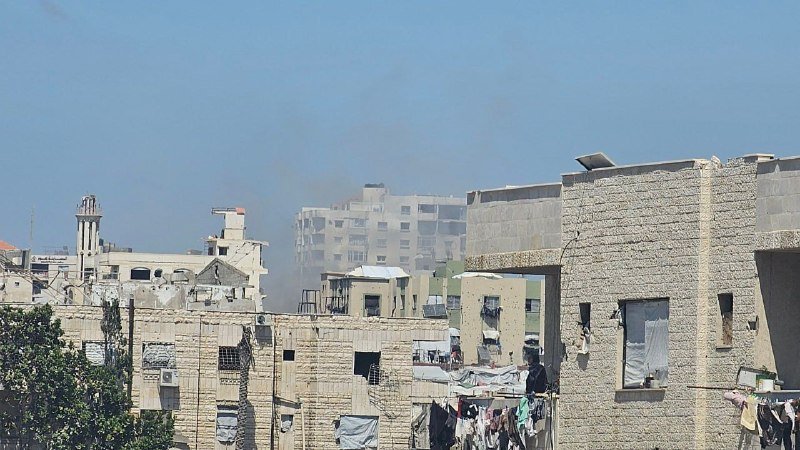
On 26 April 2026, between 19:13 and 19:44 UTC, three separate incidents were reported from the Gaza Strip in rapid succession. A civilian was shot in the abdomen in the Al-Faluja area of northern Gaza, what Al Alam Arabic described as the result of random gunfire by Israeli occupation forces. Within the next half hour, Israeli naval boats opened fire toward the northwestern reaches of the Strip. Then flare bombs were fired into the eastern airspace above Gaza City. Four events. One hour. No change in the global diplomatic temperature.
That is the structural problem worth examining—not the individual incidents, which carry their own weight and deserve individual accounting, but the architecture of indifference that makes them illegible as news.
The Reporting Problem
Wire services and international broadcasters have covered Gaza for nearly two decades with a consistency that borders on formula. There is the attack, the condemnation, the statement from the United Nations or the European Union, and then there is the interval of silence before the next attack. The vocabulary exists. The institutional machinery exists. What appears absent is any mechanism that makes the use of that machinery worth the cost to the party being asked to stop.
This is not a revelation. It is a structural observation. The gap between the international community's stated commitments—to civilian protection, to humanitarian law, to the two-state framework—and its capacity to enforce those commitments when the violator is a Western-aligned state has become so wide that it no longer functions as a deterrent. The language remains; the teeth have been pulled.
Israeli security concerns are real and this publication has never disputed that. Rocket fire into Israeli territory, the hostage question, the threat posed by militant groups operating from civilian areas—these are first-order facts. They do not, however, explain why a civilian shot in the abdomen in Al-Faluja registers as a data point rather than a crisis. They do not explain why the same international framework that imposed sweeping sanctions on Russia over its invasion of Ukraine has not produced comparable consequences for policies that a growing body of UN officials has described as meeting the threshold of famine and collective punishment.
The Diplomatic Arithmetic
The calculus is not complicated. Western governments that would prefer to see restraint in Rafah or northern Gaza face a structural constraint: the constituencies that care about Palestinian civilian welfare do not, in most Western electoral contexts, constitute a majority coalition capable of forcing the issue. The constituencies that view Israeli security as non-negotiable do. That asymmetry produces a policy drift toward continued weapons transfers, continued diplomatic cover, and continued statements that use the word "concern" to describe situations that, by any forensic measure, amount to ongoing rights violations.
The result is a diplomatic vocabulary that has been hollowed out by repetition. The word "condemn" has lost its meaning through overuse; the phrase "deeply concerned" functions as a valedictory rather than a warning. When the UN Secretary-General invokes Article 99 of the UN Charter—a tool used perhaps twice in the body's history—the response is a phone call and a statement, not a change in behaviour. The occupation has learned this. So have its subjects.
What the Hour Illustrates
The three incidents reported on 26 April did not occur in a vacuum. They occurred in a context where the Israeli military has maintained a grinding presence across the Strip for more than eighteen months, where displacement orders have covered the majority of the northern population, and where aid delivery mechanisms remain subject to bureaucratic and physical obstruction that UN agencies have documented in detail. In that context, a single hour of flare fire, naval shelling, and a gunshot wound in Al-Faluja represents not an escalation but a baseline.
The baseline is the story.
What Monexus found, reviewing the wire across the week, was a pattern consistent with what this desk has flagged before: Gaza coverage is technically present, legally accurate, and substantively incomplete. The legal accuracy does the least work. The occupation is not illegal in the way that a specific operation might be deemed unlawful; it is ongoing, documented, and structurally resistant to the mechanisms that have historically been used to change state behavior. Calling it what it is—that the Strip has been under a comprehensive military closure that its own former commanders have described in strategic terms—would require a clarity that the diplomatic register currently prohibits.
The Stakes
The stakes are not abstract. A population of more than two million people, half of them children, has been classified as facing acute food insecurity by the integrated food security classification methodology used by the UN and major aid agencies. The mechanism for that classification is not political—it is caloric. The mechanism for response is political, and it is failing. The gap between what aid agencies say they need and what they are permitted to deliver has widened to the point where the distinction between the humanitarian crisis and its management has collapsed.
The international order that produced the Geneva Conventions, the Rome Statute, and the Responsibility to Protect doctrine did so on the premise that sovereign states could be induced to comply with civilian protection norms when the costs of non-compliance were made credible. The premise is being tested, in real time, and the results are in. The costs are not credible. The compliance is not forthcoming. The norms remain on the books, and the population they were designed to protect remains under fire.
The 26 April hour will not make the wire summary. It will not generate a new statement from Brussels or Washington. It will instead settle into the record—a data point among thousands, illustrating the distance between the language of concern and the reality of the airspace over Gaza City, where the flare bombs went up at 19:44 and the night closed in the way it has closed every other night this year. That is the editorial judgment worth questioning, not just the specific incidents, but the framework that makes them ordinary.
This article was filed from the MENA desk on 26 April 2026.
Wire provenance
This editorial synthesis draws on the following public wire/social posts:
- https://t.me/gazaalanpa/12473
- https://t.me/alalamarabic/18934
- https://t.me/alalamarabic/18936