Footage Emerges of Hezbollah FPV Drone Strikes on Israeli Targets in Southern Lebanon
On 26 April 2026, Hezbollah released footage of multiple FPV drone strikes against Israeli forces and armour in southern Lebanon, footage verified by open-source researchers that demonstrates a growing precision-strike capability among non-state actors operating along the northern border.
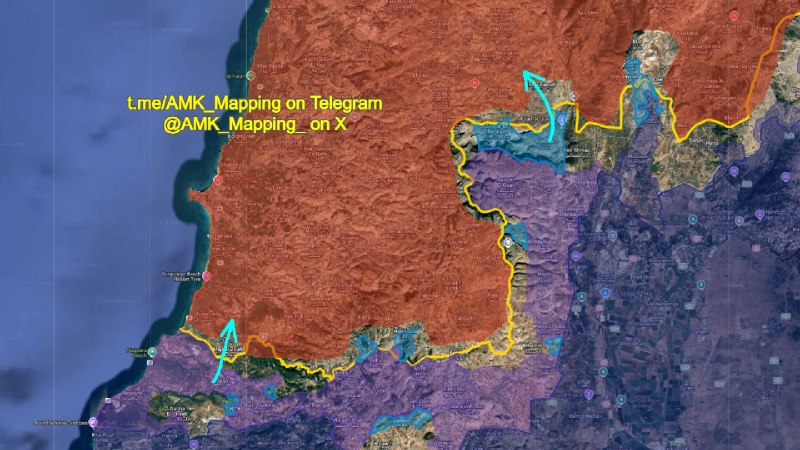
Hezbollah released footage on 26 April 2026 of multiple first-person-view drone strikes against Israeli forces and military vehicles operating in southern Lebanon. The footage, independently corroborated by open-source intelligence analysts, shows an FPV drone striking a Merkava tank near Beit Lif, a separate FPV drone targeting an Israeli rescue force, and a third drone approaching a military helicopter as it attempted to evacuate wounded personnel. Golani soldiers were filmed firing small arms at one of the drones. No casualties were reported from the incidents. The strikes, spanning a single day and captured from the drone's own camera, offer an unusually detailed picture of how a non-state armed group is deploying commercially available drone technology for precision strike operations.
The footage, analysed frame by frame by researchers tracking the conflict, shows a level of tactical precision that defence analysts have noted is no longer the exclusive domain of state militaries. The attacks in southern Lebanon on 26 April follow a pattern established over months of near-daily exchanges along the Israel-Lebanon border, where FPV drones have become the primary strike platform on both sides. What distinguishes the latest incidents is not the scale — three strikes in a single day falls within a broader pattern of regular engagement — but the clarity and completeness of the footage released.
The Incidents
The most tactically significant of the three documented strikes shows an FPV drone locating and tracking an Israeli Merkava main battle tank on roads near Beit Lif, a village in southern Lebanon close to the border. The footage, released by Hezbollah-affiliated channels, shows the drone adjusting course to follow the tank before impact. The Merkava series is among the most heavily armoured vehicles in the Israeli Defence Forces, and its targeting by an inexpensive commercial drone — the FPV platforms used cost a fraction of a tank — underscores a structural shift in the economics of modern warfare. Whether the tank was destroyed or damaged could not be independently confirmed from the footage alone.
A second strike targeted an Israeli rescue force operating near a helicopter in southern Lebanon. The drone struck close to the aircraft as it hovered, footage shows. Golani soldiers were filmed returning fire with small arms as the drone approached — a response that open-source analysts noted reflects the difficulty of countering small, low-altitude drones with conventional infantry weapons. The helicopter was not confirmed to have been hit. A third incident involved a drone approaching a separate evacuation helicopter, again in southern Lebanon. No casualties were reported in any of the three incidents, though the operational disruption to evacuation procedures is self-evident.
Israeli military spokesman Unit for Coordination of Government Activities in the Territories and IDF Spokesperson did not immediately issue a detailed public statement on the specific incidents by time of publication. The footage circulated widely across regional Telegram channels and was reported by international wire services monitoring the northern front.
The Weapon
FPV drones — first-person-view platforms originally designed for civilian racing — have been refashioned as strike weapons across multiple conflict zones. Their adoption in the Russia-Ukraine war established the tactical template: a single operator can guide a drone carrying a shaped charge into a specific point on a target, often the top or rear armour of a vehicle, where protection is thinnest. The Ukraine conflict also demonstrated that non-state actors and state forces alike could acquire the components — airframe, flight controller, payload — through commercial supply chains.
Hezbollah's FPV capability has developed visibly over the course of the conflict. Earlier strikes showed less precision and were frequently countered or failed to reach their targets. The footage from 26 April reflects improved targeting methodology: the drone operators maintained lock-on over a moving vehicle, the flight path shows pre-planning rather than opportunistic attack, and the camera angles suggest the drones were launched from prepared positions at known chokepoints. That level of operational preparation implies a dedicated drone unit with training, logistics, and intelligence support — not improvised attacks by individual fighters.
The drones used are commercially sourced multi-rotors adapted to carry explosive payloads, a conversion well documented in open-source analyses of battlefield remnants recovered from various conflict zones. What has changed is the skill curve. The footage from 26 April suggests operators who have trained extensively on moving targets in a permissive environment — southern Lebanon, where airspace is contested but not comprehensively controlled by Israeli forces.
What the Footage Reveals
The decision to release multi-angle, high-definition footage of the strikes carries operational and informational weight simultaneously. For Hezbollah, the publication is a message to its domestic constituency and to Iran, its primary backer: the group possesses a functioning precision-strike capability that is growing in sophistication. For Israel, the footage is a reminder that the northern border presents a qualitatively different challenge from the Gaza front — an adversary with territorial depth, drone manufacturing and maintenance capacity, and the ability to conduct armed reconnaissance in real time.
The footage of soldiers firing small arms at an incoming drone is not unique to this conflict; Ukrainian forces have posted similar footage from the Russia-Ukraine war. But the image carries a specific resonance in the Lebanon context: it illustrates the gap between the threat that FPV drones pose and the countermeasures currently available to ground forces without dedicated anti-drone systems. Electronic warfare jammers, counter-drone radars, and directed-energy weapons exist but are not universally deployed, and their effectiveness against adapted FPV platforms — which can be flown on pre-programmed routes or in manual mode to evade jamming — remains contested.
The incidents also illuminate the blurring line between surveillance and strike. Several of the drones in the footage appear to loiter before attacking, suggesting they conducted reconnaissance passes before committing to a strike. The ability to switch between reconnaissance and strike missions with a single platform increases the operational burden on forces operating in the open.
Escalation Risk and Operational Reality
Hezbollah has been conducting cross-border operations since October 2023 as part of what it frames as a support front for Hamas. Israel has responded with strikes into Lebanon targeting drone launch sites, command facilities, and individual operatives. The exchange has killed hundreds of people on both sides and displaced tens of thousands from border communities. Neither side has publicly committed to a full-scale ground operation, but the operational tempo along the northern border remains higher than at any point since the 2006 war.
The 26 April strikes land within this broader dynamic. They do not appear to represent a qualitative escalation in terms of damage inflicted — no confirmed vehicle kills, no confirmed casualties — but they do represent a quantitative intensification of drone activity. When a non-state actor can field multiple FPV strikes in a single day with footage quality sufficient for public release, the operational calculus for forces in the field changes. Supply chains for components, manufacturing capacity for adapted airframes, and the training pipeline for operators become strategic concerns.
Israeli forces have invested in countermeasures, including Iron Beam — a directed-energy weapon in development designed to intercept drones and mortars — but field deployment remains limited. For the forces operating in southern Lebanon on 26 April, the counter-drone response available was a rifle. That asymmetry defines the problem. The incidents of 26 April are unlikely to shift the strategic balance of the conflict, but they confirm a trend that military planners have been watching closely: the democratisation of precision strike capability is not a future scenario. It is the present reality of the northern border.
This article was filed from wire and open-source monitoring reports covering the Israel-Lebanon border on 26 April 2026.
Wire provenance
This editorial synthesis draws on the following public wire/social posts:
- https://t.me/abualiexpress
- https://t.me/wfwitness
- https://t.me/rnintel
- https://en.wikipedia.org/wiki/First-person_view_(drone)