Lebanon Ceasefire Collapses Under Drone Strike and Hezbollah Vow to Continue Attacks
Open-source footage from southern Lebanon and Hezbollah's explicit vow to continue 'legitimate response' to Israeli ceasefire violations exposes a framework that was never built to last.
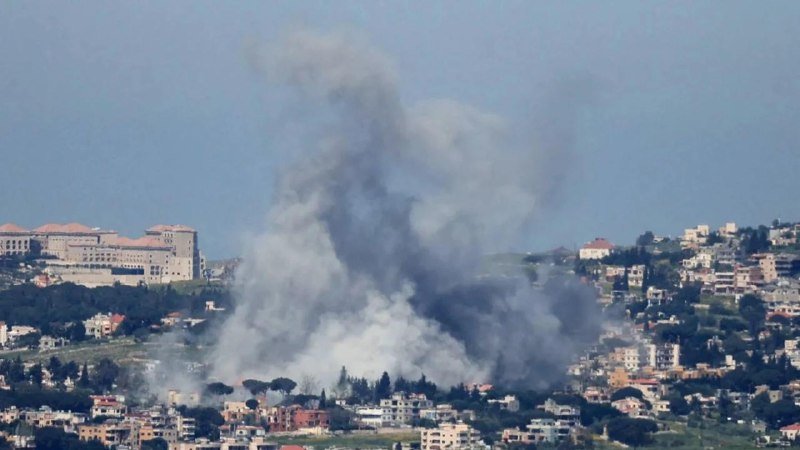
The footage runs less than ninety seconds. A quadcopter drifts over scrubland in southern Lebanon, adjusts its descent, and detonates within metres of a hovering Israeli helicopter. The blast sends debris skyward; figures scatter. By the time the video reaches Telegram on 26 April 2026, Hezbollah has already issued a statement. The movement, according to Iranian state-linked PressTV, will continue what it calls its "legitimate response" to Israeli ceasefire violations — and explicitly names Prime Minister Benjamin Netanyahu as the party responsible for the breakdown.
The sequence — strike, statement, escalation signal — is not new. What makes the 26 April footage significant is the precision with which it documents the moment and the explicitness with which Hezbollah frames its actions as lawful. This is not the language of a group seeking to avoid accountability. It is the language of a party that has decided the ceasefire, such as it was, is already over.
What the footage shows
The open-source material, corroborated by independent analysts reviewing the drone's trajectory and impact geometry, depicts an FPV-class device — cheap, man-portable, difficult to intercept — striking near the landing zone of what appears to be a medical or casualty-evacuation helicopter. War Monitor, the channel that first distributed the footage, described it as a Hezbollah FPV targeting an Israeli rescue force. The visual evidence is consistent with that description: the drone descends with the deliberation of a guided weapon, not the randomness of an errant launch.
Israeli officials have not issued a public casualty assessment as of this publication. The IDF Spokesperson confirmed an incident in the northern sector but provided no operational detail. What is certain is that a rescue operation was interrupted, that a helicopter was involved, and that the strike occurred within what is nominally a ceasefire zone. Each of those facts matters independently; taken together, they describe a deliberate act, not a misfire.
Hezbollah's framing is precise. The movement does not describe the strike as aggression. It describes it as a response — specifically, a response to violations that Hezbollah has documented and published through its own media channels over recent weeks. Whether those documented violations meet the threshold the ceasefire established for triggering authorized response is the contested question at the centre of everything.
Hezbollah's legal argument
The movement's statement, carried in full by PressTV on 26 April 2026, invokes language that tracks closely with the ceasefire's textual architecture. When Hezbollah says it will continue its "legitimate response," it is making a legal argument, not merely a political one. The ceasefire framework — brokered under international pressure in early 2025 — contained explicit provisions for what happens when either party perceives a violation. Hezbollah is arguing that Israeli movements, overflights, and the positioning of forces in disputed sectors constitute violations that activate its right of proportionate reply.
Israeli officials have rejected this framing. From Jerusalem's perspective, the ceasefire's security architecture gives Israel wide latitude to act against threats, and Hezbollah's invocation of "violations" is a pretext for ongoing hostility. Netanyahu's office has accused Hezbollah of using the ceasefire framework as cover for a sustained military campaign. That accusation is not without merit. Hezbollah has issued strike documentation, including maps and timing assessments, that suggest systematic monitoring of Israeli activities — the work of an organization that entered the ceasefire with a legal team and a targeting calendar.
What is notable, however, is that neither side is operating in bad faith within a vacuum. The ceasefire text, assembled under considerable diplomatic pressure from Washington, Paris, and Riyadh, was ambiguous precisely because its framers could not agree on a clearer formulation. The ambiguity was a feature, not a bug — it allowed both parties to accept terms they could not endorse in full. What the 26 April footage exposes is the cost of that ambiguity: a framework in which both sides can sincerely believe they are acting defensively, and in which both sides can act accordingly.
Why this keeps happening
The pattern is not accidental. Ceasefires in asymmetric conflicts — where one party enjoys decisive conventional superiority and the other relies on distributed resistance capacity — tend to produce exactly this dynamic. The stronger party interprets its security requirements broadly and acts on threat assessments that do not require prior consultation. The weaker party, unable to match conventional capability, builds legal and narrative frameworks that give each of its actions the appearance of legitimacy. The ceasefire does not eliminate the conflict; it relocates it to a domain of language, documentation, and calibrated escalation.
In the months since the ceasefire took effect, Israeli forces have conducted operations that Hezbollah has documented as violations: surveillance flights over southern Lebanese villages, checkpoint establishment along access routes, the movement of armour into areas the ceasefire designated for reduced military presence. Hezbollah has responded — initially with smaller-scale strikes, now with FPV operations targeting aircraft and rescue forces. Each Israeli action produces documentation; each documentation produces Hezbollah's "legitimate response." The cycle does not resolve; it accumulates.
This is structurally predictable. A ceasefire built on mutual interpretation rather than third-party enforcement is a ceasefire built on mutual provocation. Every action by either party becomes a potential trigger — not because either side wants full-scale war, but because the architecture offers no mechanism for authoritative resolution. When Hezbollah documents an Israeli violation and the IDF responds by saying it acted against an imminent threat, neither party is lying. Both are reading the same ambiguous text and drawing reasonable conclusions. That is the problem.
What comes next
The immediate question is whether the 26 April strike represents a threshold-crossing event or another increment in the accumulation. Israeli officials have not announced a suspension of the ceasefire or a return to active combat in the south. But the footage — the drone's precision, the targeting of a rescue helicopter, the statement vowing continuation — raises the cost of treating this as a routine incident. International mediators, including the French Foreign Ministry and the Americans who helped broker the original terms, face pressure to respond before either party uses the footage as justification for escalation.
The stakes are concrete. A full Israeli ground operation in southern Lebanon would be operationally feasible but politically and economically costly, with implications for an already strained domestic coalition. Hezbollah, for its part, has internal constraints: the movement's standing in Lebanon depends partly on its ability to present itself as a defensive force rather than an aggressor. The "legitimate response" framing is designed to manage that constraint. A drift toward open war would expose Hezbollah to accusations that it destroyed the ceasefire, which would damage its position both domestically and in regional diplomatic calculations where its Iranian patron is navigating complex negotiations.
What the 26 April footage confirms is that the ceasefire, understood as a durable political arrangement, was always an overstatement. It functions as a tactical pause — a reduction in the scale of violence, not a resolution of the structural conflict that produced it. Hezbollah has decided that pause is no longer sufficient. Whether Israel and its international backers respond with pressure or with force will determine whether the next cycle produces another calibrated strike or something the ceasefire was designed to prevent.
This publication covered the incident primarily through open-source material and Iranian state-linked reporting, framing the strike within the ceasefire's legal architecture rather than treating it as an isolated act of aggression.
Wire provenance
This editorial synthesis draws on the following public wire/social posts:
- https://t.me/wfwitness/4892
- https://t.me/wfwitness/4891
- https://t.me/presstv/13467