Russian Africa Corps Flees Kidal as Tuareg-Jihadist Coalition Overruns Northern Mali
Russian mercenary forces abandoned their Malian military allies and withdrew under white flag as a joint Tuareg-jihadist offensive seized the historic city of Kidal on 26 April 2026.
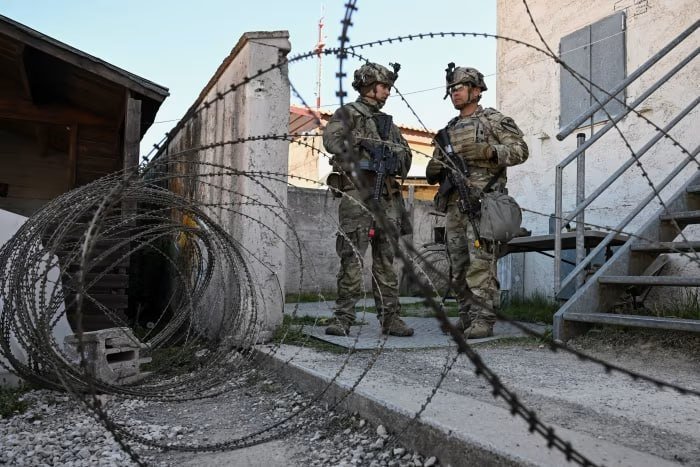
The Russian Africa Corps — the mercenary force formerly known as Wagner that Moscow deployed across the Sahel as a tool of influence without the legal cover of official state forces — fled Kidal on 26 April 2026, ceding the historic Tuareg capital of northern Mali to a coalition of local rebels and jihadist fighters. The withdrawal, conducted under a white flag, marked a humiliating reversal for Russia's most prominent military venture on the African continent and left Mali's national army encircled and alone.
The Front de Libération de l'Azawad, a Tuareg separatist movement, and Jama'at Nusrat al-Islam wal-Muslimin, the Al-Qaeda-affiliated jihadist group better known by its French acronym JNIM, launched a coordinated assault on Kidal city that overwhelmed the Malian garrison and forced Russian Africa Corps fighters to abandon the base they had occupied for more than two years, according to reporting from the region on 26 April. Video verified by open-source analysts showed an FLA member wearing the removed Russian tricolour as a trophy. A Russian helicopter of unknown type was shot down over northern Mali during the fighting; its crew was killed. The Malian armed forces, known by the French acronym FAMa, were encircled inside the base and not permitted to withdraw under the terms of the deal that secured the Russian pullout, frontline sources reported.
The Collapse in Kidal
The offensive that toppled the Russian position in Kidal was the product of an unlikely but operationally coherent alliance between two actors with divergent long-term visions: the secular-nationalist Tuareg of the FLA, who seek an independent or highly autonomous Azawad state across northern Mali, and JNIM, whose stated aim is the establishment of an Islamic emirate across the Sahel. That the two groups coordinated their assault — combining JNIM's knowledge of asymmetric warfare and the FLA's local tribal networks and terrain familiarity — suggests an escalation in the strategic sophistication of non-state armed coalitions operating in ungoverned Sahelian space.
The city of Kidal had been a flashpoint since Mali's colonial-era incorporation into French West Africa. It served as a base for two successive external interventions: first the French Barkhane operation, which withdrew in 2022 under pressure from the Bamako junta, and then the Russian Africa Corps, which arrived as a de facto replacement security guarantor. For the FLA, Kidal's fall was not merely a military victory but a symbolic repossession — the city had been the capital of the short-lived Azawad republic declared in 2012 before French and Malian forces pushed the Tuareg back. This time, the attackers held.
Moscow's Aborted Deal
Reports from the morning of 26 April 2026 described intensive negotiations between the Russian Africa Corps command and FLA representatives over a safe passage agreement. Initial accounts indicated a deal had been struck; subsequent updates corrected that assessment, with Russian and Malian sources confirming fighting had resumed. A short time later, a new deal was reported — one that permitted the Russian contingent to withdraw but left the Malian army behind. The sequence itself is instructive: Moscow extracted its own personnel while effectively trading the fate of its ostensible ally.
The Africa Corps began departing Kidal's military installation before midday on 26 April. Social media footage showed the convoy moving out under a white flag — a surrender signal that will complicate Moscow's narrative of an orderly retrograde. For a force that has sold itself to regimes across Africa as an invincible professional military, the optics of retreat under a flag of truce are damaging. It remains unclear whether the Africa Corps will attempt to return or whether Kidal has permanently passed from Malian and Russian control.
What This Means for the Wagner Model
The Russia-Africa Corps model — private military contractors deployed alongside state diplomatic cover, billing themselves as security advisors while running actual combat operations — has been the cornerstone of Moscow's influence strategy in the Sahel since France began its withdrawal. Mali was the flagship deployment. When Wagner personnel arrived in late 2021, they helped the junta recapture territory from jihadist groups and the Tuareg, and the junta made its gratitude public. Mali's subsequent pivot away from France toward Russia was presented in Moscow's framing as a vindication of the model.
That vindication is now in question. The Africa Corps' inability to hold Kidal — and its willingness to abandon a national army partner to do so — reveals structural limits. Without the legal protections of official state forces, contractors lack the institutional obligation to die for an ally's strategic interest. When the calculation turned against holding Kidal, the Africa Corps did not hesitate to extract itself. Mali's government, having burned its relationship with France and Western security partners, now faces the prospect of holding a vast northern territory without a credible external backer. The junta in Bamako has not issued a public statement on the withdrawal as of late afternoon on 26 April.
Regional and Structural Stakes
The fall of Kidal carries implications beyond Mali. Burkina Faso and Niger — both of which have expelled French forces and deepened ties with Moscow under the banner of the Alliance of Sahel States — will be watching closely. The lesson available from Kidal is ambiguous: Russia's security guarantees are real only when they are profitable, and they become negotiable the moment the costs exceed Moscow's appetite. For Sahelian states that have wagered their security architecture on the Africa Corps, the episode offers little comfort.
It also raises a question about what fills the vacuum. JNIM's presence in the Kidal coalition is a reminder that the Sahel's jihadist insurgencies are not simply a problem that Russian firepower was solving — they were a problem that Russian firepower was managing in exchange for political leverage. If the Africa Corps' defeat accelerates the insurgent networks' confidence and territorial reach, the consequences will be felt well beyond the borders of Mali.
The sources covering the Kidal offensive on 26 April do not yet agree on the final disposition of the Malian garrison, the total number of casualties, or whether the city will remain under coalition control or face a counteroffensive. What is not in dispute is that the Africa Corps withdrew, and it did so under a flag of surrender. Everything else — the diplomatic scramble, the implications for Russia's African footprint, the future of the Sahel's security architecture — follows from that fact.
This article draws on reporting from Telegram channels covering the Sahelian conflict in real time. Monexus supplements these primary sources with regional wire reporting where available. The Telegram attribution reflects the operational reality of coverage from conflict zones where Western journalists face significant access restrictions.
Wire provenance
This editorial synthesis draws on the following public wire/social posts:
- https://t.me/rnintel/12438
- https://t.me/rnintel/12436
- https://t.me/rnintel/12434
- https://t.me/AMK_Mapping/18921
- https://t.me/rnintel/12429
- https://t.me/ClashReport/15812