Trump Issues Iran Infrastructure Warning While Leaving Door Open to Phone Talks
President Trump threatened to destroy Iran's oil infrastructure within days while simultaneously suggesting negotiations could be conducted by telephone, a dual-signal approach that observers say is designed to deepen economic pressure while keeping diplomatic options technically open.
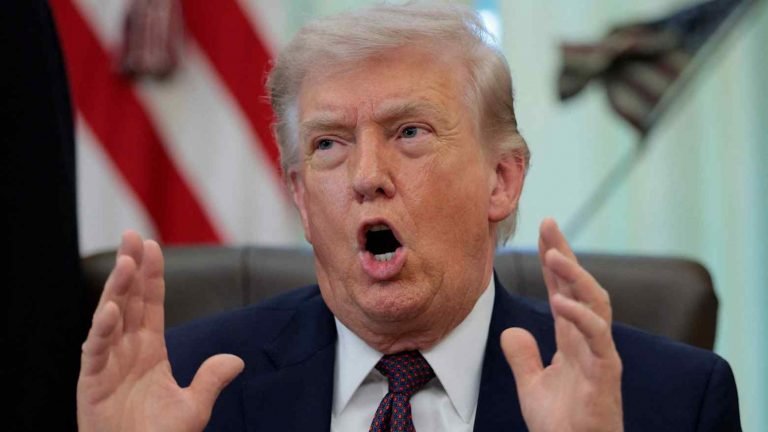
In a Fox News telephone interview released on 26 April 2026, President Donald Trump delivered what amounted to a two-track message on Iran: an explicit threat against the country's oil infrastructure, paired with a comparatively casual suggestion that negotiations could happen by phone. The remarks, carried in full by Iranian state-affiliated outlets that covered the interview closely, represent the sharpest and most detailed public articulation yet of the administration's pressure campaign against Tehran.
The juxtaposition is deliberate. Trump's infrastructure warning — that Iran has approximately three days of oil storage capacity remaining before facilities reach capacity — functions simultaneously as threat and as signal that the cumulative effect of sanctions and secondary-market restrictions is beginning to bite. The diplomatic overture, by contrast, keeps a line open without conceding anything. Senior administration officials have used similar dual-register language throughout 2026, but the specificity of Trump's storage-capacity claim marks a new phase in public signalling.
The infrastructure warning
Trump told Fox News that Iran's oil storage infrastructure is approaching a saturation point within days, and that the country's oil sector faces imminent pressure. The claim restates a concern that has circulated in Western sanctions-tracking circles for several months: that the cumulative weight of primary US sanctions, secondary-market restrictions on third-country buyers, and maritime-enforcement operations in the Gulf have progressively squeezed Tehran's ability to move crude to market. Storage facilities in Iran, built for a much larger export volume, are now filling faster than demand can clear them.
The framing carries the hallmarks of the administration's negotiating style — specific, time-bound, and calibrated to suggest imminent consequences without committing to a specific trigger. Whether the three-day estimate is a precise intelligence assessment or a rhetorical device designed to accelerate decision-making in Tehran remains unclear from the public record. The administration has not released supporting data on Iranian storage levels.
Iran's oil infrastructure has been a recurring target of Trump's messaging. In prior statements the administration drew parallels to the maximum-pressure approach taken with other adversaries, where infrastructure vulnerability was presented not as a predicted outcome but as a policy instrument. The tone here is consistent with that approach.
The NATO criticism
The interview also contained a pointed rebuke of the Atlantic alliance. Trump said he was "very disappointed" that NATO had not assisted the United States in its pressure campaign against Iran, a complaint that reflects a longstanding friction in the relationship but which has taken on sharper edges in recent months as the alliance debates its own posture toward the Persian Gulf.
European governments have taken a notably more cautious line than Washington on secondary sanctions targeting third-country entities that continue purchasing Iranian oil. Several EU member states have argued that unilateral US enforcement actions against European companies lack legal basis under EU law, and have resisted cooperating with Treasury Department requests. The NATO framing — treating a diplomatic and commercial dispute as an alliance-obligation matter — escalates the rhetorical stakes and puts allied governments in a politically awkward position without necessarily changing their behaviour.
The phone-call offer
Trump told Fox News that Iran could initiate negotiations "by phone," a formulation that is notable for both its informality and its implicit conditions. "If the Iranians want to talk to us, they can call," he said, a phrasing that places the burden of first contact entirely on Tehran while suggesting the US side requires no formal diplomatic process, no intermediaries, and no preconditions. The offer is, in structural terms, hollow as a standalone gesture — it does not specify what the US would offer in exchange for Iranian concessions, and it does not acknowledge any Iranian red lines. But its function as a signal is more important than its content: it allows the administration to claim publicly that diplomacy was available while Iran refused to pick up the phone.
On the nuclear question, Trump's position was unambiguous: Iran cannot be permitted to obtain a nuclear weapon, and the administration believes the steps it has taken should have prevented that outcome entirely. That framing — framing what are effectively sanctions as a substitute for a binding agreement — sidesteps the question of whether the current maximum-pressure approach is achieving what a formal deal was designed to accomplish.
The ambiguity problem
What remains unclear from the interview is whether the administration has a defined threshold — a storage-capacity level, a crude-output figure, a diplomatic gesture from Tehran — that would trigger a change in posture. The infrastructure warning reads as an ultimatum in some contexts and as a bluff in others; the phone-call offer reads as genuine openness in some contexts and as a face-saving mechanism for later claiming to have tried diplomacy. Both readings cannot be simultaneously accurate as genuine policy, and the sources do not resolve which reading reflects the administration's actual intent.
Tehran has not publicly responded to the specific three-day claim as of 26 April 2026. Iranian state media covered the interview extensively but did not immediately address the storage-capacity allegation on its merits. The absence of a direct rebuttal may itself be informative — a government confident that its infrastructure is resilient would be expected to challenge the claim explicitly. Silence, in this context, is not neutrality.
The broader trajectory, however, is one of escalating pressure with a diplomatic escape clause that remains deliberately vague. That combination has been effective, in the short term, at maintaining US leverage in negotiations with other adversaries. Whether it produces a durable outcome with Iran — a country with a longer institutional memory of sanctions than any other state in the Middle East — remains the unanswered question the incoming weeks will test.
Wire provenance
This editorial synthesis draws on the following public wire/social posts:
- https://t.me/englishabuali/123456
- https://t.me/nexta_live/789012
- https://t.me/FarsNewsInt/345678
- https://t.me/FarsNewsInt/901234