Trump's Three-Day Ultimatum and the NATO Fault Line in America's Iran Strategy
As President Trump publicly quantified a timeline for Iranian capitulation and confirmed NATO's refusal to join a US-led military coalition, the fissures in Washington's unilateral approach to Tehran are becoming impossible to paper over with bravado.
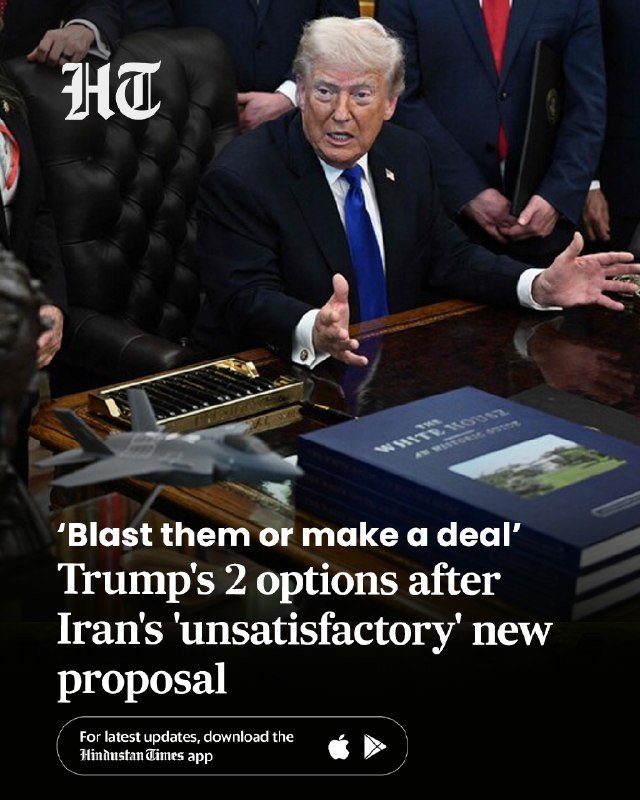
On 26 April 2026, President Donald Trump delivered two statements in quick succession that illuminate the contours of an American Iran strategy built on leverage, ultimatum, and increasingly, improvisation. Speaking to reporters, the President declared that the war with Iran would end "very soon" and that the United States would be "victorious" — then, in a separate exchange, offered a three-day countdown for Tehran to begin "exploding from within" because of the American blockade on its oil exports. "When the oil gets clogged, a very bad thing is gonna happen," he said, without elaborating on what that bad thing would be or who would bear its consequences.
The remarks land in a week already marked by the most explicit confirmation yet that the United States is prosecuting its Iran campaign without the backing of its most critical alliance. Trump confirmed that he had asked NATO members directly whether they wished to join the campaign against Tehran — and received an unambiguous answer. "Sir, we don't want to get involved," he quoted allied leaders as saying. The admission is notable not merely for its content but for its casual delivery: a President who built his political brand on transactional strength acknowledging, in public, that he could not deliver the one thing the moment appears to require.
The Ultimatum and Its Mechanics
The three-day framing is either a diplomatic pressure tactic of the highest order or something closer to a rhetorical improvisation that commits the administration to a timeline it cannot enforce. The sources do not indicate what mechanism the White House would deploy to make good on the implied threat, nor is there evidence of a coordinated sanctions escalation set to hit at the seventy-two-hour mark. What is documented is the blockade itself — a US-directed effort to prevent Iranian crude from reaching international buyers — and Trump's framing of that economic stranglehold as a weapon with a built-in detonation timer.
The oil blockade is not new. American pressure on intermediaries and shipping routes has constricted Iranian exports since the maximum-pressure campaign of the first Trump term and intensified under subsequent administrations. What changes with the three-day statement is the explicit temporal framing: the President has given the world a date. If nothing changes in Iranian behaviour by 29 April 2026, the question becomes what the administration does with the failure of its own ultimatum — and what credibility cost it pays.
Iranian state media and officials have not yet formally responded to the specific three-day framing, according to open-source monitoring of available channels as of 26 April 2026. Tehran's posture in recent months has combined military hardening with diplomatic signals through third-party intermediaries, a dual-track approach that has historically been resistant to deadlines set by adversaries.
The NATO Confession
The NATO exchange is, in structural terms, the more consequential disclosure. Trump said he was "not satisfied" with the alliance — language that echoes his longstanding grievances about burden-sharing and collective-action costs. But the substance went beyond abstract frustration. By his own account, the President posed a direct question to NATO members: join us in the Iran campaign or stand aside. The answer, delivered "clearly" in his telling, was refusal.
This matters for several reasons beyond the obvious diplomatic friction. A multilateral economic and diplomatic coalition without NATO's formal participation is a fundamentally different entity than one with it: smaller, more fragile, and more dependent on bilateral relationships that can be unwound at the pleasure of any single partner. The EU has maintained its own sanctions architecture on Iran independently of Washington in recent years, but that architecture has been unevenly enforced, with significant variance between member states in both capacity and political will.
The sources do not indicate which NATO members were consulted or whether the question was put to the alliance as an institution or to individual capitals. What is clear is that no formal NATO commitment to the Iran campaign emerged from the exchange — a vacuum that the United States is now filling with unilateral measures and public ultimatums.
Beijing's Calculated Ambiguity
Pressed on whether China was helping Iran circumvent the blockade, Trump offered a response that was notable for its restraint. "I think they might be helping, but not much," he said. He then drew an explicit parallel to his own administration's support for Ukraine, suggesting that all major powers engage in a form of client-state backing that makes the Iran situation a matter of degree rather than principle. "We also help Ukraine," he noted — a comparison that is analytically accurate in the narrow sense that great powers routinely support allied states under stress, but which elides the legal and moral distinction between defending a country invaded without cause and pressuring a state into submission through economic warfare.
Chinese state media has not issued a formal response to the Trump comments as of the publication of this article. Beijing's official posture on Iran sanctions has historically been to oppose unilateral US measures while nominally enforcing United Nations Security Council obligations — a position that creates maximum diplomatic cover for selective non-compliance with American secondary sanctions. Whether that posture is shifting, holding, or deepening is not yet clear from the available record. What is clear is that Trump, for now, appears willing to accept a level of Chinese hedging that his rhetoric on trade and geopolitics would not have predicted.
The Structural Logic of Unilateral Pressure
The combination of the three-day ultimatum, the NATO refusal, and the Beijing hedge reveals something structural about the current American approach to Iran. The strategy is not incoherent — it is a coherent theory of economic strangulation executed without the diplomatic infrastructure that makes strangulation effective. Sanctions work not because of their direct economic impact alone but because they are embedded in a network of multilateral enforcement that makes circumvention costly and risky. A sanctions regime maintained by a single power — or a primary power with a declining coalition — is a regime that creates hardship without producing the political change it seeks.
The historical record on maximum-pressure campaigns against Iran is instructive. The previous round of comprehensive sanctions, enforced multilaterally through the P5+1 framework, produced a negotiated agreement in 2015. The unilateral withdrawal from that agreement in 2018 began a period of escalation that has not, to date, produced a better deal — only a more militarised region and a more isolated Iranian economy. The current administration's approach appears to be a variant of the same theory applied more aggressively, with shorter timelines and louder rhetoric.
Whether that theory succeeds depends entirely on what "success" means. If the objective is Iranian compliance with American demands on nuclear activity, regional behaviour, and ballistic missile programs, the evidence from four decades of US Iran policy suggests that unilateral pressure is insufficient to achieve it. If the objective is to degrade Iranian oil revenues and limit Tehran's ability to fund proxy forces, the blockade is already producing effects — but those effects accrue to the global economy as well as to Iran, in the form of elevated energy prices and increased volatility in an already fragile Asian market.
What remains genuinely uncertain — and what the available sources do not resolve — is whether the three-day ultimatum represents a genuine escalation trigger or a negotiating posture that the administration expects to walk back after the deadline passes. Trump has used countdown language before. The difference now is that NATO has declined to participate in whatever comes next, China has signalled its unwillingness to be conscripted into enforcement, and the Iranian leadership has survived maximum pressure before.
The United States may yet get its victory in Iran. But the coalition it is building to get there is, by the President's own account, a coalition of one.
Monexus covered the three-day ultimatum framing as a diplomatic improvisation that exposes coalition gaps rather than as a credible escalation signal. The wire picture, particularly from European outlets, has been more focused on the NATO refusal — a framing that this article argues is the more structurally significant disclosure.
Wire provenance
This editorial synthesis draws on the following public wire/social posts:
- https://t.me/osintlive/12458
- https://t.me/osintlive/12457
- https://t.me/osintlive/12456
- https://t.me/farsna/12441
- https://t.me/tasnimplus/9872