Trump Convenes Situation Room on Iran as War Decisions Loom
President Trump will gather his senior national security team in the Situation Room on Monday to review Iran policy, as the gap between the administration's stated preference for a deal and its escalating military posture grows increasingly difficult to reconcile.
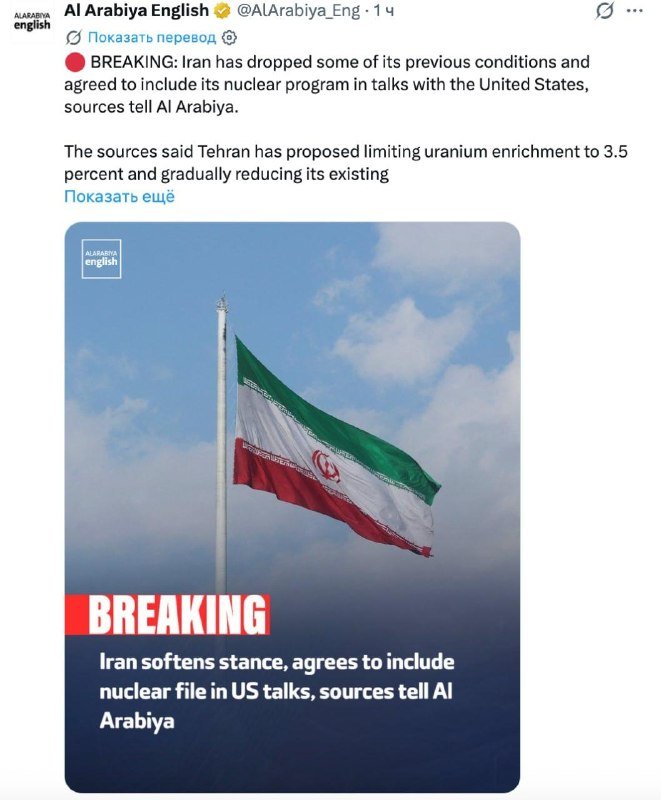
President Trump will convene his senior foreign policy and national security team in the White House Situation Room on Monday, 27 April 2026, to discuss the situation in Iran and the next steps in what the administration has described as an ongoing regional conflict, according to reporting by Barak Ravid of Axios, cited by multiple intelligence-focused Telegram channels.
The meeting, first reported by Axios and corroborated by open-source intelligence aggregators, will bring together the national security adviser, secretary of state, director of national intelligence, and senior military commanders. It represents the most structured high-level review of Iran policy since the collapse of indirect nuclear negotiations in early 2026 and the re-imposition of the Biden-era maximum pressure architecture that the Trump administration initially signal it would depart from.
The immediate context
The Situation Room gathering follows a period of deliberate ambiguity in the administration's Iran posture. Trump has stated publicly that he prefers a negotiated outcome and has at various points distanced himself from Israeli Prime Minister Benjamin Netanyahu's more aggressive rhetorical line. Yet simultaneously, the administration has reinforced its naval presence in the Gulf, tightened sanctions on Iran's financial infrastructure, and maintained the designation of Iran's Islamic Revolutionary Guard Corps as a foreign terrorist organization — measures that Iranian officials have characterized as incompatible with the diplomatic flexibility Washington has publicly claimed.
The meeting's agenda is expected to include a review of intelligence assessments on Iran's nuclear programme, which Western officials have said has progressed meaningfully since the 2015 Joint Comprehensive Plan of Action was abandoned in 2018. Also on the table: the status of Iran-aligned militia networks across Iraq, Syria, and Yemen, and the question of whether current levels of US military presence in the Gulf are sufficient to deter, or to prepare for, escalation.
What the sources do not clarify is whether Monday's meeting is intended as a genuine strategic review or a procedural precursor to a decision already made. The distinction matters enormously — for the region, for Congress, and for the allies who would bear the consequences of whatever comes next.
The competing signals
The administration has been operating on a dual-track that is difficult to decode from the outside. On one track, senior officials have spoken publicly about the possibility of a renewed deal framework, and Trump himself has at various points suggested that economic pressure could bring Iran to the table on terms acceptable to Washington. On the other track, the military deployments in the Gulf, the aggressive rhetoric from Iran envoy Steve Witkoff, and the sustained sanctions campaign paint a picture of a maximum pressure campaign aimed not at inducing concessions but at building legal and political justification for a harder strike.
Iranian state media has described the current US posture as an inducement to war, not to negotiation. Whether that framing is propaganda or a genuine read of American intent, it reflects a hardliner consensus inside Tehran that the window for diplomatic engagement has effectively closed. Reformist voices inside Iran who argued for compliance with the original nuclear deal as a way to head off exactly this scenario are now politically marginalized — a fact that the hawks in Tehran will cite as evidence that engagement with Washington was always a dead end.
Trump separately, on Sunday, denied details of the Jeffrey Epstein case in pointed terms, telling reporters he was "not a rapist" and "not a pedophile" and that the accounts he had read were the work of "a bunch of sick people." The statement, carried by Iranian state-affiliated media, does not alter the substance of the Iran policy calculus but underscores the degree to which the administration is simultaneously managing a domestic legal and reputational landscape alongside the foreign policy agenda.
The structural frame
What is happening with Iran is not simply a bilateral dispute — it is a stress test of the architecture the United States has built in the Middle East over three decades. The framework has relied on three pillars: Israeli military superiority, Gulf state financial and diplomatic cooperation, and a credible US deterrence posture backed by forward-deployed naval and air assets. Each of those pillars is under pressure simultaneously.
Israel has its own red lines on Iranian nuclear capability and has made clear that it does not consider US diplomatic process a substitute for its own deterrent options. Gulf states are watching with acute sensitivity — their economies are linked to global energy markets that would be severely disrupted by an Iranian strike or counter-strike, and their political relationships with Washington are complicated by domestic constituencies and the broader multipolar realignment that has made the United States a less reliable long-term partner than it once was. The question being asked quietly in Riyadh, Abu Dhabi, and Doha is not whether the US will act, but whether it will act in ways that do not leave the region to manage the aftermath alone.
The structural pattern here is one of managed escalation without declared intent — a posture in which the accumulation of military assets and economic pressure creates conditions where conflict becomes the path of least resistance not because it was chosen but because it was not foreclosed.
The stakes and what comes next
Monday's Situation Room meeting will determine whether the administration moves toward a renewed diplomatic track backed by real leverage — or toward a military track that will demand significant deployment decisions and carry a high probability of regional escalation. The sources do not indicate which direction is preferred, and the ambiguity may be deliberate.
What is clear is that the decision will not be made in the Situation Room alone. It will be shaped by congressional pressure — particularly from members who view an Iran conflict as a distraction from the Indo-Pacific and from domestic priorities — and by the calculations of allies who would be expected to support or refuse support for various scenarios. It will also be shaped by what the intelligence actually says about Iranian timelines: how close Iran is to a nuclear threshold, whether the IRGC's regional proxies are preparing for coordinated action, and whether there is any indication of internal fracture inside the Iranian system that could be exploited diplomatically.
The danger — as several former senior officials have noted in recent months — is not a dramatic decision but an accumulated trajectory. Maximum pressure that produces no concessions, military deployments that signal seriousness without producing results, and diplomatic isolation that hardens Iranian resolve rather than softening it: each step is defensible on its own terms. The combination may not be.
The world will be watching to see whether Monday's meeting clarifies that trajectory, or whether it simply accelerates it.
This article was drafted at 06:30 UTC on 27 April 2026. The wire picture was dominated by the Axios exclusive on the Situation Room meeting, with Trump denial coverage concentrated in the political and entertainment feeds. Monexus has foregrounded the strategic dimensions of the Iran meeting over the domestic political elements, in line with its geopolitical desk mandate.
Wire provenance
This editorial synthesis draws on the following public wire/social posts:
- https://t.me/rnintel/3849
- https://t.me/JahanTasnim/12847
- https://t.me/osintlive/2291