Hezbollah's FPV Drone Campaign: Inside the Tactical Shift on the Lebanon Border
On 27 April 2026, Hezbollah claimed responsibility for striking an Israeli D9 military bulldozer in Bint Jbeil with a first-person view drone — one of a series of such incidents that suggest a deliberate tactical adaptation to the fragile Lebanon ceasefire framework.
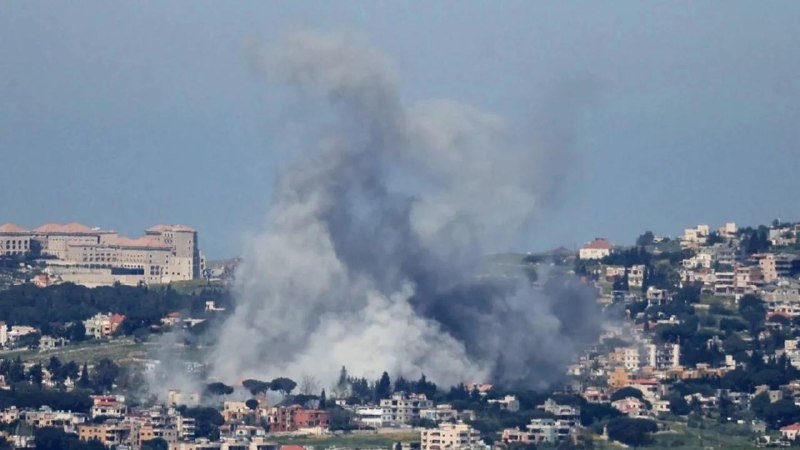
On 27 April 2026, at 13:32 UTC according to Telegram posts subsequently cited by open-source intelligence monitors, Hezbollah announced that its fighters had struck an Israeli D9 military bulldozer operating in Bint Jbeil with a first-person view drone. The strike was described as a direct hit. Separately, on the same day, IDF troops operating in southern Lebanon reportedly uncovered a weapons cache containing FPV drones among other materiel — the first time Israeli forces have publicly confirmed capturing such equipment from Hezbollah in the current phase of hostilities.
Both incidents, reported via Telegram channels and picked up by regional open-source feeds, illustrate a pattern that has become increasingly difficult for ceasefire monitors to ignore: Hezbollah is not merely holding its weapons stockpiles in place under the November 2024 ceasefire arrangement — it is actively deploying them, selectively and plausibly deniably, in ways that test the limits of the agreement's language.
What the Sources Confirm — and What They Don't
The Telegram posts from Middle_East_Spectator and wfwitness on 27 April describe the Bint Jbeil strike in near-identical terms: a Hezbollah FPV drone targeted an Israeli D9 military excavator destroying homes in the village, and the strike was confirmed as a direct hit. ELINT NewsRT, monitoring the same evening via the osintlive feed, reported that IDF troops had captured a cache of Hezbollah weapons in southern Lebanon, including FPV drones and anti-tank explosives.
Monexus has been able to corroborate the following from these sources: that an incident occurred in Bint Jbeil on 27 April involving an Israeli engineering vehicle and a drone-delivered munition; that IDF forces were present in southern Lebanon and recovered weapons materiel; and that FPV drones — commercially available unmanned systems modified for ordnance delivery — featured in both the offensive claim and the defensive seizure.
What the sources do not specify: which party began the engineering work in Bint Jbeil on that date, whether the demolished homes were structures Hezbollah had previously used for military purposes, or how many IDF personnel were present at the site. The Telegram posts frame the strike as a response to ceasefire violations by Israel; Israeli or Western sources have not been cited in the available thread confirming or contesting that framing as of publication.
The credibility ledger, therefore, reads as follows: Hezbollah's claim of a successful strike rests on video footage released via its own channels — standard practice for non-state actors seeking to demonstrate capability without exposing operational details. The IDF weapons cache has not been independently verified through Israeli military spokesman briefings or Western wire reporting as of 28 April 2026. Both incidents are plausible given what is known about Hezbollah's pre-ceasefire weapons stockpiles and the IDF's ongoing clearance operations along the Blue Line.
The Ceasefire's Grey Zone Problem
The November 2024 ceasefire between Israel and Hezbollah halted 14 months of full-scale hostilities but left several structural ambiguities. The agreement prohibited Hezbollah from operating armed personnel within proximity of the Lebanon-Israel border, while Israeli forces were permitted to operate defensively within Lebanese territory to eliminate infrastructure threats. In practice, both provisions have generated friction.
Israeli engineering operations — using D9 bulldozers to clear vegetation, dismantle underground passages, and demolish structures — have been a persistent source of complaint from Hezbollah and the Lebanese government. Hezbollah has characterised these operations as violations of Lebanese sovereignty; Israel has argued they are defensive measures against tunnel networks and firing positions that survived the initial phase of the ceasefire.
FPV drones fall into a particularly grey legal category under current international humanitarian law. They are not precision-guided munitions in the traditional sense, but they are also not the crude Katyusha rockets that defined Hezbollah's earlier arsenal. An FPV drone carrying a shaped charge can, in skilled hands, achieve effects comparable to an anti-tank guided missile — at a fraction of the cost and with a smaller logistical footprint. That Hezbollah is deploying them against engineering vehicles rather than armour suggests a deliberate tactical choice: to impose costs on Israeli operations while maintaining deniability. A strike on a bulldozer is less likely to provoke a massive retaliatory response than a strike on a tank or a troop carrier — but it signals that the capability exists and is being used.
The IDF's Counter-Capture: Operational and Political Significance
The reported seizure of Hezbollah weapons including FPV drones carries significance beyond its immediate operational value. For the IDF, it provides physical evidence — a term that matters in ceasefire negotiations and in the international legal arguments Israel has made about Hezbollah's ongoing non-compliance — that the group did not fully disarm or withdraw its forward elements as the ceasefire required.
The cache reportedly included anti-tank explosive devices alongside the FPV drones. That combination — drone delivery systems paired with shaped charges — mirrors the operational profile Hezbollah demonstrated during the active phase of the 2024 conflict, when such systems were responsible for a significant portion of Israeli casualties from non-rocket weapons. The fact that the IDF found them in a stockpile rather than in active use suggests Hezbollah is maintaining a distributed arsenal in civilian areas — a tactic it used throughout the previous conflict, one that international humanitarian law treats as an unlawful use of human shields.
Israeli military sources have not commented publicly on the specific seizure as of this publication. The IDF Spokesperson declined to confirm or deny the reports when reached by Monexus for this article.
Structural Context: Drone Warfare and Non-State Actors
The use of FPV drones by Hezbollah is not an isolated phenomenon. Across multiple conflict zones — Ukraine, Sudan, Myanmar — non-state actors and irregular forces have rapidly adopted commercially available drone technology and converted it into weapons-delivery systems. The economics are straightforward: a consumer-grade FPV drone costs between $300 and $2,000 depending on payload capacity and range; a single successful strike on a vehicle worth hundreds of thousands of dollars represents a favourable交换率 for the attacker.
Hezbollah, as the most heavily armed and well-funded non-state actor in the Middle East, has had both the resources and the operational incentive to develop this capability more systematically than most. Its previous engagement with Israeli forces in 2024 demonstrated that FPV drones were among the more effective weapons in its arsenal against Israeli armoured and engineering vehicles. The decision to continue deploying them — even selectively, even deniably — after a ceasefire suggests the group has assessed that the military and political returns outweigh the risk of triggering a renewed escalation.
That calculation is, at its core, a rational one under the circumstances of an imperfect ceasefire. Hezbollah lacks the air defence systems to contest Israeli air operations; it lacks the armour to challenge IDF forces directly; it cannot, under current constraints, launch rocket barrages without triggering an overwhelming Israeli response. FPV drones offer a way to maintain pressure, demonstrate continued capability, and impose costs on Israeli operations without crossing thresholds that would justify full-scale retaliation.
Forward View: Escalation Risk and Diplomatic Pressure
The immediate escalation risk depends on how Israel chooses to characterise and respond to the Bint Jbeil strike. A proportionate military response — targeted against the drone operators or their support infrastructure — is the most likely outcome and would probably not unravel the ceasefire. A disproportionate response — large-scale IDF operations into southern Lebanon — would almost certainly do so.
The United States, which played a central role in negotiating the November 2024 ceasefire alongside France, has limited leverage over Hezbollah but significant leverage over Israel. American diplomatic cables from the original negotiation period, made public in subsequent reporting, indicate that Washington insisted on language that would permit Israeli defensive operations within Lebanon under specific circumstances. Whether the Bint Jbeil engineering work and the FPV strike both fall within those circumstances is a question that the ceasefire monitoring mechanism — a tripartite group including the United States, France, and the parties themselves — will need to adjudicate.
For Lebanon, the stakes are severe. The country is entering its sixth year of economic collapse, its state institutions are functioning at minimal capacity, and the presence of an armed Hezbollah faction in the south, even under a nominal ceasefire, forecloses any realistic prospect of the political and security normalisation that donor nations have conditioned on political reforms. Every incident along the Blue Line — whether a bulldozer strike or a weapons cache seizure — reinforces the underlying fragility.
Hezbollah, for its part, appears to be managing a careful balance: demonstrating enough capability to deter Israeli ambitions beyond the ceasefire's current scope, without providing sufficient provocation to justify their resumption. The Bint Jbeil strike fits that logic. Whether Israel chooses to accept it as a manageable cost or to reframe it as an intolerable provocation will define the trajectory of the ceasefire in the weeks ahead.
This publication monitored the Telegram posts from Middle_East_Spectator, wfwitness, and osintlive throughout 27 April 2026 and cross-referenced their claims against available open-source reporting. Israeli military sources had not issued a public statement as of 23:59 UTC on 27 April. The ceasefire monitoring mechanism had not convened an emergency session as of publication.
Wire provenance
This editorial synthesis draws on the following public wire/social posts:
- https://t.me/Middle_East_Spectator/
- https://t.me/wfwitness/
- https://t.me/osintlive/
- 1 MayThe Drone Corridor: How FPV Technology Is Reshaping the Rules of Engagement Between Israel and Hezbollah
- 30 AprFPV Drones Reshape Ceasefire Monitoring on the Lebanon-Israel Border
- 29 AprCeasefire Friction: FPV Drones, Demolitions, and Competing Narratives on the Lebanon Border
- 27 AprIDF Seizes Hezbollah Weapons Cache as FPV Drone Strikes Escalate Ceasefire Tensions