Leclerc Flashes Title Intent With Fastest Miami Practice Time as Ferrari Finds Rhythm
Charles Leclerc topped Friday's sole practice session at the Miami Grand Prix, giving Ferrari a timely boost as the championship enters a critical phase and the Scuderia seeks its first win of the season.
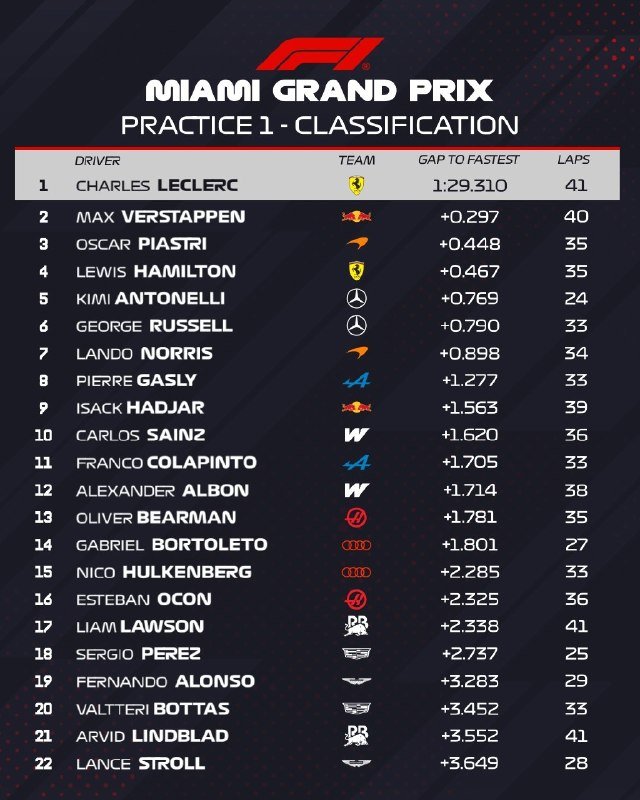
Charles Leclerc sent an early warning to his Formula 1 rivals on Friday, posting the fastest time in the only practice session available before Saturday's qualifying at the Miami Grand Prix. The Ferrari driver, who arrived in Florida with the team still searching for its first victory of the 2026 season, will take considerable confidence from topping the timesheets — but the sample size is small, the conditions unrepresentative of race trim, and the competitive order historically volatile between Friday running and Saturday grid positions.
The result marks a welcome reversal for a Ferrari outfit that has struggled for consistent race pace across the opening rounds. Leclerc's MCLu00e9andre teammate, Lewis Hamilton, has also shown flashes of competitive pace but has yet to convert qualifying promise into a podium finish with his new team. Friday's running offered both drivers valuable track time on a circuit known for its unique mixture of low-grip surface, aggressive kerbs, and the unpredictable coastal weather that can shift brake temperatures and tyre degradation profiles mid-session.
Whether Leclerc's practice benchmark translates into a genuine fight for pole position will depend on variables that practice sessions rarely expose fully. The Miami circuit's layout rewards rear-end stability through its high-speed corners and demands a precise throttle map through the technical second sector. Ferrari's SF-26 chassis has shown a tendency to be sensitive to rear tyre temperature — a characteristic that can appear manageable in cooler evening conditions but becomes a handful under the full Florida sun. Saturday's qualifying window opens at a different time of day, meaning the thermal environment Leclerc encountered on Friday may not replicate itself when the grid is decided.
What Ferrari's Friday Pace Actually Tells Us
Raw lap times from practice sessions are notoriously unreliable predictors of qualifying performance. Teams use Friday running primarily for tyre comparison work, setup exploration, and aerodynamic mapping — objectives that often deliberately sacrifice single-lap pace in favour of broader data collection. Leclerc's P1, while encouraging, should be read as a directional signal rather than an emphatic statement of speed advantage.
That said, the fact that Leclerc was quickest across a session designed to elicit data rather than headlines matters. It suggests Ferrari has identified a genuine step in the SF-26's setup philosophy and that the gap to the front-running McLaren and Red Bull cars — who have dominated the early-season narrative — may have narrowed. Whether that narrowing is structural or session-specific remains to be tested across Saturday's qualifying runs and Sunday's race distance.
Championship Context and the Hamilton Variable
Leclerc enters the Miami weekend fifth in the drivers' championship standings, forty-one points behind the leader, Max Verstappen. The gap is not insurmountable — seventeen races remain after Miami — but Ferrari's failure to win any of the opening six rounds has allowed the Dutchman's Red Bull outfit to establish a buffer that compounds with each race weekend. Leclerc's task is straightforward in formulation but brutal in execution: finish ahead of Verstappen consistently while Ferrari outscores Red Bull across the remaining rounds. Friday's practice time does not advance that arithmetic, but it prevents the weekend from beginning with a deficit in the data column.
Hamilton's integration with Ferrari has been the subplot of the 2026 season so far. The seven-time world champion switched from Mercedes during the off-season and has publicly described the SF-26 as a machine requiring a different driving philosophy than the cars he mastered in his previous life. His practice positions on Friday were not disclosed in the available session data, making it difficult to assess whether Ferrari's single-lap improvement is Leclerc-specific or part of a broader car-wide gain. That distinction matters enormously for Ferrari's race strategy: a one-driver pace spike suggests a setup direction that might not suit Hamilton's natural rhythm, while a car-wide improvement would indicate Ferrari has found a genuine chassis balance breakthrough.
The Miami Market and the Business of F1
The Miami Grand Prix is, by any honest measure, a manufactured event. The circuit occupies a purpose-built layout around the Hard Rock Stadium in northern Miami-Dade County, a venue that has no historic connection to motor racing and whose primary commercial logic rests on the Florida market's appetite for premium sporting entertainment. The race was introduced in 2022 as part of Formula 1's deliberate expansion into the American market — an effort that has yielded measurable returns in television audiences, merchandise sales, and the celebrity-adjacent cultural cach\u00e9 the event has cultivated.
The business case for Miami is sound from Formula 1 Management's perspective: American corporate sponsors pay a premium to associate with the event, ticket prices at the circuit have remained among the highest on the calendar, and the paddock presence of high-profile entertainment industry figures generates a media halo that extends beyond conventional motorsport coverage. That the racing itself has produced compelling moments — including a dramatic 2023 race decided in the closing metres — gives the commercial operation a sport to sell. Whether the racing merit justifies the entry fee paid by spectators is a question the sport prefers not to publicise, but one that surfaces with some regularity in fan forums and among those who note that the track's layout offers limited overtaking opportunities and rewards defensive driving over genuine competition.
What Comes Next and Why It Matters
Leclerc's Friday benchmark sets up a Saturday qualifying session that will determine whether Ferrari's practice pace is reproducible under competitive pressure. The qualifying format — a knockout system across three sessions — rewards committed single-lap performance and exposes any lingering weakness in rear-end traction. If Leclerc can convert practice speed into a front-row grid slot, the narrative around Ferrari's season shifts: from a team gradually closing the gap to one genuinely threatening for victory.
Hamilton's parallel pursuit will be equally instructive. If the British driver can match or beat his teammate across the three qualifying sessions, Ferrari faces a welcome tactical problem: two cars capable of challenging at the front, a scenario that has eluded the team throughout the early-season rounds. A Ferrari front-row lockout would represent not just a symbolic win but a practical one — it would give the team strategic options in the race that a solitary front-running car cannot offer.
For the championship, the Miami round represents a checkpoint rather than a decider. Verstappen leads, but his Red Bull has not looked untouchable across all circuit types — a fact the chasing pack has noted. A Leclerc victory on Sunday would not mathematically alter the championship equation, but it would alter its psychology: it would demonstrate that Ferrari can convert practice pace into race wins, a psychological barrier that has plagued the team since its last championship in 2008. The drivers' and constructors' battles will not be settled in Miami. But they can be meaningfully joined.
This desk noted that the wire services framed Friday's running as a straightforward Leclerc result. The structural context — Ferrari's winless start, Hamilton's integration challenges, the championship arithmetic — received less prominent treatment in the initial coverage.
Wire provenance
This editorial synthesis draws on the following public wire/social posts:
- https://t.me/formula1/10542