The Mechanics of Martyrdom: How Iran's State Media Constructs Revolutionary Memory
State-aligned Telegram channels like Farsna offer a window into how Iran's information apparatus builds and sustains revolutionary mythology — but the construction techniques reveal as much about domestic anxieties as they do about intended messaging.
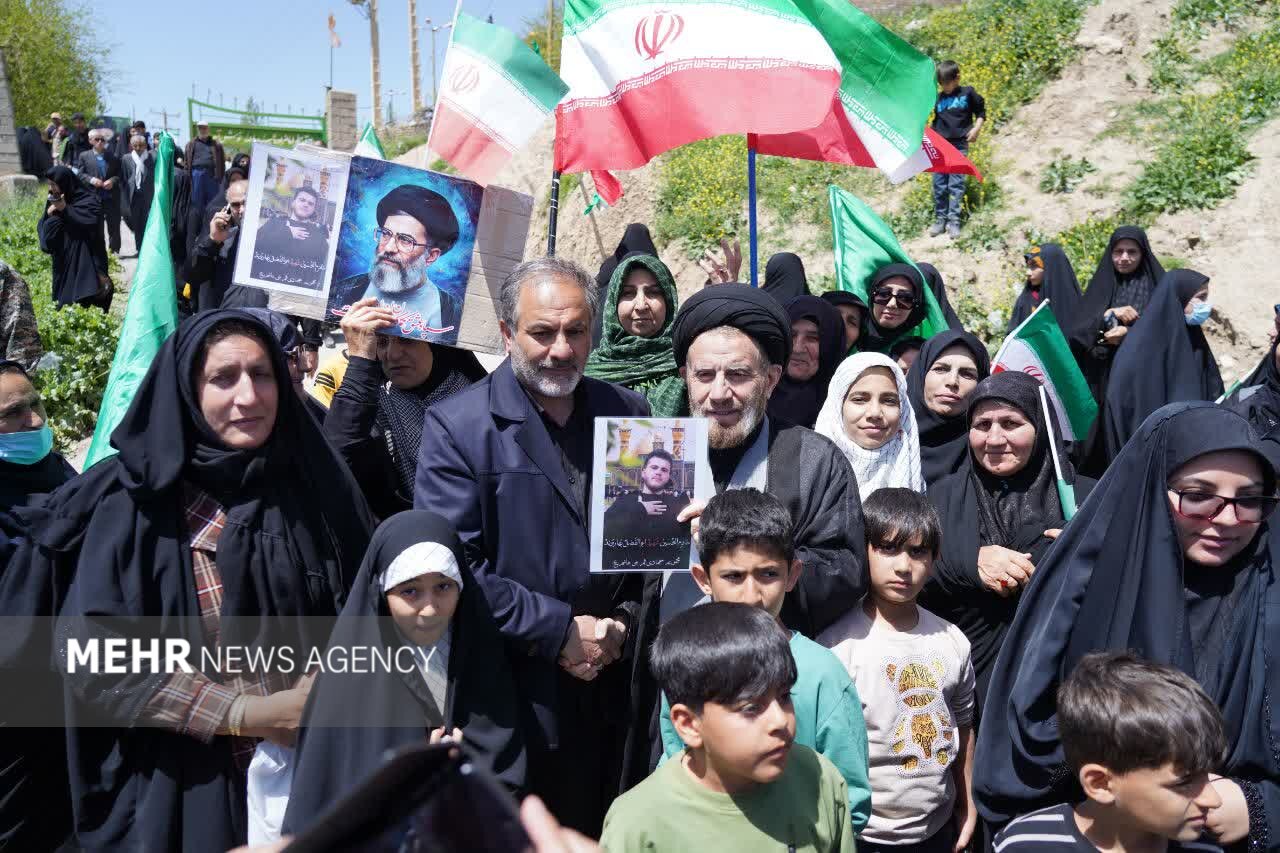
On 1 May 2026, a Telegram channel called Farsna posted three separate pieces of video content within the span of roughly 40 minutes. One revisited the Elamites — an ancient Iranian civilization — through the lens of revolutionary continuity. Another offered a documentary-style narrative about the Basij paramilitary force, structured around the stories of young volunteers and culminating in the martyrdom of Qasem Soleimani. A third showed footage of the capital's residents re-sharing a song of unity. Each post operated independently. Together, they form a coherent information architecture.
This is not accidental. State-aligned media operations in Tehran operate on a rhythm that Western analysts frequently underestimate: not the blunt megaphone of regime propaganda, but a curated system of meaning-making that feeds specific narratives to specific audiences at specific moments. Farsna's 1 May output illustrates the technique with unusual clarity because it was released in concentrated form, allowing observers to see the seams.
The Architecture of Hero Construction
The Soleimani segment warrants particular attention because it demonstrates how Iran's information apparatus transforms a real military commander into something closer to a theological figure. The piece did not simply document Soleimani's career or death. According to the Farsna content, it framed his killing in 2020 as a watershed moment that demands continued response — positioning current IRGC operations as fulfillment of a martyr's unfinished mandate rather than independent strategic choices by living commanders.
This matters because the construction technique has domestic and export dimensions. Inside Iran, it reinforces regime legitimacy by tying current policy to heroic sacrifice. Abroad, in the Shia populations of Iraq, Lebanon, Yemen, and the Gulf states, it offers a narrative framework that personalizes IRGC activity as moral obligation rather than geopolitical calculation.
Western wire coverage rarely unpacks these construction mechanics. Reporting from Reuters and the AP tends to treat Iranian state media output as monolithic propaganda without examining the specific rhetorical choices, the temporal patterns of release, or the audience segmentation evident in parallel content streams. The result is coverage that acknowledges Iranian messaging exists while remaining largely descriptive about how it functions.
Unity as Instrument
The third Farsna post — the song of unity — addresses a different audience concern: social cohesion. Post-2022 protests, the Mahsa Amini movement, and subsequent crackdowns created a documented fracture in the regime's claims to represent popular will. State media's response has not been to suppress discussion of that fracture but to overshadow it with a parallel narrative of collective purpose.
Songs of unity are not new tools in authoritarian communication arsenals. The Soviet Union deployed mass choral works; North Korea's state media regularly features collective singing as a legitimizing signal. What distinguishes the Iranian variant is the specific cultural vocabulary it draws from — religious symbolism, revolutionary history, and pre-revolutionary Persian civilization are layered together to create a composite identity that predates and transcends the 1979 revolution. The Elamite reference in Farsna's first post is the most explicit example: it reaches back 3,000 years to position current Iranian nationalism as continuous with an ancient civilization rather than a product of 20th-century political events.
This matters for readers outside Iran because it suggests that Western policy assumptions about the regime's legitimacy — assumptions often built around protest participation as a metric — may be measuring against the wrong baseline. A population that expresses dissatisfaction with economic conditions or morality police enforcement may simultaneously hold deeply internalized ideas about civilizational continuity that the regime is specifically targeting.
What the Sources Cannot Tell Us
The Telegram posts from Farsna do not include engagement metrics, view counts, or algorithmic distribution data. Independent analysts have estimated that Iranian state-aligned Telegram channels reach audiences in the millions across the region, but precise audience composition — whether viewers are predominantly inside Iran or in diaspora communities, whether the content is shared primarily among supporters or also among opponents seeking to monitor regime messaging — remains contested. The sources reviewed here offer the content; they do not offer the audience's reception.
Similarly, the posts do not reveal editorial decision-making. Whether the 1 May release timing corresponded to a specific domestic event, an external geopolitical development, or an internal IRGC communication strategy cannot be determined from the content alone. The sources must be read as artifacts of an information operation whose full scope exceeds what any single day's output can illustrate.
The Takeaway for Outside Observers
Iran's state media apparatus is often discussed as if it were a single mechanism — a megaphone held by the supreme leader. The Farsna posts from 1 May suggest something more distributed: a system that produces layered content targeting distinct anxieties (martyrdom, unity, civilizational continuity) through distinct formats (documentary, archival imagery, participatory media) on platforms chosen for their regional reach.
For Western analysts and policymakers, the implication is that monitoring Iranian state media requires more than tracking press releases or counting missile tests. It requires understanding the specific narratives being constructed, the rhetorical techniques being deployed, and the audiences being addressed — before drawing conclusions about what the regime intends or what the population believes.
The Elamite reference alone suggests a historical depth that most Western coverage of Iran does not engage with. Whether readers find that depth compelling, dismissive, or irrelevant likely depends less on the content itself than on where they already stand in relation to the civilizational argument it is quietly advancing.
This publication has previously covered Iranian state media operations across multiple briefing cycles; the Farsna output reviewed here is consistent with patterns observed since 2023.
Wire provenance
This editorial synthesis draws on the following public wire/social posts:
- https://t.me/Farsna/11234
- https://t.me/Farsna/11233
- https://t.me/Farsna/11232