Trump's Iran Gambit and the Unraveling Atlantic Alliance
The President's declaration of war on Iran comes wrapped in domestic applause and allied alarm. Meanwhile, the withdrawal of 5,000 US troops from Germany signals something deeper than a tactical reshuffle — it is a structural break with the post-war order.
At a campaign-style rally on the evening of 1 May 2026, President Donald Trump confirmed what intelligence briefings had long telegraphed: the United States had commenced military operations against Iran. "We're in a war because, I think you would agree, we can't let lunatics have a nuclear weapon," Trump told the assembled crowd, to thunderous applause. The declaration was unambiguous in its domestic framing — a preventive strike justified by proliferation risk — but it landed in European capitals with the force of a diplomatic detonation.
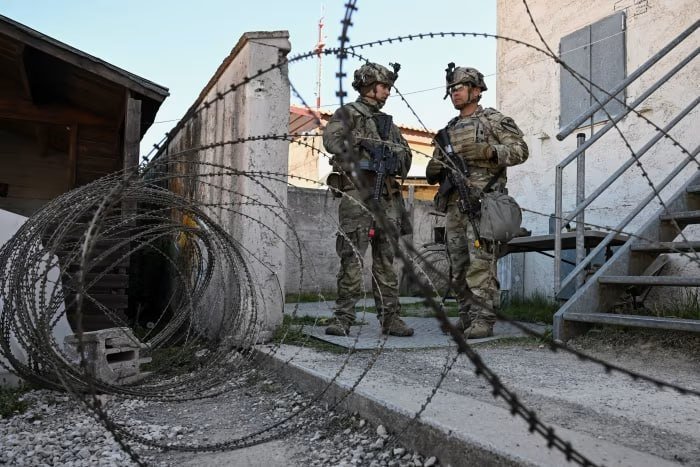
Within the same hour, the Pentagon confirmed a separate but related move: the withdrawal of 5,000 US troops from Germany, effective immediately. The timing was not accidental. Reuters reported the drawdown as "an apparent US rebuke to the close NATO ally amid a widening rift between President Trump and Europe over the Iran operation." Berlin had, earlier that day, registered its most forceful objection yet. Germany's Vice Chancellor Sigmar Gabriel publicly condemned what he called Trump's "anti-Iran strategy" and urged, according to Press TV's coverage of German government communications, "a quick end to war of aggression."
Three developments, one evening, one unmistakable signal: the transatlantic alliance that anchored Western security architecture for eighty years is under its most deliberate stress test yet.
The Military Calculus — What the Moves Mean
The Iran operation, as described by Trump's remarks, targets the Islamic Republic's nuclear programme at its source. No formal congressional authorisation has been confirmed in the available record; no United Nations Security Council resolution has been cited. The legal basis, if any, remains undefined by the statements released to wire services as of 22:00 UTC on 1 May.
The troop withdrawal from Germany is structurally distinct from the Iran strikes but politically inseparable from them. The 5,000 personnel represent a meaningful fraction of the roughly 35,000 US troops currently stationed in Germany under the NATO posture established after World War II. Their departure is not a rotation — it is a reduction. The message is not that the United States is leaving Europe, but that it is leaving on its own terms, without consultation, and in a manner that reads as punitive.
Gabriel, speaking for the German coalition government, drew the sharpest possible line. His characterisation of the Iran operation as a "war of aggression" is a term of art in international law — it denotes a use of force without Security Council authorisation and without the consent of the state targeted. Under the UN Charter, wars of aggression are a crime under the jurisdiction of the International Criminal Court. Gabriel was not speaking off-script. His statement reflected a considered German government position.
The Alliance Fracture — Deeper Than Diplomatic Routines
It is tempting to read Gabriel's criticism as the latest entry in a long catalogue of transatlantic friction — predictable, cyclical, manageable. That reading would be wrong. The difference this time is structural: Germany's objection is not to a policy detail but to the premise that the United States retains the right to act alone.
Every major military intervention since 1945 in which the United States engaged European allies — Korea, the Gulf War, Yugoslavia, Libya, the sustained campaign against ISIS — involved some degree of allied buy-in, however grudging. The Iran operation has none of that scaffolding. There is no coalition. There is no NATO invocation. There is no allied burden-sharing arrangement. Germany, France, and the United Kingdom — the three European powers with the most sophisticated intelligence penetration of the Iranian programme — were not consulted in any fashion that has been made public.
That omission is the story. It suggests that the unilateralist posture visible in trade negotiations, in NATO spending disputes, and in the abandonment of climate agreements has now fully extended into the domain of military force projection. The Atlantic alliance, in this framing, is not a partnership. It is a convenience that the United States will use when it serves domestic political interest and discard when it does not.
European capitals have registered this before. What they have not had to contend with is the coincidence of a military operation in the Middle East with an open, public rupture in the northern European posture. The troop withdrawal is not merely a diplomatic signal. It is an operational degradation of the alliance's forward presence. Germany hosts the largest US military footprint in Europe; it also hosts the headquarters of US Army Europe and Africa. Pulling 5,000 troops from that base structure is not a symbolic gesture. It degrades real capability.
The Dollar Dimension — Sanctions, Energy, and Financial War
The available record does not specify what economic instruments accompany the military operation. But the structural logic of US-Iran confrontation offers a clear guide. Previous rounds of maximum-pressure sanctions — the 'maximum pressure' campaign launched in 2018 — targeted Iran's oil exports, its banking sector, and its access to dollar-denominated commerce. Those sanctions already had the effect of forcing Tehran toward bilateral trade arrangements denominated in non-dollar currencies, particularly with China and, to a lesser extent, India.
A new military operation escalates the financial dimension. Any strike on Iranian nuclear infrastructure would, under existing statutory frameworks, trigger immediate secondary sanctions on every entity — Chinese, Turkish, Emirati, Indian — that continues to transact with sanctioned Iranian sectors. The effect would be to force a binary choice: do business with Iran and lose access to the US financial system, or exit Iranian commerce entirely.
This is the leverage the dollar system provides, and it is leverage that no other country possesses. But it is also leverage whose repeated use has accelerated a structural shift already underway: the diversification of reserve holdings, the growth of bilateral currency-swap arrangements, and the quiet build-out of alternative payment systems outside SWIFT. Each cycle of dollar weaponisation pushes more states toward hedging. The more the United States uses financial sanctions as a first-order instrument, the faster the erosion of the system that makes those sanctions effective.
What Comes Next
The immediate trajectory is unpredictable in its particulars but clear in its direction. An Iran operation without allied support degrades the intelligence picture — allied agencies had better access to Iranian nuclear sites than the United States operating alone. It degrades the legal-political cover — a coalition is not merely a diplomatic nicety but a legal shield against claims of illegality that can complicate post-conflict reconstruction and reparations claims. And it degrades the long-term alliance calculus in ways that will not reset when the bombing stops.
Germany has signalled its intention to push back. The language of "war of aggression" is a legal and political gauntlet. It is unclear whether Berlin will move beyond statement into formal action — a referral to the International Court of Justice, a diplomatic recall, a suspension of NATO contributions. What is clear is that the assumption of allied solidarity, which underpinned eight decades of European security policy, can no longer be treated as automatic.
The troops leaving Germany are not coming back as a matter of course. A decision made unilaterally will require a unilateral reversal to undo — and the political conditions for that reversal do not currently exist. What the world witnessed on 1 May 2026 is not a single policy choice. It is the structural consequence of a sustained approach to alliance management that treats relationships as transactions rather than commitments.
This report was filed from London. Monexus covered the Germany withdrawal as a bilateral rupture rather than a NATO internal matter, reflecting the severity of the public language employed by the German government.
Wire provenance
This editorial synthesis draws on the following public wire/social posts:
- https://t.me/BellumActaNews/
- https://t.me/presstv/
- https://x.com/reuters/status/