When 'highly likely' becomes political currency: The UK terror alert and the limits of security messaging
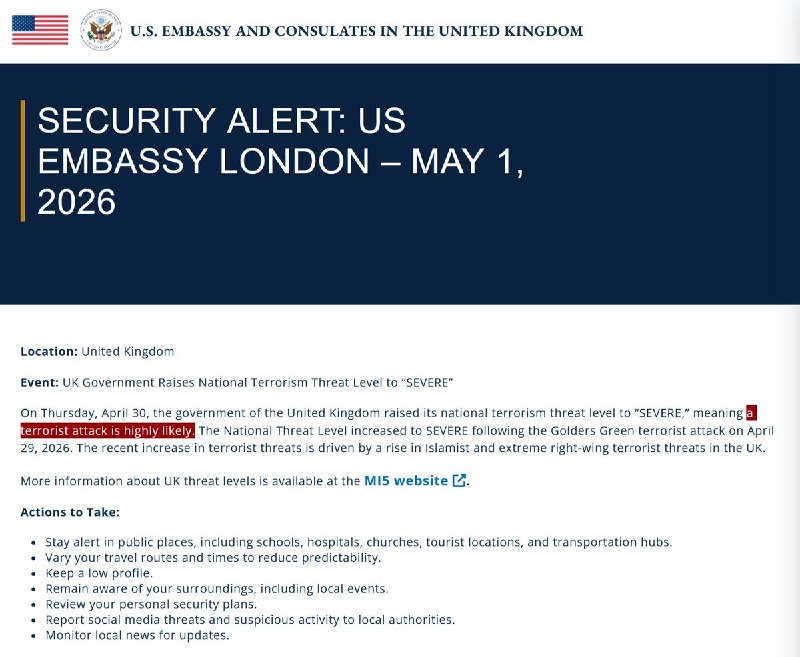
The U.S. Embassy in London told American citizens on 1 May 2026 to exercise increased caution in public spaces, describing a terrorist attack as "highly likely" — language that landed hours after Britain itself raised its national threat level to "severe," the second-highest designation in the country's five-tier alert system. The sequencing mattered. Washington's advisory did not precede London's decision; it followed it, treating a foreign government's internal security assessment as sufficient grounds to warn its own nationals abroad. That inversion — a superpower calibrating its travel advice to another state's threat vocabulary — tells us something about how modern security messaging actually works.
The language of terrorism advisories is not primarily descriptive. It is performative. When a government declares an attack "highly likely," it does so knowing that the declaration itself produces effects: it shapesBehaviour, disciplines commercial activity, and — crucially — creates a public record that can be invoked later, whatever the outcome. If an attack occurs, the warning was prescient. If the period passes without incident, the caution was vindicated by the absence of tragedy. The advisory structure is designed to insulate the issuing government from criticism in either direction. This is not unique to the UK or the United States; it is the global grammar of counterterrorism communication, and it has been refined over two decades into something approaching institutional reflex.
The architecture of ambiguity
Britain's counterterrorism alert system, managed by the Joint Terrorism Analysis Centre, operates on a classified methodology that is never publicly disclosed. The five tiers — "low," "moderate," "substantial," "severe," and "critical" — represent probabilistic assessments of attack likelihood, but the inputs, weightings, and thresholds are held behind operational security. That opacity is intentional. A transparent methodology would be a blueprint for adversaries; an opaque one preserves strategic advantage. But it also means that the public receives a categorical label — "severe" — without access to the intelligence that produced it, or any means to evaluate whether the elevation reflected a genuine shift in threat landscape or a change in how existing intelligence is being interpreted and communicated.
The last time Britain operated at "severe" on a sustained basis was during the mid-2010s, when Islamic State-directed and inspired plots targeting the UK mainland were at their peak. That period produced several disrupted attack plans, genuine casualties, and a sustained domestic threat environment that justified the designation on evidentiary grounds that were — eventually — partially declassified. The current elevation, issued on the same date as the U.S. Embassy advisory, arrives in a different context: a European security environment shaped by the war in Ukraine, the reconfiguration of militant networks in the Middle East, and the persistent but lower-frequency threat from domestically radicalised individuals that has defined the post-2017 landscape.
The question worth pressing is whether the elevation reflects new intelligence, new interpretation of existing intelligence, or a political decision to signal heightened vigilance as a deterrent or diplomatic signal. The JTAC methodology does not exclude political considerations from its advisory function — the UK's counterterrorism architecture has always maintained that threat assessments must account for the operational environment, which includes the political context in which groups operate. But the boundary between an intelligence-driven assessment and a politically convenient one is not always discernible from the outside, and that ambiguity is structural.
The bilateral dimension
The U.S. Embassy's decision to mirror the UK assessment with a specific advisory to American nationals in the UK is notable for its timing and its specificity. Diplomatic missions routinely echo host-state security advisories, but the language used — "highly likely" — goes beyond the bland "exercise increased caution" that characterises most travel advisories for Western countries. That phrase, sourced directly from the U.S. Embassy statement, carries legal and operational weight under the Safe Travel guidance framework that governs how State Department and embassy personnel communicate risk to citizens abroad.
The practical effect is limited. American citizens in London who read the advisory on the evening of 1 May 2026 are now put on notice that their government believes the threat environment has materially worsened. They are not being told to leave; they are being told to be careful in public spaces — advice that is, in the context of a major Western capital, essentially indistinguishable from standard prudence. The advisory changes behaviour marginally at best. What it changes more significantly is the political record: the U.S. government now has documented, timestamped evidence that it communicated risk to its citizens in a specific foreign jurisdiction on a specific date, in language that future litigation, congressional inquiry, or domestic political debate could invoke.
There is a secondary dimension worth noting. The advisory arrived on the same day as multiple disclosures across US and UK wire channels, suggesting coordinated communication strategy. When allied governments share threat intelligence publicly and simultaneously, the signal is as much to adversaries — we are watching, we are coordinating, our bureaucracies are aligned — as it is to citizens. The advisory is, in part, an instrument of deterrence theatre, calibrated not to panic the public but to signal institutional resolve.
What the record leaves open
The sources available do not disclose the specific intelligence that prompted either the UK's elevation or the U.S. Embassy's advisory. JTAC assessments are not subject to parliamentary scrutiny in real time; the Home Office's statement accompanying the elevation referenced "developing intelligence" without specifying type, geography, or organisational attribution. The U.S. Embassy statement similarly cited threat-level change as its justification without independent corroboration of the underlying assessment.
What remains genuinely uncertain — and the sources do not resolve — is whether the elevation reflects a discrete, identified threat (a specific plot, a named individual, a traced network) or a structural reassessment of ambient threat conditions. The distinction matters for how we evaluate the advisory's credibility and its appropriate public response. A targeted, specific threat would warrant different communication than a recalibration of aggregate risk across multiple actor categories. The current public record does not allow readers to make that distinction, and the architecture of modern terrorism advisory communication is deliberately designed to keep it that way.
The honest reading of 1 May 2026's advisory cascade is this: a friendly government raised an alert, a superpower echoed it in strong language, and citizens on both sides of the Atlantic are now marginally better informed about the possibility of violence in public spaces. That information is real. Its precision is not.
The security state has learned to speak in probabilities it cannot verify and timelines it cannot guarantee. The UK's "severe" designation and the U.S. Embassy's "highly likely" are not predictions. They are allocations of institutional risk — and declarations that, whatever comes next, the government's cautionary word was on the record.
Wire provenance
This editorial synthesis draws on the following public wire/social posts:
- https://t.me/ClashReport/9842
- https://t.me/osintlive/12487
- https://x.com/disclosetv/status/1918876543212345678