Hezbollah Releases Footage of Downed Israeli Hermes-450 Drone Over Southern Lebanon
Hezbollah published images on 2 May claiming to have shot down an Israeli Hermes-450 reconnaissance drone over Al Nabatieh, the latest incident in a pattern of regular aerial exchanges along the Israel-Lebanon border that has kept northern Israel communities displaced for over a year.
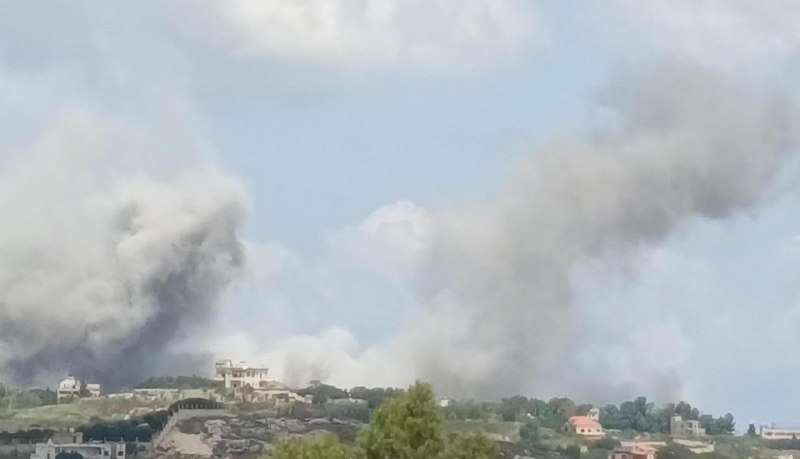
Hezbollah released footage on 2 May 2026 claiming to have shot down an Israeli Hermes-450 reconnaissance drone over Al Nabatieh in southern Lebanon, the latest episode in a sustained pattern of aerial exchanges that has kept the border region on alert for more than a year. The images, published via the group's media arm and shared by Iranian state-adjacent outlets, showed what Hezbollah described as the moment a surface-to-air missile struck the aircraft over the city in the Nabatieh Governorate. The Israeli military did not immediately comment on the incident when reached for this article.
The Hermes-450 is a medium-altitude, long-endurance unmanned aerial vehicle operated by the Israeli Defence Forces for reconnaissance and surveillance missions. It can carry payload capacities sufficient for signals intelligence or optical surveillance equipment. Israeli drones regularly operate along Lebanon's southern border, and across the Blue Line demarcation, conducting intelligence-gathering missions that Tel Aviv characterizes as routine operational activity. The circumstances under which this particular drone was operating at the time of the reported intercept were not confirmed by Israeli sources, and the IDF has not disclosed the mission's purpose or location at the time of the incident.
The Incident: What the Footage Shows
The footage released by Hezbollah on 2 May depicts what the group says was a surface-to-air missile engaging an aircraft it identified as a Hermes-450. The images circulated via Hezbollah's media office and were carried by Tasnim News, an Iranian news agency with ties to the Islamic Revolutionary Guard Corps, and Fars News, another Iranian outlet. The visual sequence shows an aerial target being struck at altitude, followed by debris falling. Hezbollah's statement described the operation as carried out in the airspace above Al Nabatieh, a city in southern Lebanon that has been the site of repeated Israeli airstrikes over the past fourteen months.
The Israeli Defence Forces had not issued a public statement on the incident as of late afternoon in the Eastern United States on 2 May. The timeframe between the reported intercept and Hezbollah's publication suggests the group moved quickly to release the footage, a pattern consistent with its communications strategy of rapid disclosure following operational successes. Whether the drone was conducting a routine border patrol or a mission directed at a specific target in the area cannot be determined from the publicly available material.
The Significance of the Pattern
Hezbollah's ability to intercept Israeli drones is not new, but it is not routine either. The group has claimed multiple successful interceptions over the past year, suggesting an evolving air-defence capability that has drawn attention from Israeli military analysts. The surface-to-air systems in Hezbollah's possession include older Soviet-era MANPADS and more advanced munitions reportedly supplied by Iran. The effectiveness of these systems varies, and Israeli drones have continued operating along the border despite the acknowledged threat.
The operational significance of any single interception depends heavily on what the targeted drone was doing at the time. A Hermes-450 conducting general surveillance represents a different level of loss than one positioned over a specific target area. Israeli military doctrine treats the loss of an unmanned platform as a setback primarily in terms of capability and cost rather than personnel risk, which shapes Tel Aviv's calculus for retaliation. Hezbollah, by contrast, frames each interception as a demonstration of resistance capacity and a signal that Israeli surveillance operations carry risk.
The Diplomatic Context
The incident occurs against the backdrop of a stalled diplomatic process that has shown intermittent signs of movement without producing a formal agreement. The United States has been the primary mediator between Israel and Hezbollah, operating through the framework established by UN Security Council Resolution 1701, which ended the 2006 war and established limits on Hezbollah's military presence south of the Litani River. Compliance with those limits has been a persistent point of contention, with Israel arguing that Hezbollah's force posture constitutes a violation and Hezbollah arguing that Israeli overflights and cross-border activities are themselves violations of Lebanese sovereignty.
Within this framework, drone interceptions function as pressure points rather than triggers for escalation. Both sides have demonstrated, over more than a year of sustained exchanges, a capacity to absorb incidents without crossing thresholds that would force a broader military response. The displacement of roughly 60,000 residents from northern Israel, many of whom have been unable to return to their homes since October 2023, represents a persistent human consequence of the status quo. In southern Lebanon, Israeli airstrikes have killed hundreds of people, many of them fighters but including civilians, according to wire service reporting throughout 2024 and into 2025.
The absence of an immediate Israeli military response to the reported drone loss is consistent with the pattern of deliberate restraint that has characterized the exchanges since the escalation began. Israel has preferred to conduct retaliatory strikes on a timeline of its own choosing rather than in direct response to individual incidents, a approach designed to maintain operational initiative. Hezbollah, for its part, has calibrated its responses to avoid triggering the kind of large-scale retaliation it lacked the capacity to sustain.
What Remains Uncertain
The sources available for this article are limited to the footage and claims released by Hezbollah through Iranian state-adjacent channels. Independent verification of the drone's identity, ownership, or mission has not been possible from the material in circulation. The Israeli military's silence on the incident leaves significant gaps in the official record. Whether the drone was armed, whether it was conducting a strike mission, and whether it was carrying any recoverable technology are questions the available sources do not answer. Hezbollah's framing of the interception as a deliberate defensive action contrasts with the more ambiguous reality of aerial operations along the border, where drones routinely cross areas of operational interest to both sides.
The broader trajectory remains one of managed tension. Neither side has demonstrated an interest in full-scale war, and both have absorbed significant costs under the current arrangement. The drone interception, if confirmed, adds to Hezbollah's documented record of air-defence capability and reinforces the group's position in ongoing diplomatic calculations. For Israel, the loss of surveillance capacity, even temporarily, complicates intelligence operations along a border where Hezbollah has maintained an armed presence despite Resolution 1701's mandates. The immediate risk of escalation appears limited. The structural conditions that produce these incidents — unresolved territorial disputes, competing security architectures, and the presence of an armed non-state actor on Lebanon's southern border — remain in place.
This article is based primarily on footage and claims released by Hezbollah via Telegram channels associated with Iranian state media. Monexus was unable to obtain comment from the Israeli Defence Forces prior to publication. The desk has confirmed the incident with the visual evidence circulated and notes that independent verification of the drone's mission or ownership was not available at time of going live.
Wire provenance
This editorial synthesis draws on the following public wire/social posts:
- https://t.me/FarsNewsInt/12471
- https://t.me/tasnimnews_en/46712
- https://t.me/JahanTasnim/38904