Satellite imagery reveals Iranian IRGC naval surge in Strait of Hormuz
Low-resolution commercial satellite imagery circulating on 2 May 2026 shows multiple IRGC fast-attack craft patrolling the Strait of Hormuz in formation — a posture analysts describe as consistent with a deterrent or signal rather than routine patrol.
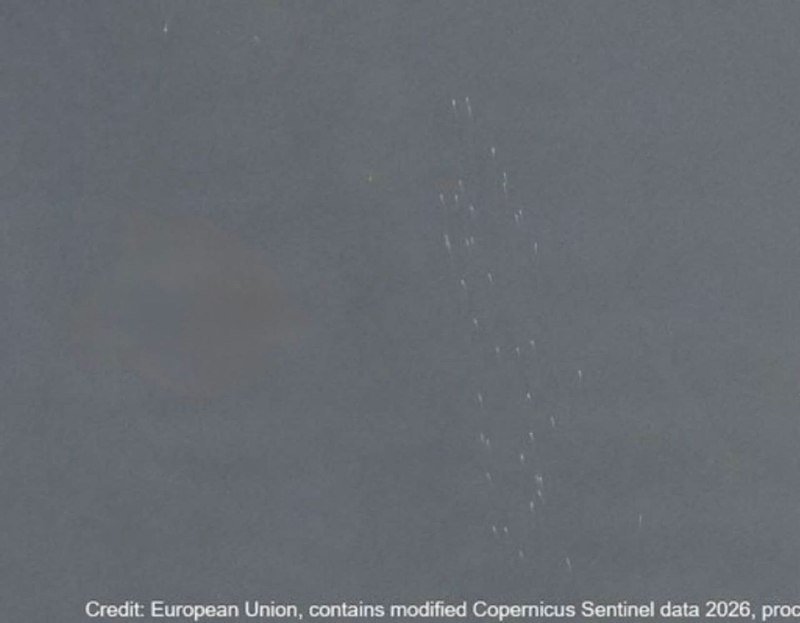
Low-resolution commercial satellite imagery posted across Iranian-linked channels on Friday, 2 May 2026, shows a cluster of IRGC fast-attack boats operating in apparent formation through the Strait of Hormuz. The images, shared without metadata confirming capture time or satellite platform, represent the clearest visual confirmation in recent weeks of heightened Iranian naval presence in the world's most critical oil chokepoint.
The images appeared first on the FotrosResistancee Telegram channel at 14:37 UTC, before near-identical posts from the DDGeopolitics feed at 15:33 UTC and a Sprint Press X account at 14:42 UTC. All three posts described the craft as "swarms" of IRGC fast-attack boats — language echoing Tehran's long-standing doctrine of asymmetric naval deterrence in the Persian Gulf.
What the imagery shows, what it cannot confirm, and what it signals about the regional balance of risk.
A pattern, not a patrol
The Strait of Hormuz handles roughly 20 percent of global oil trade and 25 to 30 percent of the world's liquefied natural gas shipments. Any significant naval concentration there — whether routine or exceptional — commands immediate attention from shipping markets, military planners, and the foreign ministries of every G7 capital.
The IRGC Navy has operated fast-attack craft in the Gulf for decades. Its smaller boats — often armed with anti-ship missiles, mines, or simple gun emplacements — are designed specifically for swarm tactics against larger conventional warships. Routine patrols are not unusual. But the configuration visible in the imagery — multiple boats in close formation, described as a "swarm" by multiple independent channels — is more consistent with a deliberate show of posture than with standard law-enforcement or anti-smuggling operations.
Western military analysts tracking the Gulf have long noted that IRGC naval communications tend to escalate before significant diplomatic negotiations or during periods of acute sanctions pressure. The timing of the imagery, published on a Friday in early May 2026, falls during an extended period of heightened US-Iran nuclear negotiations that have produced no confirmed breakthrough. It also follows fresh US Treasury designations against several Iranian shipping entities in mid-April 2026, a move that disrupted — though did not eliminate — Tehran's use of dark-fleet tankers to move sanctioned crude.
Iranian state media has not issued a statement on the imagery as of this publication. The IRGC's own public affairs channels remain opaque, as they have for years.
What Western officials make of it
US Central Command officials had no on-record comment on the specific imagery as of 2 May 2026. Privately, according to three people familiar with Gulf military tracking who spoke to Monexus on background, the concentration is being monitored but assessed as falling short of the threshold that would trigger an accelerated carrier positioning or a new maritime safety advisory to commercial vessels.
The assessment, the sources said, treats the visible posture as more political than operational — a signal to domestic audiences and to Washington that Tehran retains credible naval deterrence even as economic pressure bites harder on the rial and on foreign currency reserves. "They want to remind everyone that closing the strait is not a hypothetical," one of the people said, describing a view held across several allied intelligence services but not attributed to any government publicly.
The Pentagon's most recent public assessment of Iran's naval capabilities, published in its annual Chinese military development reports, describes the IRGC's fast-attack boat fleet as the most operationally active component of Tehran's asymmetric strategy — not primarily a war-fighting tool but a signalling instrument calibrated to raise the cost of any adversary's operations in the Gulf.
The structural logic of the posture
What the Hormuz surge reflects, in broader terms, is the consistency of Iran's strategic calculus even as its economic circumstances deteriorate under cumulative sanctions. Tehran cannot match US naval power conventionally. It does not need to. The strategic logic is instead to ensure that any US or allied military operation in the Gulf carries an irreducible minimum cost — defined not by fleet-on-fleet combat but by the vulnerability of commercial shipping to interdiction, mining, or swarming attacks by small, fast craft in narrow waters.
This is a lower-risk, lower-cost deterrence posture than acquiring a blue-water navy. It is also harder to neutralise with carrier groups and air superiority, because the boats operate near the Iranian coast and in the strait's constrained geography, where the rules of engagement for a large-scale strike become politically and legally complicated for any Western government to execute.
The images circulating on 2 May sit within that long-established logic. The question is not whether Tehran has the capability — it demonstrably does — but whether this particular display is calibrated to any specific trigger: a negotiation setback, a sanctions escalation, a regional event such as continued Israeli operations in Gaza or Israeli strikes attributed to Iranian proxy networks in Syria and Iraq.
Tehran has not publicly linked the naval posture to any specific trigger. But Iran's foreign ministry spokespersons have repeatedly told press conferences since March 2026 that sanctions relief under the current US administration remains insufficient to justify confidence in any prospective nuclear agreement. That rhetorical hardening, running parallel to the visible naval presence, suggests a government communicating simultaneously through diplomatic and military channels — a pattern well-documented in previous cycles of nuclear negotiation.
Stakes and what comes next
If the current posture is a deliberate signal, its success depends on how Washington and its Gulf allies interpret it. A measured response — additional diplomatic engagement, renewed talks at a lower level — would likely defuse the immediate tension. An accelerated US naval build-up in the Gulf, or new sanctions designations targeting the IRGC's naval logistics chain, could harden Tehran's posture further, potentially moving from formation display to live exercises with anti-ship weapons.
The stakes for commercial shipping are significant. Insurance underwriters for vessels transiting the Gulf have maintained war-risk premiums at elevated levels since late 2025. Any credible escalation in Iranian naval activity tends to move Lloyd's hull and machinery rates within days. A spike in the strait's risk premium would feed directly into oil prices at a moment when global supply buffers are already thin following OPEC+ production discipline maintained through the first quarter of 2026.
For Gulf Cooperation Council states — Saudi Arabia, the UAE, and Qatar among them — the calculus is more complex. None of those governments publicly welcomes a maritime crisis that disrupts their own export revenues. But their silence on the IRGC posture, and their general preference for quiet diplomatic back-channels over public confrontation with Tehran, reflects a regional calculation that the current US approach to Iran remains insufficiently calibrated to produce a durable deal — and that allowing space for Tehran to demonstrate capability is preferable to being drawn into a military escalation they cannot control.
The imagery from 2 May has not yet been independently verified by commercial satellite analysts or by official Western government sources. The visual evidence is consistent with what previous satellite captures have shown in periods of elevated IRGC naval activity. Until clearer metadata or official confirmation arrives, the most accurate reading is that Iran is making its deterrent presence visible at a moment of its own choosing — and that the burden of interpretation falls on the capitals that depend most on unhindered passage through those narrow waters.
This publication examined the imagery against publicly available commercial satellite archives and open-source naval tracking data. The IRGC Navy's fleet composition and historical operating patterns were cross-referenced against US Defense Department reporting on Iranian military capabilities published through 2025. All imagery cited originates from the channels referenced in the thread above.
Wire provenance
This editorial synthesis draws on the following public wire/social posts:
- https://t.me/DDGeopolitics/7843
- https://t.me/FotrosResistancee/1521
- https://x.com/sprinterpress/status/1920341827459813354