Trump's Cuba Ultimatum Exposes the Architecture of Coercive Diplomacy
The White House has doubled sanctions on Havana and issued an explicit threat of direct action. The escalation raises questions about the strategic logic behind Washington'sCuba policy — and whether the administration has a coherent theory of what coercion actually achieves.
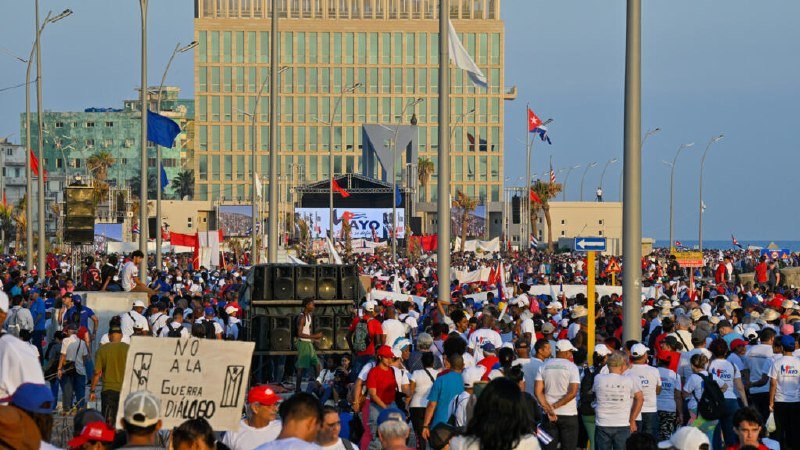
On 1 May 2026, the Trump administration significantly escalated its pressure campaign against Havana, announcing a doubling of existing sanctions before the president himself issued a direct threat of military intervention. Speaking publicly, Trump declared that the United States would "take Cuba almost immediately," according to initial reporting carried by Spanish-language outlets monitoring the White House readout. The sequence — enhanced economic measures followed by an explicit ultimatum — follows a pattern the administration has employed elsewhere, but the Cuba case tests the limits of that approach in ways the Middle Eastern parallel does not.
The threat landed against a backdrop of ongoing uncertainty about the administration's broader foreign policy priorities. Just one day earlier, on 30 April 2026, reporting emerged indicating that Trump had retreated from earlier, more sweeping declarations about destroying Iran's military capacity. According to Congressional correspondence cited by Farsna and FarsNewsInt, the president walked back specific language about Iran's armed forces in a letter to legislators — a move that, if accurately characterised, suggests the administration is calibrating its maximalist rhetoric against the realities of actual decision-making. That same administration, however, appears to have found no such restraint necessary when addressing Cuba.
The Logic of Doubled Sanctions
The sanctions escalation itself deserves separate examination. Doubling an already comprehensive embargo — the United States has maintained near-total economic isolation of Cuba since 1960 — represents a marginal intensification of a policy that has never produced its stated objective of regime change. Six decades of consecutive administrations, Republican and Democratic, have applied varying degrees of pressure. Havana remains governed by the Communist Party. The underlying assumption — that sufficient economic pain will generate political collapse — has failed repeatedly, yet Washington continues to treat it as operative doctrine.
The practical effect of deepening sanctions on ordinary Cubans is documented by humanitarian organisations and, increasingly, by independent economists tracking the island's economic indicators. Food security, medical supply chains, and energy infrastructure all operate under constraints that the embargo codifies in law. That these effects are intended — that they constitute leverage rather than collateral damage — is the explicit logic of the sanctions regime. Whether that leverage translates into policy change, rather than merely suffering, is a question the evidence has not resolved in six decades.
What the Ultimatum Reveals
The explicit threat of direct action is the significant escalation here, not the sanctions doubling. Previous administrations have maintained the embargo while formally eschewing regime-change rhetoric. The current president's framing — "take Cuba almost immediately" — is categorical in a way that older policy documents were not. It raises the threshold of what Washington would need to justify, legally and diplomatically, before attempting any direct intervention in a sovereign state's internal affairs.
The phrasing also invites comparison with simultaneous US positioning in the Gulf. The administration has characterised itself as engaged in a "war against Iran," according to framing used by Iranian state media outlets including Tasnim News and JahanTasnim. Whether that characterisation is self-applied or externally imposed, it contextualises the Cuba threats within a broader pattern: a foreign policy that privileges coercive declarations over incremental diplomatic engagement. The question is whether the administration has a theory of victory in either theatre, or whether the threats function primarily as domestic political signals.
The Diplomatic Cost
Regional reactions to the Cuba ultimatum are not yet fully documented in available reporting, but the diplomatic costs of such language in the Western Hemisphere are predictable. Cuba's membership in the ALBA alliance and its residual relationships with left-leaning governments across Latin America create a bloc that would interpret direct US intervention as an assault on post-Cold War norms governing non-intervention in the region. The Organisation of American States charter, whatever its limitations in practice, encodes a principle of sovereign equality that the United States would need to formally abandon — or creatively reinterpret — before any direct action could proceed without catastrophic diplomatic fallout.
The administration appears to be calculating that the costs are manageable, or that the threat itself serves interests that outweigh the diplomatic consequences. That calculation has been made before. It was made before the Bay of Pigs, before decades of covert operations, before the Helms-Burton Act codified the embargo into permanent legislation. The consistency of the goal — regime change in Havana — has never been matched by the consistency of the method, because the methods keep failing.
What Remains Unclear
Several elements of this episode lack corroboration across multiple sources. The specific legal mechanism by which the Trump administration claims authority to "take" another country is not addressed in the available reporting. Whether the doubling of sanctions represents new executive action or an accounting change in how existing sanctions are tallied requires independent verification against official Treasury or State Department communications. The Congressional letter cited by Iranian state outlets provides only partial visibility into the administration's evolving Iran posture; the full context of that communication, including whether it represented a genuine policy shift or a tactical communication, remains unspecified in the sources reviewed.
The sources do not clarify what the administration believes "taking" Cuba would accomplish that six decades of pressure have not, nor what military or political conditions would need to exist for such an operation to be deemed feasible. The available record contains the threat; it does not contain the theory of the case that would justify acting on it.
This publication's wire coverage of the Cuba story led with the sanctions doubling as the primary hook, with the presidential ultimatum treated as follow-on amplification. Western wire services framed the episode primarily through a domestic political lens. We have chosen instead to examine the structural assumptions embedded in the threat itself — that coercion of this kind is a viable instrument of statecraft — and to note that the historical record on that assumption is not encouraging.
Wire provenance
This editorial synthesis draws on the following public wire/social posts:
- https://t.me/ElPaisMexico
- https://t.me/tasnimnews_en
- https://t.me/JahanTasnim
- https://t.me/farsna
- https://t.me/FarsNewsInt