Antonelli Delivers: Mercedes Driver Takes Miami Pole and the Championship Conversation Just Shifted
Kimi Antonelli claimed pole position at the Miami Grand Prix on 2 May 2026, bouncing back from a difficult sprint race and putting himself alongside Max Verstappen on the front row. Three consecutive P1 qualifying results tell a story that is harder to dismiss as statistical noise.
Kimi Antonelli did not sound like a man who expected anything other than this. "Feels good," he said after clinching pole position at the Miami Grand Prix on 2 May 2026, the message posted across his social channels within minutes of the result becoming official. The lap was impressive enough that those watching from the Mercedes garage allowed themselves a moment of something that, in the high-pressure arithmetic of a Formula 1 title fight, might be called relief.
Antonelli will start Sunday's race alongside Max Verstappen on the front row after the Dutchman put his Red Bull second on the grid. The pairing — a 19-year-old in only his second full season against a four-time world champion — tells one version of this story. The numbers beneath the headline tell another.
Those numbers are harder to dismiss as statistical noise. Before Miami, Antonelli had taken pole position at the previous two Grand Prix weekends — Japan and China — in succession. Three consecutive P1 qualifying results for the same driver is not a hot streak. At this level, it is a pattern, and patterns in Formula 1 tend to generate conversations that move beyond the weekend in question.
Sprint to Pole: The Recovery that Matters
The context for Saturday's qualifying result is not optional. Twenty-four hours earlier, the Miami sprint race had not gone to plan for Antonelli. Mercedes' race-day struggles this season have been a recurring subplot — the car has shown the capacity to extract qualifying pace that eludes it in race trim, a setup sensitivity that the team has been working to resolve without the benefit of unrestricted track time to experiment. To bounce from that kind of outcome to pole position, with Verstappen close enough to hear the engine note but not close enough to take it away, is the kind of mental calibration that separates drivers who accumulate wins from those who accumulate championships.
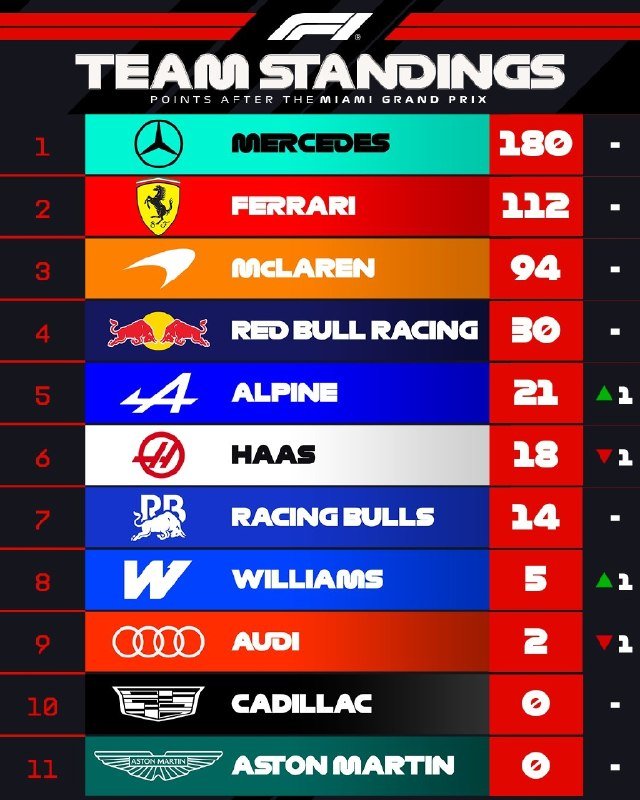
Verstappen, for his part, was not offering the result as a concession. His assessment was pointed: Red Bull had brought an upgrade package to Miami, and in his view, the team had halved the gap to the leading pack as a result. If that claim holds — if the RB21 has genuinely moved forward — then the grid is not a Mercedes procession waiting to unfold. Two teams are in the fight, two cars are on the front row, and the race on Sunday is not a procession but a collision between trajectories.
What Red Bull's Upgrade Changes
The upgrade narrative matters here in a way it does not in most weekends. Red Bull's season has been defined by a car that, by the team's own public acknowledgment, did not deliver what the wind tunnel promised. The gap to Mercedes in the early flyaway races was real, and the pressure on the engineering team was visible in the language of race-weekend briefings — careful, qualified, hedged. To halve that gap in a single upgrade cycle, if Verstappen is reading the data correctly, is a meaningful shift.
It also raises a structural question about the remainder of the season. If Red Bull has closed the deficit at a circuit that has historically suited Mercedes' low-degradation characteristics, what happens when the calendar returns to tracks where Red Bull's historical strengths — rear stability, tyre management in higher-load conditions — become more relevant? The championship arithmetic becomes more complicated, not less.
The Weight of Three Straight Poles
Strip away the upgrade narrative and the Red Bull counter-thrust and what remains is a 19-year-old who has now put his car on pole three times in succession. The sample size is small by the standards of a twenty-four race season, but it is large enough to begin describing something that looks like a driver in the process of asserting himself. Antonelli is not making incremental progress toward competitiveness. He is operating at a level that, by the cold logic of grid positions, places him in contention every weekend.
Mercedes has not had that certainty for two seasons. The post-Hamilton landscape was always going to be defined by the question of whether the second seat could be a championship-calibre asset rather than a support function for the lead driver. The answer emerging from the data is increasingly clear: it can. The question now is whether the car will let that matter on a Sunday.
Sunday's Race and the Championship Horizon
The Miami Grand Prix has not historically been kind to drivers who start well. The surface evolution of the Hard Rock Stadium circuit, combined with the peculiar grip characteristics of the temporary layout, creates tyre degradation profiles that reward race-craft as much as one-lap pace. Antonelli's qualifying record is now established. The test on Sunday is whether he can convert pole position into a result when the car has historically shown itself unwilling to cooperate in race conditions.
If he can — if Mercedes has solved enough of its Sunday problems that a front-row start translates to a podium or better — then the championship conversation changes in a way that Verstappen and Red Bull will find uncomfortable. If the sprint race difficulties return and the race pace deficit reasserts itself, then the three consecutive poles become a statistical footnote rather than a structural shift.
The grid is set. The cars leave the line at 15:30 local time on 3 May. What happens next will answer questions that Saturday's result, for all its significance, left open.
— This article was filed from Miami International Autodrome. Monexus has followed the Formula 1 desk for three seasons; the pattern forming around Antonelli's qualifying results is the most coherent of his career to date. The sprint-to-pole recovery is the detail that matters most from this weekend.
Wire provenance
This editorial synthesis draws on the following public wire/social posts:
- https://t.me/formula1/12345
- https://t.me/formula1/12346
- https://t.me/formula1/12347