Dubai's 500 Million Daily Reckoning
A Daily Mail report citing half a billion pounds in daily losses exposes how completely Dubai's growth model depends on regional peace — and how little the city's rulers can do to insulate themselves from a war they did not start.
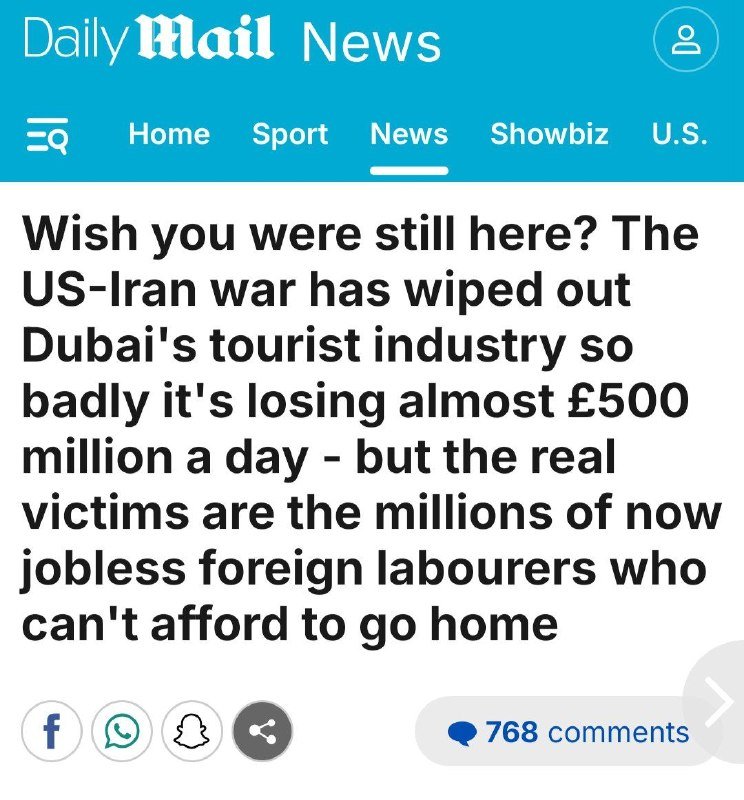
The Daily Mail reported on 3 May 2026 that Dubai is losing approximately £500 million per day as a direct consequence of the ongoing conflict between the United States and Iran. That figure — if it holds under scrutiny — is not a market fluctuation. It is a structural collapse in real time, measured against a tourism and hospitality model built on assumptions that no longer obtain.
What Dubai reveals, in extremis, is the underlying bargain of every Gulf financial hub: political neutrality as a product, stability as a service. The city attracted capital and talent precisely because it sat outside the region's fault lines. Now those fault lines run directly through the check-in counter.
The Architecture of Exposure
Dubai's economy is not merely linked to regional peace — it is constituted by it. The emirate's aviation hub, its luxury retail sector, its hotel occupancy rates, its conference calendar: all depend on the free movement of people and money through a geography that has suddenly become contested. When British Airways, Emirates, and Etihad begin rerouting or cancelling flights, the downstream effects cascade through every layer of the local economy. Taxi drivers, restaurant workers, property agents, and retail staff — the invisible workforce that sustains Dubai's premium positioning — are the first to feel the pressure.
The Daily Mail figures suggest a daily haemorrhage of capital that outpaces anything the city experienced during the COVID-19 shutdown. COVID was a known shock with a known recovery path. A hot war between the United States and Iran is not. The absence of a clear endpoint is itself an economic variable — investors, insurers, and event planners cannot price an open-ended conflict into their models, so they price uncertainty instead, and that uncertainty drives capital away.
Neutrality Was Never Neutral
The deeper structural point is that Dubai's celebrated neutrality was never apolitical. It was a political choice — expensive to maintain, contingent on a balance of power that kept the Gulf from becoming a theatre of direct great-power confrontation. The United States' presence in the region, for all its contradictions, served as a stabilising constraint on outright conflict between regional powers. That constraint has now been removed, or at least overridden.
UAE officials have sought to position the country as a mediator in the US-Iran standoff, hosting talks and issuing carefully calibrated diplomatic signals. The calculation was straightforward: a negotiated settlement protects the economic interests of every Gulf state. What the Daily Mail reporting indicates is that that diplomatic strategy has failed to prevent the damage, either because mediation efforts came too late or because the conflict's dynamics have outrun the capacity of back-channel diplomacy to contain them.
What Diversification Could and Could Not Do
The UAE has spent the past decade diversifying away from oil dependency, investing heavily in logistics, technology, finance, and tourism. That strategic turn is real. It has given Dubai some cushion that a purely hydrocarbon-dependent economy would lack. But diversification does not immunise a city-state against the thing it diversified into. Dubai's new economic pillars — conferences, tourism, re-exports — are precisely the sectors most exposed to exactly the kind of disruption now underway. A logistics hub requires goods to move freely. A tourism destination requires guests to feel safe travelling there. Both assumptions have been invalidated, at least for the duration of the conflict.
There is no substitute, in the short term, for peace. Long-term resilience — redundant supply chains, greater food self-sufficiency, deeper domestic consumption — is real but operates on a horizon measured in years, not months.
The Stakes Beyond Dubai
The consequences extend beyond the emirate's borders. Gulf sovereign wealth funds, many of which are denominated in dollars and invested globally, face a dual pressure: their home economies are destabilising, and the safe-asset flight that typically accompanies such events drives capital toward US Treasuries and gold — ironically reinforcing the dollar hegemony their governments have spent years trying to reduce. A regional conflict that began as a challenge to American power may, perversely, strengthen the dollar's reserve status as investors seek safety.
For the United States, the question is whether the strategic calculus that produced the conflict accounts for its secondary costs — not just the military expenditure, but the permanent damage to relationships with Gulf partners whose cooperation on counterterrorism, energy policy, and regional security is not infinitely fungible. Dubai's losses are not Washington's losses, but they are not irrelevant to Washington's position in the region either.
For now, the Daily Mail's half-billion-pound daily figure stands as a stark metric: not of the war's military dimensions, but of its economic collateral. The city's rulers can manage the aftermath. They cannot prevent it.
Monexus covered the Dubai losses reporting via the Daily Mail figure as a structural story about Gulf economic fragility under great-power confrontation — a framing the wire services tended to subordinate to the conflict's tactical developments.
Wire provenance
This editorial synthesis draws on the following public wire/social posts:
- https://t.me/alalamarabic/
- https://t.me/farsna/
- https://t.me/tasnimplus/