Kimi Antonelli Converts Miami Pole to Victory, Delivers Mercedes First Win of 2026
The 19-year-old Italian converted his maiden F1 pole into a commanding victory at the Miami Grand Prix on 3 May, ending Mercedes's winless start to the 2026 season and delivering a statement result against the field.
Kimi Antonelli arrived at the Miami International Autodrome on 2 May with the fastest car on track, and by the time the chequered flag fell twenty-four hours later, the youngest driver in the 2026 Formula 1 field had converted that pace into his first grand prix victory. The margin over Lando Norris in second place was 3.4 seconds — clean, controlled, and decisive. For a driver who entered the season with two F2 championships and a reputation as Mercedes's long-term heir apparent, this was a categorically different kind of result.
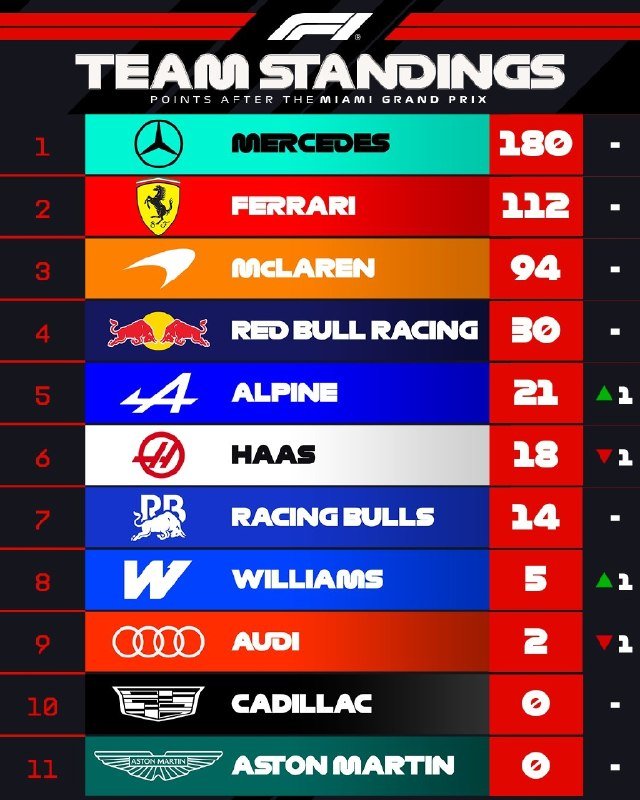
The result matters for reasons that extend well beyond a single trophy. Mercedes had opened the 2026 campaign without a race win through the first five rounds, watching McLaren's MCL39 establish a clear constructor championship lead while Ferrari kept Norris's title hopes within striking distance. George Russell had shown race-winning pace on his day, but the W18 had been inconsistent — fast in qualifying trim, less dominant on race day. Antonelli's Miami victory changes the team's trajectory, at minimum providing the psychological boost of a win and at maximum signaling that the car has turned a developmental corner. Whether the Miami package will hold on the higher-degradation circuits of the European season remains the operative question.
From Junior Series to the Top Step
Antonelli's path to Formula 1 has been unusually compressed. Two consecutive Formula 2 championships — the second won in 2025, his first season in the category — established him as the most credentialed junior driver in recent Mercedes history. The team moved quickly to place him alongside Russell for 2026, absorbing the uncertainty of pairing an nineteen-year-old with a seasoned driver who had also spent just three seasons in the top category. The pairing made strategic sense for a team building toward 2027 and beyond, but it carried performance risk. Antonelli's early-season results had been solid without being spectacular — consistent top-six finishes, a handful of podiums, but no wins. Miami changes the ledger entirely. A driver who converts a first-ever pole position into a lights-to-flag win has demonstrated the combination of single-lap pace and race management that separates front-runners from flash-in-the-pan talents. The Mercedes garage, which had supported him through his entire junior career, now has concrete evidence that the investment was warranted.
Norris Holds Second as McLaren's Lead Shrinks
Lando Norris's second-place finish extended McLaren's consecutive podium streak to six races — an impressive consistency record — but it also reinforced the structural problem facing the papaya squad. Norris started fifth, inheriting positions through the first stint's competitive chaos, and drove a clean race to salvage meaningful points. Piastri, who had won the preceding round in Saudi Arabia, finished fifth. The gap between McLaren's two drivers in the championship — Norris thirty-two points behind the Australian — underscores how the MCL39's race-one pace advantage is not translating into the kind of dominant weekends that close margins. If Miami revealed anything about the competitive order, it is that the field is no longer a two-team fight. Mercedes is now a legitimate threat, and the constructor championship, which looked like a McLaren-versus-Ferrari duel three weeks ago, has a third player. The gap to Norris in the drivers' table is eleven points — a deficit that is recoverable but no longer theoretical.
Ferrari's Weekend and the Engine Reality
Charles Leclerc salvaged third place in Miami — a result that kept the Monegasque driver within touching distance of Norris in the standings but did not reflect Ferrari's genuine race pace. Leclerc was fast on Saturday, qualifying second, but the SF-26's race-day performance dropped behind Norris early in the stint and never recovered. The Scuderia's power unit has been the subject of scrutiny since pre-season testing, with reliability concerns flagged by multiple insiders across the opening rounds. Miami did nothing to silence those concerns; if anything, the gap to McLaren's straight-line speed on the back straight suggested the PU deficit has not been fully resolved. Leclerc's podium was earned through qualifying skill and opportunistic strategy, not through the kind of sustained race pace Ferrari will need on the high-energy circuits of Barcelona and Monaco. The question for the Maranello garage is whether the Monaco upgrade package can close what remains a meaningful gap to the top two teams — a gap that Miami only partially concealed.
What the Result Means for the Season
The immediate implication is straightforward: Mercedes is no longer a development story waiting for a result. Antonelli's victory gives the team a win, a pole, and a driver who has demonstrated he can execute under pressure. Russell remains a viable championship contender — his third-place finish in Miami keeps him six points behind Norris in the drivers' table — and the W18's qualifying pace now has a race-day counterpart. For the broader grid, the message is less comfortable. McLaren's lead, while still real, has been trimmed by two constructors' points in a single afternoon. Ferrari's podium disguised a pace deficit that will be harder to hide on circuits where race strategy is more decisive than single-lap speed. The Miami result does not automatically make Mercedes the championship favorite — the European season will stress-test every team on circuits where data is more mature and development trajectories diverge further. But for a team that entered 2026 being written off as a distant third force, the result resets the conversation. The European rounds beginning with the Barcelona round will determine whether Miami was a statement or an anomaly. If the W18 continues to develop at the rate it has shown through the opening five rounds, the constructor championship is anyone's race. If the McLaren's reliability advantages hold, the papaya cars will remain the team to beat. What Miami established, unambiguously, is that Antonelli belongs — not as a future star with potential, but as a driver capable of delivering, in the present tense, on the day that matters most.
Antonelli's victory is the first for Mercedes since Russell's win at the 2025 season finale in Abu Dhabi, and the Italian's first podium finish since his Formula 2 career.
Wire provenance
This editorial synthesis draws on the following public wire/social posts:
- https://t.me/formula1/11567
- https://t.me/formula1/11566
- https://t.me/WarMonitors/8924