Trump's Iran "Suffocation" Strategy Is Built on a Dangerous Assumption
Treasury Secretary Bessent says the sanctions regime is breaking Tehran's military payroll. But the historical record suggests economic asphyxiation hardens regimes more than it topples them.
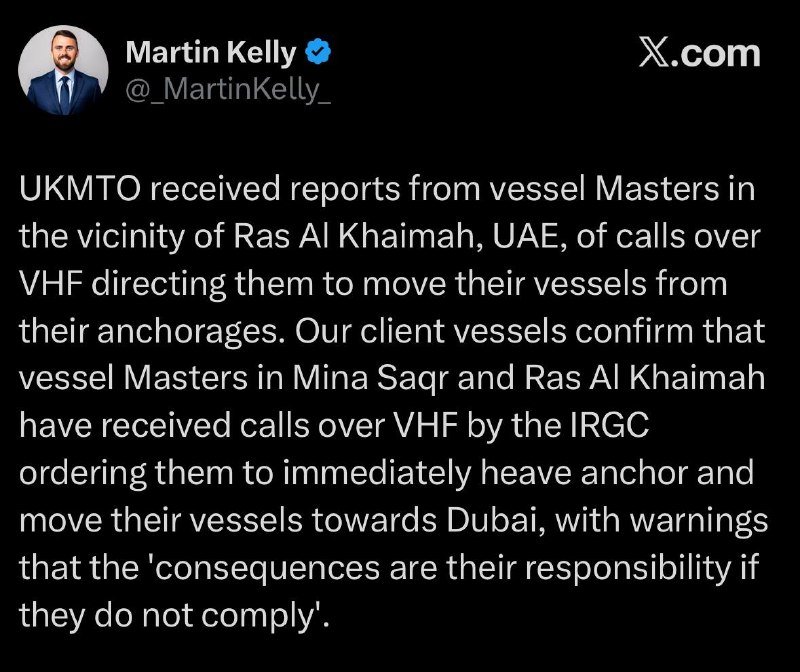
The Treasury Secretary says the regime cannot pay its soldiers. The President calls the naval barrier a "very friendly blockade." And $8.6 billion in emergency arms sales to Middle East allies sits in the pipeline, fast-tracked on the same day the blockade rhetoric hardened. That convergence — economic strangulation paired with military encirclement — defines the Trump administration's current posture toward Iran. Whether it produces the concessions the White House wants, or something considerably more volatile, depends on a set of assumptions about Iranian political economy that the historical record does not support.
Bessent's public framing, delivered on 3 May 2026 and amplified via the ClashReport Telegram channel, was direct: the sanctions architecture is inflicting enough pain that the Iranian military is going unpaid. The implication is a familiar maximum-pressure syllogism — financial pressure compounds, the regime's grip weakens, and eventually Tehran comes to the table on Washington's terms. That logic drove the first Trump administration's "maximum pressure" campaign between 2018 and 2021. The evidence that it produced the intended result was, to put it charitably, mixed.
The Suffocation Theory Has a Problem With History
The core assumption of economic suffocation as a regime-change mechanism is that pain becomes politically unbearable for the governing class, and that unbearable pain translates into capitulation. Iran's history suggests the mechanism works differently. When external pressure tightens, the default Iranian response has been to consolidate authority around hardliners who frame hardship as proof of external enmity rather than evidence of internal governance failure. Reformist factions — those most open to negotiation — are the first casualties of a siege environment, because they have the most to answer for in terms of economic promises that sanctions prevented them from keeping.
The political economy here is structural. Iran's theocratic-bureaucratic system has survived previous rounds of severe sanctions partly because it developed internal redistribution mechanisms — subsidies, ration systems, Revolutionary Guard economic networks — that shield core constituencies from the worst effects. Those mechanisms are strained. Bessent is not wrong that military payroll is under pressure. But strained and broken are different things, and the regime has demonstrated a capacity to accept considerable internal friction before that line is crossed.
Trump himself acknowledged the gap between pressure and capitulation in a post dated 2 May 2026, stating that Iran had "not yet paid a big enough price" for its actions — language that implicitly concedes the current regime of costs has not yet produced the desired result. That admission, buried inside a Polymarket-sourced post about the blockade, is more revealing than the administration likely intended. It signals that the suffocation thesis remains aspirational rather than accomplished, and that more escalation is being held in reserve.
The Diplomatic Window That Is Not Closing
The Polymarket odds on a US-Iran diplomatic meeting this month sat at 39 percent as of 3 May, with a 33 percent probability assigned to the blockade being lifted by month-end. Those are not low odds. Prediction markets price in the collective judgment of participants with real money on the line, and those numbers suggest that, even within the context of a maximum-pressure campaign, serious actors are assigning meaningful probability to a negotiating track re-opening.
That track exists because both sides have reasons to talk. The administration wants nuclear constraints and regional de-escalation. Iran wants sanctions relief and the preservation of its enrichment program — at minimum as a negotiating chip, at maximum as a strategic capability. These positions are far apart, but they occupy the same dimensional space. The question is whether the pressure campaign produces conditions for productive diplomacy or forecloses it entirely.
The arms sale pipeline complicates the picture. $8.6 billion in emergency weapons transfers to regional allies — announced on 2 May 2026, fast-tracked without the standard congressional review window — signals that the administration is simultaneously preparing for a scenario in which diplomacy fails and for a scenario in which escalation requires rapid capability insertion. The regional partners receiving those systems — the sources do not specify which allies received priority delivery — have their own incentives to keep the Iran threat salient, because threat inflation justifies their own military buildups and their strategic relationships with Washington.
The Blocade That Cannot Be Friendly
Trump's description of the Hormuz naval posture as a "friendly blockade" on 2 May 2026 is notable as a piece of political messaging, even by the standards of the genre. A blockade is an act of war under international law. Its purpose is to deny an adversary the resources needed to sustain military operations. Calling it friendly is either a diplomatic signal that the mechanism is reversible if Tehran complies, or a rhetorical device to make an aggressive act more palatable to a domestic audience that has absorbed years of "maximum pressure" framing without witnessing the outcome the framing promised.
Neither read is reassuring. If the blockade is genuinely reversible as a diplomatic concession, it functions as a bargaining chip — useful, if managed carefully. If it is irreversible and permanent, it is a casus belli waiting for a spark. And if the "friendly" framing is simply rhetorical cover for a sustained military posture, it suggests the administration is building a new normal around the Strait of Hormuz that does not resolve but instead contains and extends the confrontation.
The risk in that scenario falls most heavily on the countries closest to the Strait. Oman, the UAE, and Saudi Arabia have commercial and energy infrastructure that relies on unimpeded transit. A prolonged blockade — even one described as friendly — imposes costs on third parties who are not party to the US-Iran dispute and whose interests are collateral to it.
What the Administration Is Actually Betting On
The suffocation thesis, in its current incarnation, rests on a bet that Iranian military unpayrolls eventually translate into political instability inside the regime, and that instability creates an opening for either internal collapse or capitulation at the negotiating table. That bet has been made before, and the historical record of its success is thin.
What it has produced, reliably, is a consolidation of hardliner authority inside Iran, a reduction in the political space available to any figure who might propose compromise, and a deepening of the structural dependencies — on Chinese energy purchases, on reduced SWIFT access, on gray-market oil movement — that have allowed the Iranian economy to survive despite documented and severe pressure.
The Polymarket odds suggest the market is not confident the bet resolves soon. A 39 percent chance of diplomatic contact within a month implies that serious actors see the pressure campaign as a prelude to talks, not as a substitute for them. If that reading is correct, the administration is using the suffocation language as a negotiating posture — a way of signaling strength before sitting down — rather than as a description of an ongoing outcome.
That distinction matters. A posture can be reversed. An outcome cannot. And the history of Iran policy across multiple administrations is a history of postures mistaken for outcomes, with consequences that compound in both directions.
This publication's coverage of the Iran standoff will continue as the diplomatic and military tracks develop in parallel. Readers may follow Monexus's live wire for updates as they break.
Wire provenance
This editorial synthesis draws on the following public wire/social posts:
- https://t.me/ClashReport/14243