US Launches 'Project Freedom' Operation to Secure Strait of Hormuz Commercial Shipping
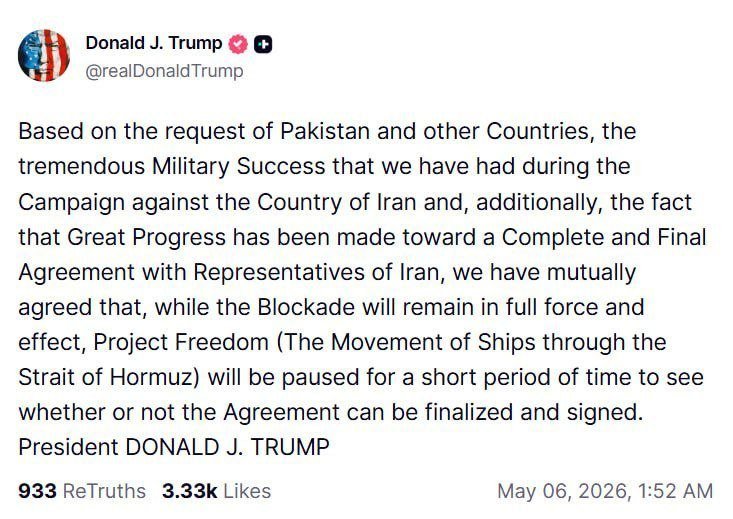
On Saturday, 3 May 2026, President Donald Trump announced via social media that the United States would launch "Project Freedom," a military operation beginning Monday, 5 May 2026, to escort commercial vessels through the Strait of Hormuz. U.S. Central Command issued a operational release shortly afterward, providing the first detailed account of what the mission will involve.
According to the CENTCOM statement, more than 100 land and sea-based aircraft, guided missile destroyers, and unmanned systems will take part in the operation, alongside approximately 15,000 U.S. personnel. The commander's office described the deployment as essential to regional security and the global economy, noting that intelligence sharing with international partners would form a core component of the mission. The announcement comes as the naval blockade against Iran — a feature of U.S. pressure policy toward Tehran for years — remains in place, a continuity the CENTCOM commander explicitly acknowledged in accompanying remarks.
The Strait of Hormuz is among the world's most consequential maritime chokepoints. Roughly one-fifth of global oil trade passes through its narrow channel between Oman and Iran, making any disruption to shipping there an immediate macro-economic event. The operation's stated purpose — restoring freedom of navigation for commercial ships — directly targets that vulnerability.
The Military Footprint
The figures released by CENTCOM describe a substantial, multi-vector presence. Fifteen thousand troops, 100 or more aircraft, and guided missile destroyers represent a major allocation of Central Command resources — one that suggests the administration is prepared for a sustained posture rather than a short-term show of force. The inclusion of unmanned systems indicates the operation is structured to leverage autonomous platforms for intelligence, surveillance, and potentially strike missions, reducing risk to U.S. personnel while maintaining persistent coverage of the waterway.
The intelligence-exchange component is notable. By formalizing information-sharing with unnamed international partners, the operation positions itself as a coalition effort, even if the combatant command structure remains firmly in American hands. Whether those partners are regional states with standing interests in Hormuz transit, or more distant allies contributing sensors and communications, is not specified in the available CENTCOM material. That ambiguity matters: a genuinely multilateral framing would carry more diplomatic weight than a U.S.-led operation wearing a multilateral mask.
Blockade Without Name
The CENTCOM commander drew a direct line between Project Freedom and the ongoing naval blockade of Iran, framing the two initiatives as complementary rather than contradictory. "Our support for this defense mission is essential to regional security and the global economy," the commander stated, according to CENTCOM's own release — while simultaneously confirming that the blockade, which Iran and its regional allies treat as an act of economic warfare, continues.
This linkage is the operation's most contested dimension. Proponents will argue that a blockade is a lawful instrument of statecraft and that protecting commercial shipping through an actively contested waterway is a legitimate exercise of freedom of navigation. Critics — including legal scholars who have questioned the blockade's compatibility with contemporary international maritime law — will note that combining escort operations with coercive economic measures against the same country raises the stakes significantly. An Iranian response to the blockade may now need to factor in U.S. destroyers actively protecting the vessels Tehran is trying to pressure.
Commercial Stakes and Market Reaction
For ship operators, insurers, and energy markets, the core question is practical: will U.S. naval presence reduce risk, or will it concentrate risk by making the Hormuz a flashpoint between Iranian forces and American escorts? The record of naval convoy operations in other contested corridors — the Red Sea operations under ongoing maritime security initiatives — suggests the answer depends heavily on rules of engagement and the degree to which accompanying vessels are willing to be drawn into retaliatory exchanges.
Oil markets have not yet registered a sharp move in the immediate aftermath of the announcement, per available reports, though the seasonality of demand and the tightness of global spare capacity mean that any genuine disruption to Hormuz transit would translate quickly into price action. The operation's credibility as a deterrent — its ability to discourage Iranian interference rather than invite it — will be tested as soon as the first escorted convoy enters the strait.
What Remains Unconfirmed
The sources available at time of publication draw heavily from CENTCOM's own releases and the commander of Central Command's public remarks. Neither the scale of Iranian military response, the specific rules of engagement the escorts will operate under, nor the identities of the international partners contributing intelligence have been independently verified beyond the official framing. The prior operational record of U.S. naval presence in the Gulf is mixed: periods of relative quiet alternated with episodes of escalation, often driven by incidents at sea that neither side anticipated. The available sources do not address what contingency planning exists for a kinetic incident involving a commercial vessel in the escort lane.
Project Freedom is, on its face, a concrete commitment of military resources to a defined mission. What is less clear is whether the political and diplomatic architecture around it — the signals sent to Tehran, the expectations set with commercial shipping operators, the limits defined for escalation — is equally well-defined. The sources do not specify.
This article's framing prioritizes CENTCOM's official account as the primary source of operational detail. Al Alam Arabic, an Iranian state-linked outlet, provided the most granular English-language translation of the CENTCOM releases available at time of publication. The desk notes that Iranian state media's sourcing of U.S. military statements should be read with appropriate caution about any editorial layering, even where the quoted language appears consistent across outlets.
Wire provenance
This editorial synthesis draws on the following public wire/social posts:
- https://t.me/OSINTdefender/8479
- https://t.me/alalamarabic/19482
- https://t.me/alalamarabic/19481
- https://t.me/alalamarabic/19480
- https://t.me/alalamarabic/19479
- https://t.me/alalamarabic/19478
- https://t.me/alalamarabic/19477
- https://t.me/alalamarabic/19476
- https://x.com/polymarket/status/1934474287619997697