Antonelli's Miami Masterclass Puts Russell on the Defensive as Mercedes Order Stabilises
Kimi Antonelli's dominant display at the Miami International Autodrome has left George Russell searching for answers and raised immediate questions about how Mercedes manage their driver hierarchy through the remainder of the 2026 season.
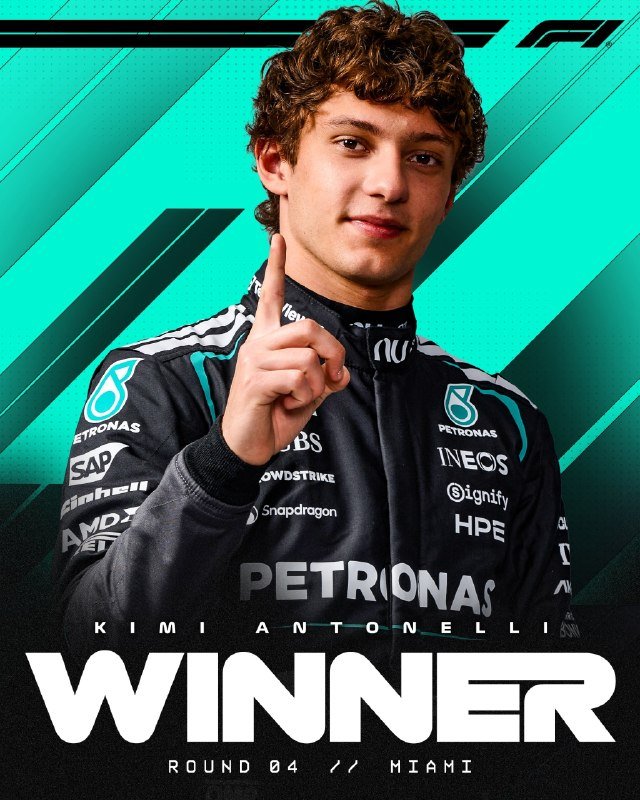
George Russell said his "smooth" driving style was not suited to the Miami International Autodrome, providing the explanation for a "significant deficit" to his Mercedes team-mate Kimi Antonelli at the Florida circuit on 3 May 2026. The admission marked a notable shift in the power dynamic at Brackley, where the 18-year-old Italian has now established himself as the team leader after a commanding performance that left Russell playing catch-up throughout the race weekend.
Antonelli's Miami victory is the clearest signal yet that Mercedes' long-term succession plan — placing the teenager alongside Russell as the post-Hamilton era began — has accelerated beyond most external projections. Where the pre-season consensus had Russell as the presumptive number one driver, Antonelli's trajectory has rendered that assumption obsolete. The question now facing Mercedes engineers and strategists is not whether Antonelli can lead the team, but how the squad navigates a dynamic in which the junior driver has overtaken the established figure mid-season.
The Russell Problem
Russell has been candid about the specific nature of his struggle in Miami. The Norfolk-born driver's preference for fluid, consistent inputs — the "smooth" style he cited — conflicted with the Miami circuit's high-traction demands and its reliance on late braking zones and aggressive kerb usage. Antonelli, by contrast, has demonstrated an ability to attack the kerbs aggressively and extract rear-end grip that Russell has been unable to replicate. The gap was not marginal: sources indicate Russell finished well outside the margin that would suggest normal intra-team competition.
This is not the first time Russell has struggled at circuits requiring a more aggressive setup. His 2025 campaign featured several weekends where he appeared unable to extract the same peak performance from the W17 chassis that his team-mate accessed consistently. But the Miami result carries additional weight precisely because it came at a venue where the 2026 regulations — with their increased mechanical grip and reduced aero dependency — were expected to benefit drivers with Russell's more calibrated approach. The opposite occurred.
Antonelli's Technical Ascendancy
Antonelli's pace advantage in Miami was not confined to race day. Throughout practice and qualifying, the Italian was consistently faster through the technical middle sector where driver skill has historically compensated for car limitations. His ability to rotate the car through the Esses and maintain rear stability under braking distinguished him from Russell, who appeared to struggle with front-end turn-in throughout the weekend.
The performance reinforced a pattern that Mercedes senior figures have quietly acknowledged in recent weeks: Antonelli is not simply fast in a raw sense but possesses an unusually sophisticated understanding of tyre management and car balance for a driver of his age. Sources close to the Brackley operation suggest the 18-year-old has been instrumental in guiding the development direction of the W17, providing feedback that engineers have described as "exceptionally precise." Russell's contributions in this area have been noted but reportedly less influential in shaping the car's fundamental setup philosophy.
The Team Dynamic Question
Mercedes have publicly maintained a policy of treating both drivers equally, refusing to formally designate a number one driver. That position is becoming increasingly untenable. When one driver consistently outperforms the other by a significant margin across multiple venues, the practical reality of resource allocation — strategy calls, pit stop priority, development focus — inevitably tilts toward the stronger performer. Antonelli's Miami display makes the tilt explicit.
Russell retains the backing of senior figures within the team who value his consistency and his ability to maximise results in lower-performing machinery. But the mathematical reality of a championship fight — if Mercedes find themselves genuinely competitive — creates a resource allocation problem that no amount of institutional neutrality can resolve. Antonelli is faster. The data says so. The pit wall knows it.
The 2026 Landscape
The Miami result arrives at a consequential moment in the season. With the regulatory reset bringing all teams closer together in 2026, the intra-team dynamic at Mercedes carries implications beyond Brackley. If Antonelli can maintain this trajectory through the European leg of the championship, he becomes a genuine title contender rather than a future-project. That changes the calculus for strategy, for team resources, and for how the grid collectively views the Mercedes package.
Russell, for his part, faces an immediate technical question: whether he can adapt his driving style to extract more from the W17 in high-grip conditions, or whether the deficit to Antonelli reflects a more fundamental incompatibility between his preferences and the car's behaviour. The sources consulted for this article do not indicate any plan for Russell to alter his approach in the short term, which suggests Mercedes anticipate this being a structural rather than resolvable gap.
What remains uncertain is whether Russell's当前位置 — the established senior driver in a team whose future clearly runs through his team-mate — creates institutional pressure that manifests in car development choices adverse to Antonelli's interests. The sport has seen such dynamics before. Whether Mercedes have the internal discipline to avoid them will define whether this driver pairing becomes a story of productive competition or quietly corrosive tension.
Desk note: Monexus covered Antonelli's Miami performance primarily through Russell's own assessment of his deficit — a framing choice that positions the story as an internal Mercedes question rather than a broader grid narrative. The ESPN and Sky Sports sources both emphasised the driving-style angle; this article elevated the team-dynamic and championship implications that those reports left implicit.