Freedom of Navigation or Economic Siege? The U.S. Navy's New Posture in the Strait of Hormuz
U.S. carrier groups are conducting what the Pentagon calls a freedom-of-navigation operation near Iranian ports. The language matters, and so does what it obscures.
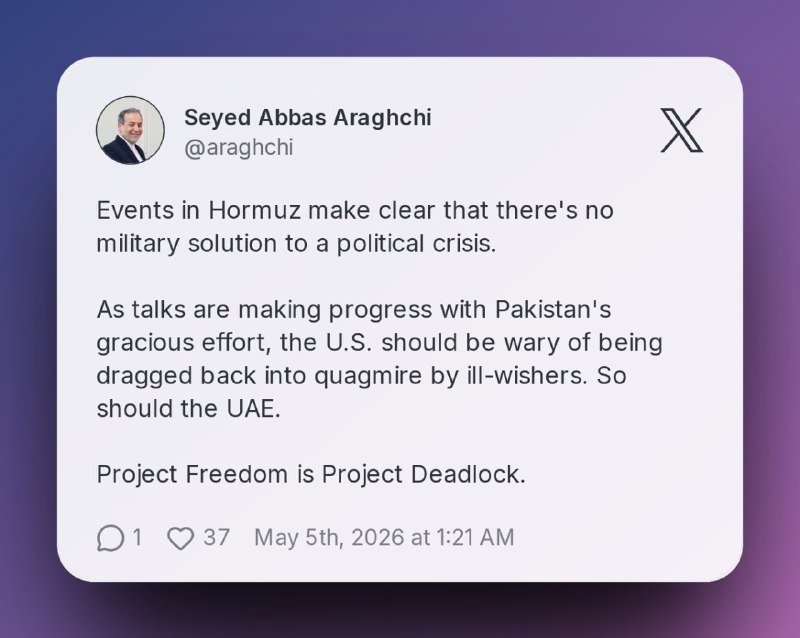
On the morning of 4 May 2026, the U.S. Navy guided two U.S.-flagged tankers through the Strait of Hormuz under what CENTCOM calls "Project Freedom." The operation involved F/A-18 Super Hornets launching from the USS Abraham Lincoln and MH-60 Sea Hawk helicopters working in concert with Army AH-64 Apache attack helicopters. A second carrier group is also on station. The public framing is familiar: freedom of navigation, protection of commerce, deterrence of malign actors. The reality on the water looks different, and the gap between the two is worth examining.
The distinction between a freedom-of-navigation operation and a blockade is not semantic. International law treats them differently. A blockade is an act of war—codified under the 1909 Declaration of London and affirmed in subsequent jurisprudence—requiring notification, proportionality, and an avenue for neutral vessels to exit. Freedom-of-navigation operations, by contrast, assert the right of innocent passage through international straits without seeking to cut off an adversary's trade entirely. What CENTCOM is doing near Iranian ports—enforcing a visible, persistent military presence that functionally impedes vessels bound for Iranian terminals—sits uneasily in the space between those two categories. The Pentagon has not declared a blockade. It has not needed to. The presence of two carrier groups and their associated escort craft communicates the same practical reality without the legal obligations.
What the language forecloses
The "Project Freedom" branding is precise messaging. It positions the United States as the guarantor of open waters and Iran as the destabilizing force threatening them. That framing is not new—American military communications have relied on variations of it for decades—but it performs specific work in the current moment. Nuclear talks between Washington and Tehran have stalled. Iran has enriched uranium to weapons-grade levels in the absence of a renewed Joint Comprehensive Plan of Action. The Trump administration reimposed maximum pressure sanctions and has signaled, through multiple channels, that military deterrence is back on the table as a coercive instrument.
The language of freedom of navigation allows the administration to frame an economic strangulation campaign as a defensive posture. It shifts the burden of escalation onto Iran: any Iranian response to the carrier presence becomes, in this framing, an attack on free trade rather than a response to a de facto siege. That is a useful rhetorical position, and it is almost certainly intentional.
The enforcement mechanism
A carrier strike group in the Strait of Hormuz is not a passive presence. The F/A-18 squadrons provide fixed-wing air cover; the Sea Hawks and Apaches offer rotary-wing responsiveness. Together, they create a layered air picture and a credible interdiction threat against any vessel attempting to move toward Iranian ports without U.S. consent. The practical effect is that Iranian-linked shipping—and, by extension, much of Iran's legitimate international trade—faces a gauntlet of American military hardware.
The Strait of Hormuz is the world's most critical oil chokepoint. Roughly 20 percent of global oil commerce transits its narrow waters. A sustained American military presence there does not merely inconvenience Iranian trade; it places a thumb on the global energy scale. Markets know this. The very announcement of "Project Freedom"—the public documentation of two carrier groups escorting commercial vessels—signals American willingness to enforce economic containment by naval means. That signal is, at least partly, the point.
What remains uncertain
The sources do not specify what happens when a non-American vessel attempts to dock at an Iranian port regardless. Whether CENTCOM's rules of engagement permit the interception of third-country flagged ships bound for Iranian territory, or whether "Project Freedom" is limited to ensuring U.S.-flagged vessel passage, remains unclear from the available record. That ambiguity is almost certainly deliberate. A public declaration of full blockade would invite international legal scrutiny and alienate European allies who remain nominally committed to the JCPOA. A vague "freedom of navigation" posture leaves Iran guessing and leaves the administration flexibility to escalate or de-escalate as circumstances demand.
Iran has not remained silent. Iranian state media and regional proxy messaging channels have characterized the American presence as an act of economic warfare. That framing has resonance across the Global South, where memories of unilateral sanctions regimes—and the human costs of economic isolation—are not abstract. The sources available do not include Tehran's specific response to the 4 May operations, but the pattern of Iranian reaction to American maximum pressure is well-documented: diversification of trade relationships, deepening of ties with Russia and China, acceleration of nuclear enrichment, and periodic threats to close the strait entirely.
That last option is the one that keeps energy markets awake. It is also the option most likely to trigger the kind of direct U.S.-Iranian confrontation the Biden and now Trump administrations have, for different reasons, sought to avoid. The current carrier posture raises the floor for that outcome with every week it persists.
The stakes, named plainly
If "Project Freedom" succeeds in its implicit objective—bringing Iranian oil exports to a near-halt while compelling Tehran back to the negotiating table on American terms—the precedent is significant. Economic coercion backed by visible, persistent military force will become the preferred instrument for resolving nuclear disputes with adversaries who lack blue-water navies. That calculus will not be lost on Beijing, which watches American carrier operations in the South China Sea with different eyes than the Pentagon perhaps assumes.
If it fails—if Iranian exports continue through third-country intermediaries, if the nuclear program continues advancing, if regional proxy activity increases in response to perceived American aggression—the administration will face a choice between doubling down and finding an off-ramp. Neither path is comfortable. The first risks a conflict the United States does not need and cannot easily contain. The second risks the appearance of weakness that has historically been intolerable to American policymakers, regardless of party.
What is clear is that "Project Freedom" is not a routine naval operation. Two carrier groups are not standard escorts for civilian tankers. The language of freedom of navigation does not disguise the underlying fact: the United States is using its naval supremacy to apply economic pressure on a regional adversary, and the Strait of Hormuz has become the stage on which that pressure is being performed.
The question is not whether the strait will remain open. It will, for now, and with American assistance. The question is what costs the international system is prepared to accept for that arrangement—and whether those costs are distributed fairly across the nations that depend on Hormuz's waters.
This publication's coverage of the Strait of Hormuz operations differs from wire reporting primarily in its emphasis on the legal ambiguity between freedom-of-navigation framing and blockade mechanics, a distinction that wire coverage has largely elided.
Wire provenance
This editorial synthesis draws on the following public wire/social posts:
- https://t.me/osintlive/4521
- https://t.me/osintlive/4520
- https://x.com/polymarket/status/1919348961283301376