The Strait of Hormuz Has Become a Flashpoint — And the West Should Not Be Complacent
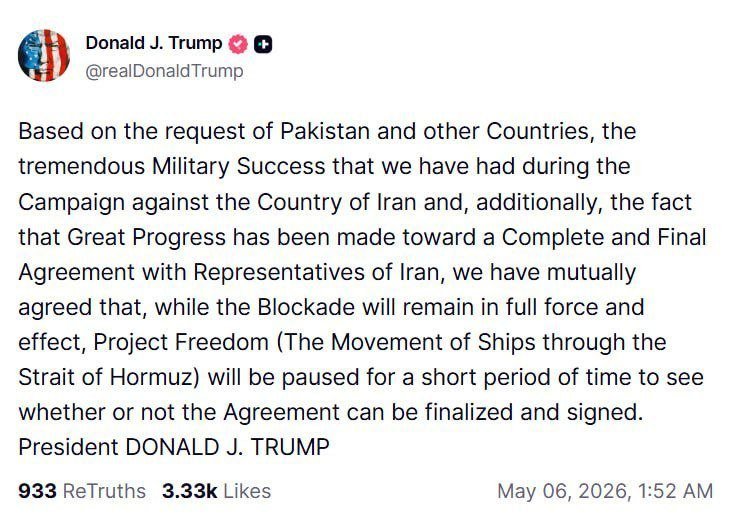
On 4 May 2026, Iran's Islamic Revolutionary Guard Corps announced that no commercial vessel or oil tanker had passed through the Strait of Hormuz in the preceding hours. The IRGC further stated that any vessel attempting to cross without Iranian authorization would be stopped by force. The announcement, reported across regional wire services, marks the most direct Iranian assertion of control over the world's most critical maritime oil chokepoint since at least 2019.
The Strait of Hormuz is not an abstraction. Approximately 20 to 25 percent of global oil trade transits its narrow corridor — a figure Western energy analysts treat as a stabilising constant rather than a political variable. Iran's declaration punctures that assumption. What the IRGC has done, in plain operational language, is announce that this constant is now conditional on Tehran's consent.
This publication does not treat the IRGC statement as theatre. The record of the past decade suggests that when Iran announces it can close a shipping lane, it means it has the capability and the willingness to demonstrate it under sufficient pressure. The relevant question is not whether Tehran is bluffing — it is what conditions would make the bluff unnecessary.
The Chokepoint Is Already a Weapon
Geographers describe the Strait of Hormuz as a 33-kilometre-wide pinch point between Oman and Iran at the mouth of the Persian Gulf. Tanker traffic modelling from energy intelligence firms consistently places it among the three most consequential infrastructure chokepoints in the global economy, alongside the Suez Canal and the Malacca Strait. Unlike the Suez, which Egypt can theoretically close, or the Malacca, which Singapore and Malaysia jointly manage, Hormuz sits adjacent to a single state with a documented history of using asymmetric maritime leverage.
That history matters. In 2019, during the maximum-pressure campaign under the Trump administration, Iran struck Saudi oil infrastructure at Abqaiq and then scaled back compliance with the Joint Comprehensive Plan of Action. Tanker traffic through Hormuz did not stop — but insurance premiums spiked sharply, and several shipping firms quietly rerouted vessels around the Cape of Good Hope, adding weeks to transit times and millions to per-barrel costs. The mechanism worked without a single shot being fired.
The IRGC's language on 4 May is more direct than anything deployed in 2019. Calling the strait closed — rather than threatening consequences for violators — is a categorical claim, not a deterrent posture. That distinction matters for markets, for navies, and for the diplomatic actors who will spend the coming days attempting to parse intent.
Why the Western Frame Understates the Problem
Initial wire coverage of the IRGC statement will likely focus on the timing — whether this is a response to stalled nuclear negotiations, a signal to the incoming US administration, or a pressure tactic ahead of a specific diplomatic deadline. Those questions are legitimate. But the dominant framing risks treating this as an episodic provocation rather than a structural development.
The structural development is straightforward: the architecture of global oil commerce was designed on the assumption that major chokepoints remain open except during active wartime. For decades, that assumption held. The Strait of Hormuz has been a toll road the world drove through without paying, because the United States Navy provided the security public good and Iran lacked the capability or willingness to contest it. Both parts of that equation are eroding simultaneously.
American naval dominance in the Persian Gulf remains formidable. But the willingness of any US administration to deploy that dominance in defence of tanker traffic during a period of elevated US-Iran tension is a different question — and one the current White House has not answered clearly. Meanwhile, Iran's anti-ship missile capabilities, drone technology, and naval assets have improved substantially since 2019. The gap between capability and willingness to use it narrows when diplomatic channels are exhausted.
Coverage that frames Iran's statement as purely performative — designed for domestic or regional audiences — underestimates the extent to which performative and operational signals have converged in Iranian strategic doctrine. When the IRGC says a thing, it typically prepares the conditions to make the thing true.
The Asian Import of This Escalation
One aspect of the story that Western-centric reporting tends to elide is the degree to which the consequences of a Hormuz closure would land unevenly on the Global South rather than the Western economies that typically dominate the news cycle.
China, Japan, South Korea, and India are the primary destination markets for crude oil transiting the Strait of Hormuz. Chinese energy security planners have long identified the Malacca Dilemma — the vulnerability created by the concentration of Asian energy imports through a small number of chokepoints — as a strategic liability. A closure of Hormuz would compound that liability substantially, accelerating the diversification strategies Beijing has already invested in: increased Russian pipeline imports, expanded refining capacity in Central Asia, and accelerated EV deployment to reduce transport fuel dependency.
For European importers, a Hormuz closure would initially mean higher spot prices and longer supply lines, but Europe has structurally reduced its Gulf oil exposure over the past decade. For South and Southeast Asian economies — Pakistan, Bangladesh, Vietnam, the Philippines — the price spike accompanying any sustained disruption would translate directly into domestic energy costs and political instability.
The asymmetry matters. A Hormuz closure is not a symmetric escalation between Washington and Tehran. It is an asymmetric imposition on the global energy market, the consequences of which would be borne most heavily by states that have little role in the underlying US-Iran dispute.
What Comes Next
The sources available at time of publication do not indicate whether the closure is operational — meaning mines, patrol vessels, or interdiction — or declaratory, meaning a political signal without immediate physical enforcement. That distinction will determine the market and diplomatic response.
What is clear is that the window for de-escalation has narrowed. The IRGC has put a claim on the table that it cannot easily withdraw without appearing to have blinked. Diplomatic back-channels, if they exist, are now operating under a deadline imposed by commercial realities: tanker operators will begin rerouting within 24 to 48 hours if the closure is treated as credible, and rerouting decisions are self-reinforcing regardless of whether the underlying threat is real.
Western governments will issue statements affirming freedom of navigation. The US Fifth Fleet will likely increase visible presence in the Gulf. These responses are predictable and, in a narrow operational sense, appropriate. But they do not address the underlying vulnerability: the global economy's continued dependence on a chokepoint that a single state can claim to control, for reasons rooted in a dispute that has never been resolved diplomatically.
The Strait of Hormuz has been a stable feature of global commerce for fifty years. On 4 May 2026, Iran served notice that stability was always a choice — and the choice, this time, may be different.
Wire provenance
This editorial synthesis draws on the following public wire/social posts:
- https://t.me/ClashReport/18432
- https://t.me/alalamarabic/12441
- https://t.me/osintlive/8923