Iran's Hormuz Ultimatum Is a Pressure Play, Not a Suicide Note
Tehran's armed forces command says it will attack U.S. warships near the Strait of Hormuz. The rhetoric is loud. The calculation behind it is colder and more deliberate than the Western wire copy suggests.
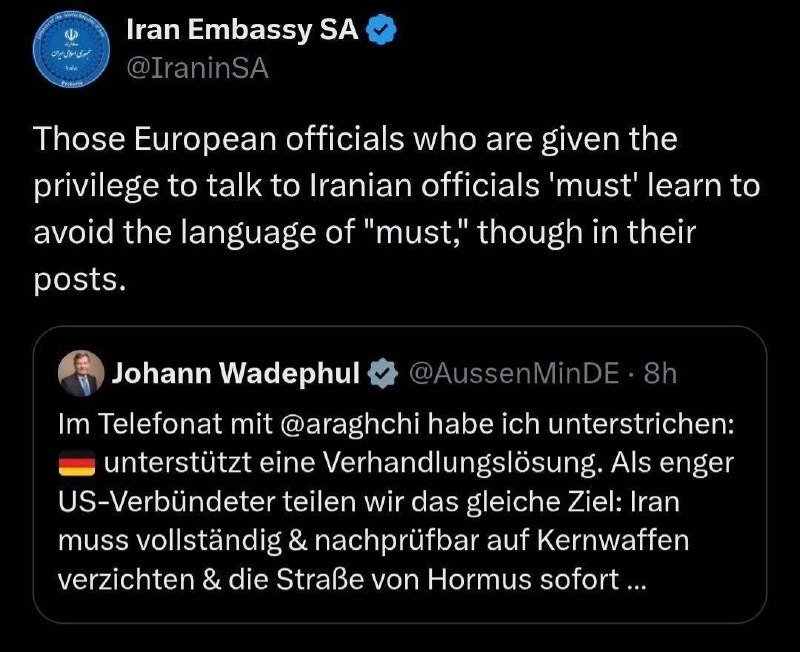
On 4 May 2026, Iran's armed forces command issued a statement that Western wire copy ran as a threat: any U.S. military vessel approaching the Strait of Hormuz would be attacked. Commercial ships were warned not to cross without Iranian approval. State media simultaneously announced new rules and signage governing the waterway. The language was stark, the timing unmissable.
The question worth sitting with is not whether Tehran means it — it certainly intends the warning to land — but what calculation sits underneath it. Iranian officials have made similar noises before without acting. This time, the context is different. The U.S. Navy, one day earlier, deployed AI-powered software to accelerate mine detection in the same strait. That deployment was not a coincidence, and Iran knows it.
What Tehran Actually Said
The Iranian statement was sweeping in tone but specific in target. According to reporting carried across regional OSINT feeds, the armed forces command claimed "full control" of the Strait and framed any foreign military approach — with explicit emphasis on the United States — as grounds for engagement. The new navigational rules for commercial vessels add a bureaucratic layer to what Iran is presenting as enforceable jurisdiction.
Western outlets framed this as escalation. That reading is not wrong, but it is incomplete. Iranian military commanders do not issue public ultimatums without factoring in the response. Tehran's calculus here is less about wanting a direct naval clash and more about establishing a new baseline: Iranian approval as a precondition for safe passage, rather than freedom of navigation as a default.
The Hormuz Problem Nobody Wants to Say Loudly
The Strait of Hormuz is a 34-kilometre-wide channel between Oman and Iran through which roughly a fifth of the world's oil shipments pass. That single fact is the entire reason this statement matters. Every time Iranian state media publishes warnings about controlling the strait, energy markets flinch. That reaction is the signal Tehran is trying to send — not to the U.S. Navy, but to every tanker owner, every insurer, every finance ministry that depends on unimpeded Gulf traffic.
The U.S. Navy's AI mine-detection deployment on 3 May 2026 is a direct response to a persistent Iranian capability: the ability to lay mines quickly and credibly threaten the lane without a full blockade. A mine strike does not require a confrontation with an American destroyer. It requires an unmanned dory and a rainy night. The AI system is meant to close that window. Tehran, by issuing the warning now, is effectively calling that effort insufficient — daring Washington to prove it can keep the lane open at acceptable cost.
The Structural Logic of the Move
Iran cannot win a straight fight with the U.S. Fifth Fleet. Nobody with access to classified intelligence believes otherwise inside the Pentagon. What Iran can do is raise the price of presence. Every mine planted, every commercial ship warned off, every insurance premium spiked adds friction to a system the global economy runs on. The ultimatum is not a declaration of war. It is a bid to make the cost of U.S. operations in the Gulf visible to domestic American audiences who do not follow CENTCOM briefings.
That framing cuts differently than "Iran threatens to attack U.S. warships." The threat is real. The intent is leverage. Tehran is not building toward a fight it cannot win — it is constructing a scenario where backing down looks costlier than holding the line. The question is whether Washington reads it that way, or reaches for the headline.
The Narrow Gap Between Calculation and Miscalculation
Neither side wants a shooting war in the Gulf. That consensus has held for forty years. What has changed is the domestic pressure environment on both capitals — and the reduced communication channels between them. Warnings issued via Telegram and X are not diplomacy. They are theatre, but theatre that occasionally forgets its script.
The United States has the hardware to keep the strait open. Iran has the geography and the asymmetry to make that hardware bleed. Somewhere between those two facts sits a narrow corridor of managed competition that has kept Hormuz functioning since the 1980s. The statements from Tehran on 4 May do not close that corridor — but they do narrow it. And they remind anyone paying attention that the gap between deterrence and disaster is measured in signals, not weapons.
This publication will watch the waterway, not the rhetoric. The statements from Iran's armed forces command are a posture. What matters is whether any vessel moves, and who moves it.
Wire provenance
This editorial synthesis draws on the following public wire/social posts:
- https://t.me/osintlive/18939
- https://t.me/ClashReport/12847
- https://t.me/tasnimplus/9841
- https://x.com/polymarket/status/1918934261233741952
- https://t.me/osintlive/18936