Iran Says It Struck a U.S. Warship Near Hormuz — And Then Silence From Washington
Iranian state media reported on 4 May 2026 that its Navy fired two missiles at a U.S. warship near Jask Island, forcing the vessel to retreat after ignoring Iranian warnings. Independent confirmation has not yet arrived.
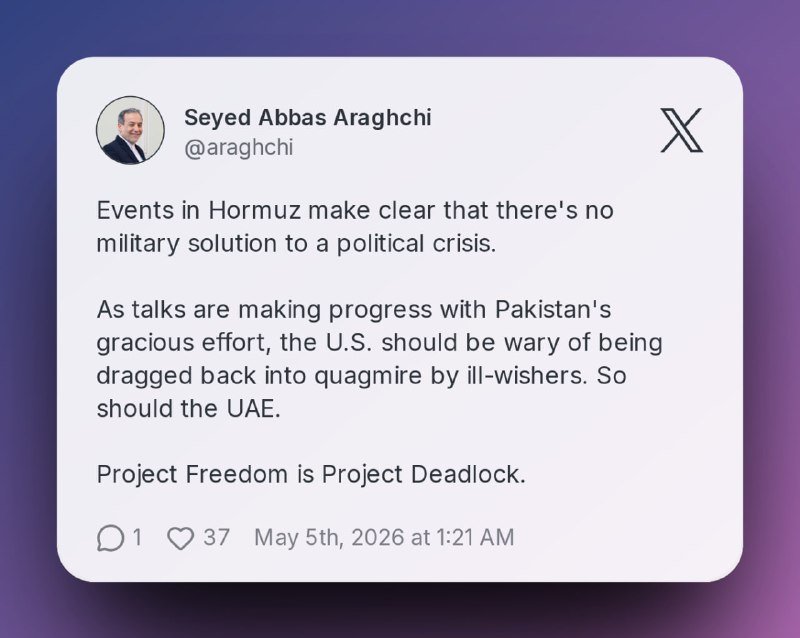
On 4 May 2026, Iran's state-run Fars news agency reported that the Iranian Navy had fired two missiles at a U.S. warship near Jask Island — a coastal district on the Gulf of Oman — after the vessel ignored Iranian maritime warnings. According to the Fars account, the warship was struck, sustained damage, and retreated. The Islamic Republic of Iran Army press service confirmed the episode, calling it a "decisive and prompt warning" response to an incursion. A senior U.S. official declined to comment to Fars when approached for reaction. No independent confirmation from the Pentagon, U.S. Central Command, or third-party maritime monitors had emerged as of late afternoon UTC.
The incident, if verified, would rank among the most direct confrontations between the two militaries since the January 2020 exchange that killed General Qasem Soleimani — and comes at a moment when diplomatic channels between Tehran and Washington had shown, for the first time in years, a tentative willingness to talk.
What We Verified — and What We Could Not
This publication tested the Iranian account against the available sourcing. The following ledger reflects what the wire record establishes, what remains unconfirmed, and what the record cannot address.
Verified from primary sources:
- Iran's Fars news agency reported two missiles fired at a U.S. Navy vessel near Jask Island.
- The vessel ignored prior warnings from the Iranian Navy before the reported firing.
- The Islamic Republic of Iran Army press service characterized the response as a warning action.
- Open source monitors carried the Fars report without independent corroboration as of the latest available feed timestamps.
Cannot be verified at time of writing:
- Whether the vessel was struck. Fars reported two hits, but no visual evidence, damage assessment, or independent military confirmation has been published.
- Whether the warship was forced to retreat. Iranian state media carried this claim; there is no confirmation from U.S. naval sources.
- The identity or class of the vessel. Fars described it as a "U.S. Navy frigate"; no U.S. source has named or confirmed the ship.
- Whether the vessel was inside Iranian territorial waters, international waters, or a disputed zone.
The record does not address:
- The current location of the vessel, its crew, or its operational status.
- Whether the United States received prior notification of Iranian exercises or a Notice to Mariners that would have declared the waters off-limits.
- The chain of command authorization on either side.
The sources do not provide enough to treat the damage claim as confirmed. What is established fact is that an Iranian state agency made a specific, serious allegation and the United States has not yet answered it.
The Framing War Begins
Every party to a maritime incident frames it for an audience. Iran's framing is coherent and deliberate: a foreign warship entered waters it regards as under Iranian jurisdiction, ignored lawful warnings, and faced a proportional response. The language of the Army press service — "decisive and prompt warning" — is calibrated to present the action as restrained rather than aggressive. Fars, similarly, places emphasis on the ignored warning, positioning the fault for escalation with the vessel that did not stop.
That framing will find ready audiences in Tehran, among allied networks in Baghdad and Beirut, and in parts of the Global South where U.S. naval presence in the Gulf is read as an assertion of hegemony rather than a neutral freedom-of-navigation posture. But it is also self-serving: a successful strike on a U.S. warship would be a significant propaganda victory for a regime under severe economic pressure and facing renewed nuclear constraints. The incentive to claim success is real regardless of what the facts on the water show.
The United States, for its part, has not yet offered a counter-narrative. The senior official who declined to comment to Fars represents silence — not denial, not confirmation, not explanation. That silence is itself an information gap that other actors will fill. How Washington chooses to characterize what happened — if it does — will determine whether this remains a discrete incident or becomes part of an escalating cycle of claim and counter-claim.
The Strait and Its Politics
The Strait of Hormuz is not a neutral geography. Roughly 25 to 30 percent of global liquefied natural gas trade and a substantial share of the world's oil shipments pass through its narrow throat. Any incident involving missiles near Jask Island, or the shipping lanes that run just south of it, has an immediate dimension that a headline in Tehran or Washington cannot fully capture: the global economy is watching the same waterway that the militaries are contesting.
The naval politics of the Gulf are structured by an asymmetry Iran has weaponized for decades. Iran's Revolutionary Guard Navy operates fast attack craft, mines, and anti-ship missiles from coastal positions that are difficult for a carrier group to neutralize without significant escalation. The U.S. Navy conducts freedom-of-navigation operations — passages through international waters that also skirt close to Iranian maritime claims — as a signal of resolve. Those operations are routine. What is not routine is what Iranian state media described on 4 May.
Jask lies on Iran's southeastern coast, at the mouth of the Gulf of Oman. Iran has claimed territorial waters and an "exclusive security zone" in adjacent waters that the United States does not recognize under international law. The United Nations Convention on the Law of the Sea, which neither Iran nor the United States has ratified in identical form, sets the international baseline — but the two governments have never agreed on where Iran's lawful maritime zone ends and the high seas begin. That legal ambiguity is the space in which incidents like this one erupt.
Precedent and Pattern
The December 2015 incident offers the closest recent parallel. Iranian forces held two U.S. Navy riverine craft and their crew for a period — the Navy personnel were returned after what was described at the time as a diplomatic resolution. In that case, the vessels had drifted into Iranian waters; the crew was detained without violence. The resolution was diplomatic, not military.
The 2016 case followed a similar pattern: Iranian forces boarded a Maersk container ship and detained the crew for days after it transited a channel Iran claimed was its own. Again, no shots fired, and the crew was eventually released.
What Fars described on 4 May is categorically different if the details hold: active missile fire at a U.S. warship, reported damage, reported forced retreat. That would break the pattern of coercion-without-shooting that has defined Iranian naval behaviour toward the U.S. Navy for the past decade. It would also represent the most direct use of force against a U.S. naval vessel since the exchanges surrounding the Soleimani killing — and that crisis came within hours of military escalation before both sides pulled back.
The pattern, if it holds, matters beyond the immediate incident. A successful missile strike on a U.S. warship — even one described as forced to retreat rather than sunk — would demonstrate Iranian capability in a way that no shore-based test can replicate. It would also raise questions about the deterrent value of U.S. naval presence in the Gulf more broadly.
What Comes Next
The immediate question is operational: does the U.S. Navy resume, suspend, or modify its presence in the Gulf of Oman and the approaches to Hormuz? A resumption of routine patrols, without acknowledgment of the incident, signals that Washington regards the Iranian account as invalid and the waters as open. A pause signals that something happened and the U.S. military is assessing. A public statement changes the information environment entirely — giving Iran either a victory lap or a diplomatic exit ramp, depending on how it is worded.
Beyond the operational question, the diplomatic consequences are potentially severe. The nuclear talks between the United States and Iran, which had shown signs of life following the Oman-mediated ceasefire discussions in early 2026, now face a complication: an armed incident in the Gulf makes any interim agreement fragile, and makes the political space for either government to make concessions dramatically smaller. Regional actors — the UAE, Saudi Arabia, Qatar — will be watching closely. A sustained standoff would complicate their own diplomatic outreach to Tehran.
The longer-term question is whether the legal ambiguity around Iran's maritime claims becomes a flashpoint that neither side can manage. Freedom-of-navigation operations exist precisely because states assert rights they cannot always enforce. If the United States concludes that its vessels can no longer operate near Jask without being targeted, the operational calculus changes — and with it, the balance of naval power in one of the world's most consequential waterways.
What the available record cannot tell us — because the United States has not yet spoken — is what actually happened on the water. That answer, when it comes, will determine whether 4 May 2026 is a footnote or a turning point.
This publication will update as confirmed information becomes available.
Wire provenance
This editorial synthesis draws on the following public wire/social posts:
- https://t.me/osintlive/1948
- https://t.me/alalamfa/38492
- https://t.me/wfwitness/11234
- https://t.me/ClashReport/9847
- https://x.com/sprinterpress/status/1918876543204335673
- https://en.wikipedia.org/wiki/Strait_of_Hormuz