Iran Declares Strait of Hormuz Closed as Regional Tensions Escalate Sharply
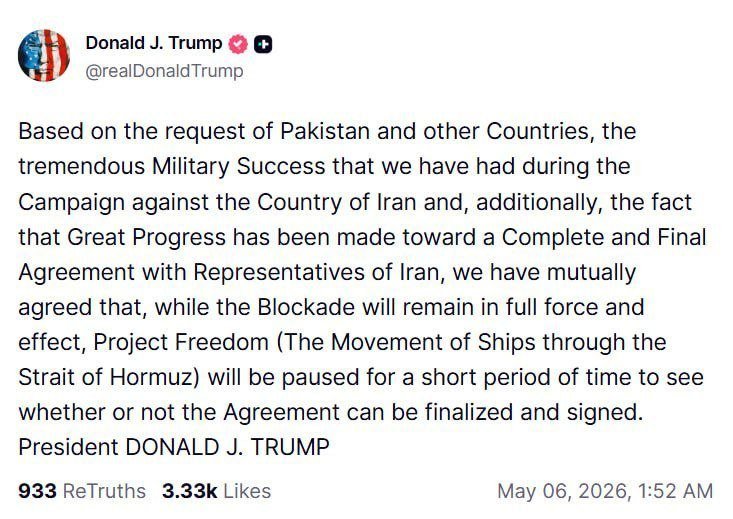
Shipping in the Strait of Hormuz came to a near standstill on 4 May 2026 after Iran's Islamic Revolutionary Guard Corps declared the waterway closed, an escalation that immediately pushed oil markets higher and raised the spectre of a broader disruption to global energy flows.
The IRGC declaration, reported via social media on 4 May at 13:57 UTC, carried immediate operational weight. Reuters documented that most commercial vessels were unable to move through the strait by mid-afternoon UTC, despite a US pledge — conveyed through official channels earlier the same day — to restore stability in Gulf shipping lanes. A South Korean-linked tanker was struck by Iranian forces in the strait, according to reporting by Yonhap News Agency, citing sources within the South Korean maritime sector. Iranian state media confirmed the incident. No casualties were immediately reported.
Separately, Iran's navy fired what it described as warning shots at US Navy vessels operating near the Strait, according to the Iranian state outlet Tasnim. The exchange represented the most direct military contact between US and Iranian naval forces in months.
"We warn that any foreign armed force, especially the aggressive US army, will be attacked if they attempt to approach and enter the Strait of Hormuz," an Iranian army spokesman told Middle East Eye on 4 May at 13:29 UTC, in language that drew directly from Tehran's long-standing framing of US regional presence as an act of hostility rather than a legitimate security posture.
The simultaneous closure announcement and kinetic actions against commercial and naval vessels mark a significant departure from previous cycles of Iranian saber-rattling in the Gulf. While Iranian officials have periodically threatened to block the strait — and occasionally carried out harassment operations against tanker traffic — a formal declaration of closure, combined with confirmed strikes on a flagged commercial vessel, places the current episode in a different category of risk.
Escalation, Counter-Escalation, and the US Pledge
The US State Department response, described by Reuters as a pledge to restore stability, offered no immediate mechanism for reopening the waterway. American officials have repeatedly affirmed freedom of navigation in the Gulf, but the practical question — how those assurances translate into safe passage for commercial vessels while Iranian forces maintain an active interdiction posture — remained unresolved at time of publication.
The gap between stated US commitment and operational reality underscores a recurring feature of Iran-West confrontations in the Gulf: Washington declares the rules, Iran enforces a different set. The language the Iranian army spokesman used — calling the US military "aggressive" and framing any approach as a hostile act — reflects Tehran's consistent framing that its own actions are defensive, and that the presence of US naval assets in the region constitutes the primary provocation. This counter-framing rarely penetrates Western wire coverage, which typically leads with the closure announcement as the event and treats Iranian statements as secondary. The asymmetry in how each side's language is treated shapes how readers understand the cause and effect of the crisis.
Whether the IRGC declaration represents a durable operational decision or a negotiating signal intended to extract concessions remains contested. Iranian state media has framed the closure as a proportionate response to what it characterises as US economic warfare — sanctions pressure, asset freezes, and the broader campaign of maximum pressure — rather than as an unprovoked act. This framing has little traction in Western capitals, but it shapes how Tehran's regional partners, and a significant portion of the non-Western world, interpret the episode.
The Chokepoint Calculus
The Strait of Hormuz, a declared maritime chokepoint, sits at the mouth of the Persian Gulf through which roughly one-fifth of the world's oil flows daily. That figure — widely cited in industry and government briefings — has become so familiar it tends to flatten into background noise. But it represents a genuine structural vulnerability in global energy logistics, and it is one Iran cannot create through political will alone. The geography is fixed. A closure, even partial, creates immediate insurance and rerouting costs that reshape commercial calculus within days.
When Iran announced the closure on 4 May, oil markets reacted accordingly: Brent crude moved higher, shipping brokers reported a sharp uptick in war-risk premiums for Gulf transits, and at least two major tanker operators announced they were suspending new bookings into the Strait until conditions clarified. The market's response was not panic — it was a calibrated repricing of political risk that had been systematically underestimated in prior weeks.
The structural logic Iran is exploiting is not new: a chokepoint creates leverage that sanctions and diplomatic pressure cannot neutralise without alternative infrastructure. No pipeline currently operational can redirect the volume of crude that transits Hormuz daily. That means Iran does not need to sustain a full closure indefinitely to extract economic and political value from the gesture. Even a two-week disruption would produce measurable inventory pressure at Asian refineries, drive LNG spot prices higher, and generate the kind of supply-chain anxiety that tends to produce political movement in capitals that might otherwise prefer to wait out the tension.
The strike on the South Korean-linked vessel adds a complication specific to the relationship between Tehran and Seoul. South Korea, while a US ally, has historically maintained a more commercially pragmatic posture toward the Gulf, with significant trade and energy interests that require a functioning relationship with Iran. Hitting a South Korean vessel signals that the closure is not merely a demonstration for a Western audience — it is an enforcement action with real consequences for non-aligned commercial actors who assumed Hormuz transit would remain available. That the vessel was struck, rather than merely turned back, suggests the IRGC intended to demonstrate willingness to use force, not merely to issue warnings.
Stakes and Forward View
The immediate stakes are commercial and energetic: every day the Strait remains effectively impassable for commercial traffic adds inventory pressure at refineries in India, South Korea, Japan, and China — all of which rely on Gulf crude. LNG carriers face similar routing disruption, pushing spot prices higher for buyers who had locked in contracts assuming normal transit conditions. Shipping insurance premiums in the Gulf have already moved sharply, which is itself a market signal that the risk calculus for doing business in the region has permanently shifted.
For Iran, the cost of extended isolation is real, but the calculation in Tehran has never been purely economic. The IRGC's institutional interest in demonstrating that sanctions pressure has not neutralised Iranian regional capability is a consistent driver of escalation cycles. The current episode follows the same pattern: maximum pressure produces maximum response, framed as defensive necessity. Whether this cycle is intended to collapse into a negotiated de-escalation or to test Western resolve remains the central unresolved question.
The longer-term stakes are structural. A sustained disruption of Gulf transit — or even a recurring pattern of interdiction threats — accelerates the diversification logic that Chinese and Southeast Asian energy buyers have been quietly pursuing for years. Pipeline routes from Central Asia, expanded port capacity in the Eastern Mediterranean, and longer-haul tanker routes from West Africa all become more economically rational if the Strait cannot be relied upon as a stable chokepoint. That diversification benefits non-Western energy buyers at the expense of a system in which Gulf stability — and US naval dominance in the Gulf — functioned as a kind of public good for global commerce. Iran is not the only actor that benefits from the erosion of that assumption.
The US faces a familiar bind: demonstrable inability to keep the strait open undermines the credibility of the security architecture that underpins its Gulf relationships with Saudi Arabia, the UAE, and other partners who depend on American regional presence as a counterweight to Iranian capability. But direct military confrontation to reopen the waterway risks the kind of escalation — particularly if Iranian naval assets are directly engaged — that no US administration currently wants to manage. The result is a posture of firmness in statement and caution in action that, from the Iranian perspective, confirms that the maximum pressure campaign has limits the West is not willing to test.
What happens next depends on whether the closure is a tactic or a strategy. If it is the former, the diplomatic channel — already active, by most accounts — will produce a mechanism for partial restoration of transit within days. If it is the latter, the shipping standstill documented by Reuters on 4 May will be the opening position of a much longer episode with compounding consequences for global energy markets and the broader architecture of Gulf security.
This publication led with the closure and vessel strike as a maritime security event. The wire services led with US official statements. The framing difference reflects a consistent editorial choice: to foreground the operational reality in the Strait rather than the diplomatic framing surrounding it.
Wire provenance
This editorial synthesis draws on the following public wire/social posts:
- https://twitter.com/MartinKelly/status/2051285868267069946
- http://reut.rs/4cO3dyr
- https://t.me/GeoPWatch
- https://t.me/ClashReport
- https://t.me/osinttechnical