Iranian Missiles Struck US Navy Vessel Near Strait of Hormuz, Tehran Claims
Iranian state media reported on 4 May that two missiles struck a US Navy patrol boat near the Strait of Hormuz after it ignored warnings to halt its approach near Jask, southern Iran. The Pentagon had no immediate comment.
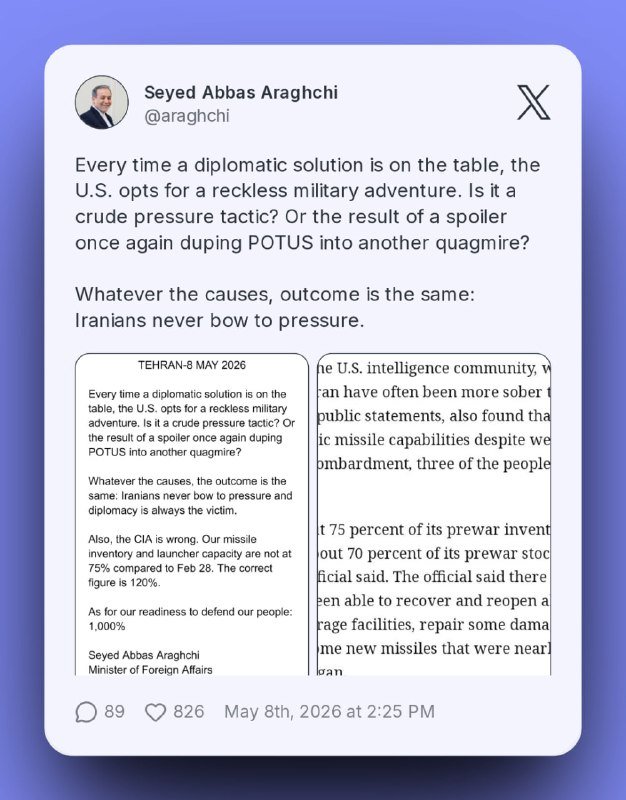
Iranian state media reported on 4 May that two missiles struck a US Navy patrol boat in the vicinity of the Strait of Hormuz after the vessel ignored warnings issued by the Iranian Navy. The incident, first reported by the Fars News Agency — a news outlet affiliated with Iran's Islamic Revolutionary Guard Corps — and subsequently carried by PressTV, Iran's English-language state broadcaster, occurred near Jask on Iran's southern coast. The vessel was forced to turn back, according to the Iranian account.
The Pentagon said it had no immediate comment on the reported strike. No US military authority has confirmed the incident as of late afternoon UTC on 4 May. Independent maritime monitoring services have not yet published corroborating data, and no Western government has issued a formal statement.
The Iranian Account
Fars News Agency described the operation as a response to what Tehran characterised as an unlawful intrusion into waters it considers under its jurisdiction. Iranian military doctrine holds that foreign naval passage through the Strait of Hormuz and adjacent Persian Gulf waters requires advance notification and clearance — a position the United States and its allies do not recognise. Washington maintains that the strait is an international waterway subject to customary international law, and that US vessels operate within their rights under the UN Convention on the Law of the Sea, to which the US is not a signatory but whose provisions it regards as reflective of customary practice.
The IRGC-affiliated outlet said the Navy issued radio warnings before the missiles were launched. The account did not specify the class of vessel targeted, the type of missile used, or the extent of any damage sustained. It described the encounter as a decisive response that compelled the US vessel to reverse course — a framing Tehran would likely characterise as successful deterrence.
The Absence of Western Confirmation
The veracity of the Iranian account cannot be independently established from the sources currently available. Fars News Agency, while a functioning news organisation with regional correspondents, has an institutional relationship with the IRGC that makes its reports on military confrontations inherently contestable. It is not unusual for Iranian state-adjacent media to publish reports that are embellished, premature, or politically calibrated to domestic or regional audiences. A US Navy vessel transiting the strait would also likely be equipped with countermeasures and communication systems that the Iranian report does not address.
Western outlets have not yet carried the story, and the US Central Command, which covers the Gulf region, had not responded to media inquiries at time of publication. The gap between the Iranian announcement and any US or Allied confirmation is significant — it does not mean the incident did not occur, but it does mean the specific details remain unverified from a second source. Readers should treat the Iranian framing as a reported claim, not a confirmed fact.
Regional Context and Maritime Tensions
The Strait of Hormuz is among the world's most strategically saturated waterways, carrying roughly a fifth of global liquefied natural gas exports and a substantial share of seaborne crude oil. US naval presence in the Gulf is routine and governed by decades of bilateral agreements with Gulf monarchies. Iran has long maintained that this presence is destabilising and has, on multiple occasions over the past fifteen years, sought to test the boundaries of what the US will accept as permissible passage.
Previous incidents near Jask and other southern Iranian ports have involved IRGC Navy fast-attack craft shadowing US warships, temporary seizures of commercial vessels, and the downing of a US surveillance drone in 2019. The current US administration has maintained a posture of consistent presence while seeking diplomatic channels to constrain Iran's nuclear programme — a tension that plays out in military signalling as much as in negotiation rooms.
What is different about this reported incident, if accurate, is the kinetic dimension: an actual missile strike, not a shadowing or warning flare. The distinction matters because it shifts the incident from a political provocation to a potential armed conflict trigger. Whether it was a direct hit, a near-miss, or a misreported intercept remains unknown from the sources available.
What Comes Next
The immediate variable is whether the Pentagon confirms any version of events, and at what classification level it chooses to respond. Previous administrations have responded to Iranian provocations with quiet military repositioning — carrier group movements, additional drone presence — rather than public escalation. The current posture is not yet known. Congress has not been formally notified, which would be required if US personnel were injured or a vessel sustained significant damage.
If confirmed, the incident would represent the most direct kinetic engagement between US and Iranian military forces since the US strike that killed IRGC Quds Force commander Qasem Soleimani in January 2020. That episode was followed by Iranian ballistic missile strikes on an Iraqi base housing US personnel, causing traumatic brain injuries to dozens of soldiers but no fatalities. The current context differs: no US official has been named as a target, and the strike reportedly targeted a vessel rather than a fixed installation.
The longer-term question is whether this episode resets the threshold for acceptable Iranian military signalling or is absorbed into the ongoing pattern of regional friction. The answer depends on what the US says next — and on whether the silence from Washington is tactical, bureaucratic, or reflective of a more complicated picture on the water.
This publication will continue to monitor for confirmation from US Central Command and independent maritime tracking sources.
Wire provenance
This editorial synthesis draws on the following public wire/social posts:
- https://t.me/presstv
- https://t.me/osintlive
- https://t.me/GeoPWatch
- https://t.me/wfwitness