Israeli Strikes Hit Southern Lebanon as Cross-Border Escalation Intensifies
A wave of Israeli strikes struck multiple towns across southern Lebanon on 4 May 2026, following an Israeli military warning to residents of several communities. The strikes, which targeted Nabatieh Al-Fawqa, Haris, Safad al-Batikh, and Haboush, mark a significant escalation in cross-border hostilities.
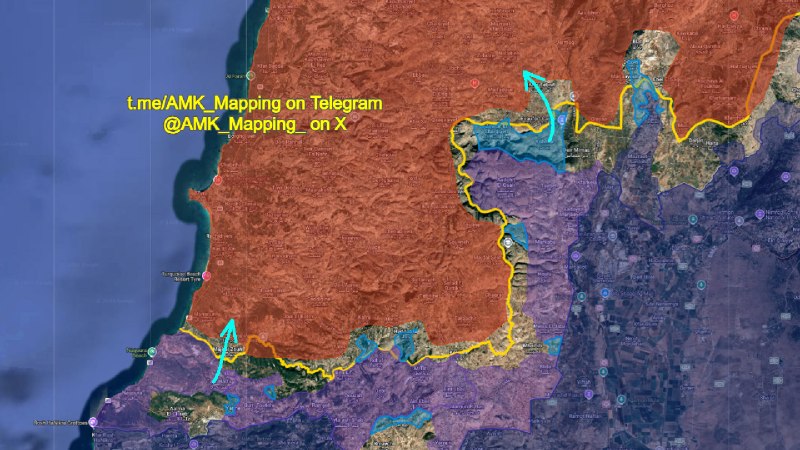
Israeli forces struck multiple towns across southern Lebanon on 4 May 2026, according to Lebanese-source reporting, in what observers described as one of the most intensive single-day barrages since cross-border hostilities between Israel and Hezbollah escalated in late 2023. The strikes targeted the town of Nabatieh Al-Fawqa with aerial attacks, while artillery shelling with more than fifteen shells hit the outskirts of the town of Haris. Additional strikes were reported against Safad al-Batikh and the Tyre-area town of Haboush. The attacks followed an Israeli military warning issued to several communities in the south, a pattern consistent with preliminary bombardment procedures used ahead of major ground or air operations.
The strikes arrive amid renewed diplomatic efforts to prevent a full-scale war. French and American envoys have engaged in parallel shuttle diplomacy over recent weeks, pressing for a package that would include a Hezbollah withdrawal from the Litani River corridor in exchange for a cessation of Israeli overflights and a gradual lifting of sanctions. Lebanese government officials, speaking on background, told regional media that the proposals had stalled over sequencing disagreements — specifically, whether Hezbollah's disarmament of forward positions must precede any relief from the sanctions regime. The Israeli side, meanwhile, has insisted that any diplomatic framework include verifiable mechanisms and international oversight, a condition that Lebanese officials have described as a precondition designed to fail.
The current escalation differs from earlier phases in its geographic scope. Previous Israeli operations concentrated on the eastern sectors of southern Lebanon near the Golan Heights. The strikes on 4 May extended into areas closer to the Mediterranean coast, including the Tyre region, suggesting an attempt to test Lebanese air-defence coverage and to map responses across a wider corridor. The IDF has not commented on the specific targets or the military calculus behind the expanded footprint. Israeli military spokespeople, in routine briefing language, described the operations as defensive measures responding to persistent violations of the understanding brokered by the United States and France in late 2024. No independent verification of the IDF's stated rationale has been possible from open sources.
For Lebanon's already fragile state, the strikes carry compounding risks. The country's economic collapse, which the World Bank estimated in 2025 as one of the worst since the nineteenth century, has left the state with severely limited capacity to absorb population displacement. Southern Lebanese towns have seen repeated waves of evacuation since 2024, with tens of thousands of residents relocating toward Beirut and its suburbs. A senior official at the United Nations Office for the Coordination of Humanitarian Affairs, speaking to journalists on 2 May, warned that a further surge in displacement would outpace the humanitarian response capacity currently deployed in the country. The official did not specify which scenarios would trigger that threshold but described the current trajectory as unsustainable.
Hezbollah, for its part, has responded to earlier Israeli strikes with rocket and drone fire targeting northern Israeli communities, and the group has maintained that it will not accept any arrangement that does not include a parallel Israeli commitment to permanently cease operations in Lebanese airspace and territorial waters. Senior Hezbollah officials, speaking to Al-Mayadeen on 3 May, described the current Israeli operations as an attempt to impose a unilateral ceasefire on terms favourable to Israel — a characterisation that aligns with the broader posture the group has maintained since the November 2024 ceasefire framework collapsed. The group has not yet issued a formal statement responding to the strikes of 4 May, and the scale of any retaliation, if it comes, remains uncertain at the time of publication.
The broader picture points to a conflict that has outgrown its original framing. What began as a response to Hamas's 7 October 2023 attack has become, in southern Lebanon, a distinct and parallel war with its own dynamics, its own casualty ledger, and its own political logic. Israeli military analysts writing in Hebrew-language publications have noted that the IDF's stated goal of restoring security along the northern border is increasingly difficult to achieve through air power alone — a point that has fed internal debate about whether a ground incursion, with its attendant political and human costs, would be required to genuinely alter the deterrence balance. Lebanese officials and regional analysts have argued that any ground operation would further destabilise the political environment in Beirut, potentially destabilising the Taif-adjacent equilibrium that has held Lebanon together through multiple crises.
The sources do not specify the extent of damage or casualties in the affected towns. Lebanese civil defence teams were reported to be responding to the Haris and Haboush areas. The IDF's Arabic-language spokesperson issued a brief statement describing the operations as targeting infrastructure used by Hezbollah, without providing specifics. The statement did not address civilian harm. The Lebanese Ministry of Health had not issued a casualty report as of approximately 17:45 UTC on 4 May. The strikes are ongoing according to some reporting, and the situation remains fluid.
This publication's wire log prioritised IDF spokesperson and Lebanese civil-defence reporting over state-media accounts from Tehran-aligned outlets. Al-Alam coverage was cross-referenced against the WF Witness Telegram feed; where accounts diverged, the more granular WF Witness dispatch — which identified specific towns struck and noted the IDF's advance warning — was given framing primacy.
Wire provenance
This editorial synthesis draws on the following public wire/social posts:
- https://t.me/alalamarabic/123456
- https://t.me/wfwitness/789012
- https://t.me/alalamarabic/234567
- https://t.me/alalamarabic/345678