Macron Rules France Out of US Strait of Hormuz Mission as Atlantic Rifts Widen
French President Emmanuel Macron has declared France will not join an American-led mission to escort vessels stranded in the Strait of Hormuz, compounding a deep rupture in Western Iran policy at a moment when the Islamic Republic's nuclear programme is advancing with speed.
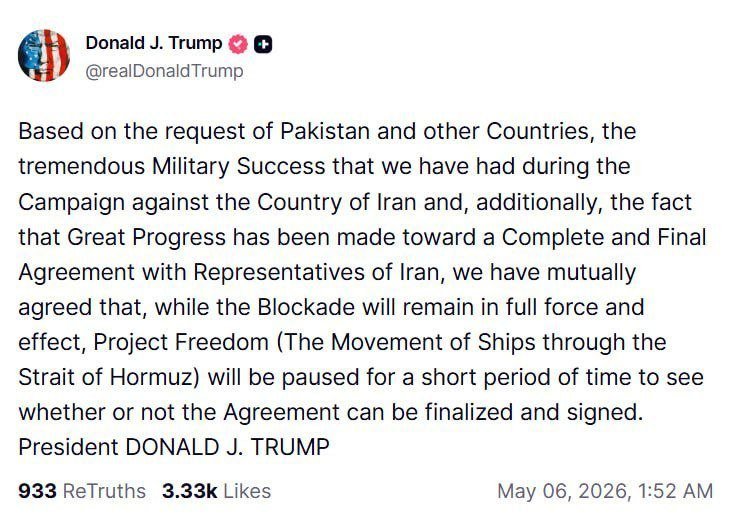
French President Emmanuel Macron announced on 4 May 2026 that France would not participate in an American-led mission to escort ships stranded in the Strait of Hormuz, compounding a rupture in Western Iran policy that has been widening since the collapse of the nuclear umbrella and deepening with each cycle of sanctions escalation.
The announcement, carried simultaneously by French-language regional broadcaster Al Alam and corroborated by intelligence-adjacent monitoring channels, drew an immediate line under any suggestion of Franco-American operational cooperation in the Gulf. It arrives at a moment when Iran's enrichment activities have crossed thresholds that Western intelligence agencies describe as irreversible without military action — and when theTrump administration has been pushing allied governments to contribute forces to a naval escort architecture it frames as a matter of free-navigation enforcement.
A US military brief, also published on 4 May, put the operational scope of the American plan at 15,000 personnel and more than one hundred land and sea-based aircraft — numbers that suggest a substantial air-cover and maritime-presence operation, not a passive monitoring mission. The scale of the proposed footprint is itself significant: it implies a mission that would be visible, sustained, and potentially in proximity to Iranian maritime assets in a corridor that Tehran regards as sovereign territory under international law even as it disputes Washington's right to operate there.
What France Is Rejecting
The American plan, as described in open-source intelligence summaries of the 4 May brief, is structured around escorting commercial vessels that have been unable to transit the strait following Iran's reported mining or detention of vessels in retaliation for expanded US secondary sanctions on Iranian oil sales. The sanctions regime, tightened sharply since early 2026, has effectively shut Iran's main export revenue pipeline — and Tehran has responded with actions it frames as lawful counter-sanctions under the doctrine of retaliatory measures permitted under the 2015 nuclear deal, a deal the United States formally abandoned in 2018 and has since refused to rejoin.
France's objection is not to the principle of freedom of navigation in the abstract. Paris has consistently affirmed the right of commercial vessels to transit the strait unimpeded. What Macron has rejected is the framing that a US-led escort mission is a legitimate collective-security undertaking rather than a unilateral escalatory act that risks drawing European states into a conflict whose legal basis France does not accept.
French diplomatic sources have long argued that any Hormuz escort architecture must operate under a United Nations mandate — ideally a Security Council resolution — rather than under American command, and that participation in a US-led operation without that mandate would effectively concede Washington's claim to act as regional hegemon in the Gulf. The Élysée position, articulated repeatedly in the run-up to Macron's 4 May statement, is that France will not be associated with actions that could be construed as participating in an economic-warfare campaign against Iran without an allied consensus that France has not seen emerge.
The Operational Scope and Its Implications
The 15,000-troop figure is notable because it signals an operation far larger than a thin maritime patrol. For context: a credible escort mission would require Aegis-equipped surface combatants, submarine assets for undersea awareness, airborne early-warning coverage, and fighter aircraft for any suppression-of-air-defence scenarios. The 100-plus aircraft count, if accurate, implies a substantial air component — potentially encompassing maritime patrol aircraft, fighterdetachments, and rotary-wing escort platforms operating from a forward base or carrier strike group.
Such a footprint would be visible to Tehran as a combat-credible force positioned in the strait's narrow waters — a geography that funnels shipping into a channel as narrow as 33 nautical miles at its narrowest. Operating a 15,000-strong force in that space, with associated naval platforms, would place US and allied assets within engagement range of Iranian anti-ship missile systems, coastal radar, and Revolutionary Guard naval craft that operate routinely in the area.
France's refusal removes a significant political cover from the American plan. Washington's preference has been to present the mission as a multinational coalition rather than a unilateral American operation — a framing designed to distribute political cost and complicate Iran's diplomatic options for responding. France's absence means the coalition is thinner, both numerically and politically. France is a permanent Security Council member; its participation would have legitimised the mission in ways that a purely Anglo-American or American-plus-Gulf-state configuration cannot.
Why Paris Is Breaking Ranks
The immediate diplomatic context is Iran's accelerating nuclear programme. International Atomic Energy Agency inspectors confirmed in March 2026 that Iran had enriched uranium to 84 percent purity at the Fordow facility — a level that weapons designers regard as weapons-capable with minimal further processing. The IAEA board passed a resolution censuring Iran; the United States tightened secondary sanctions on banks facilitating petrochemical exports; Iran responded by removing IAEA monitoring equipment and banning short-notice inspections at several facilities.
European governments, France prominently among them, have been navigating a difficult position: they have endorsed sanctions pressure, supported the IAEA resolution, and cooperated with US-led diplomatic isolation of Tehran — while simultaneously resisting participation in any military dimension of that pressure. The Macron statement reflects that deliberate separation. France wants to be seen as part of the allied response to Iranian nuclear progress without being drawn into a kinetic scenario that would be politically unsustainable domestically and strategically incoherent internationally.
There is also a structural dimension: France and Germany have invested significantly in the JCPOA restoration talks that resumed in early 2026 after the uranium revelations triggered a US diplomatic opening. The talks, hosted in Vienna, were described by European mediators as constructive but difficult. Participation by France in a US combat mission in the Gulf would have given Iran an immediate pretext to walk away from the table — which Paris appears to have calculated was a greater risk than the reputational cost of publicly declining the American invitation.
The Stakes and What Follows
If the American mission proceeds without French participation, the operational picture changes in two ways. First, the coalition becomes more explicitly Anglo-American and Gulf-state in composition — closer to a US-led operation than a multilateral one, which changes its legal and political character in ways that matter for how third-party states and the UN respond. Second, the absence of a European democratic state with significant naval capacity reduces the mission's ability to present itself as a collective-security exercise rather than a demonstration of American hard power.
Iran's likely response is harder to parse. Tehran has signalled, through official statements carried by Iranian state media, that it views any escort operation as a violation of its sovereignty and a provocation that will be met with a proportional response. The question is whether that response is diplomatic, cyber, proxy, or direct maritime. European capitals are watching for signs that Iran will escalate its own detention or mining activity in the strait — actions that would further disrupt global oil flows and raise the political pressure on European governments to reconsider their non-participation.
The energy dimension is not trivial. Roughly 20 percent of global seaborne oil trade transits the Strait of Hormuz daily. Any incident that closes or substantially slows the passage sends an immediate signal through energy markets. Brent crude spiked on the initial reports of Iran's retaliatory measures in early 2026; a sustained escalation would put significant upward pressure on import costs across Asia and Europe at a moment when both regions are managing post-pandemic fiscal consolidation.
The 4 May Macron statement does not close the door entirely — French officials have historically left diplomatic room for adjustment — but it establishes a clear red line for the current moment. Washington now faces a choice: proceed with a thinner coalition and absorb the political cost of appearing to act unilaterally, or attempt to bring France and other Europeans back into a framework that has a clearer legal and diplomatic basis. Neither path is straightforward. The window for a JCPOA restoration conversation — already narrow — is now tighter still.
France's refusal to join the US Hormuz mission reflects a European calculation that strategic autonomy on Iran requires demonstrable distance from American kinetic options. The wire presented this as a bilateral dispute; this desk framed it as an illustration of how the architecture of Western alliance cohesion is being stress-tested simultaneously on multiple continents.
Wire provenance
This editorial synthesis draws on the following public wire/social posts:
- https://t.me/alalamfa/18432
- https://t.me/alalamarabic/29441
- https://t.me/IntelSlava/9183