The Met Gala's Viral Logic Has Finally Consumed the Event It Was Built To Celebrate
An analysis of two decades of red-carpet archival photos reveals what Reuters documented on 4 May 2026: Met Gala silhouettes have grown bigger and more complex, driven by social media mechanics that reward spectacle over wearability. That measurement is also a verdict on what the event has become.
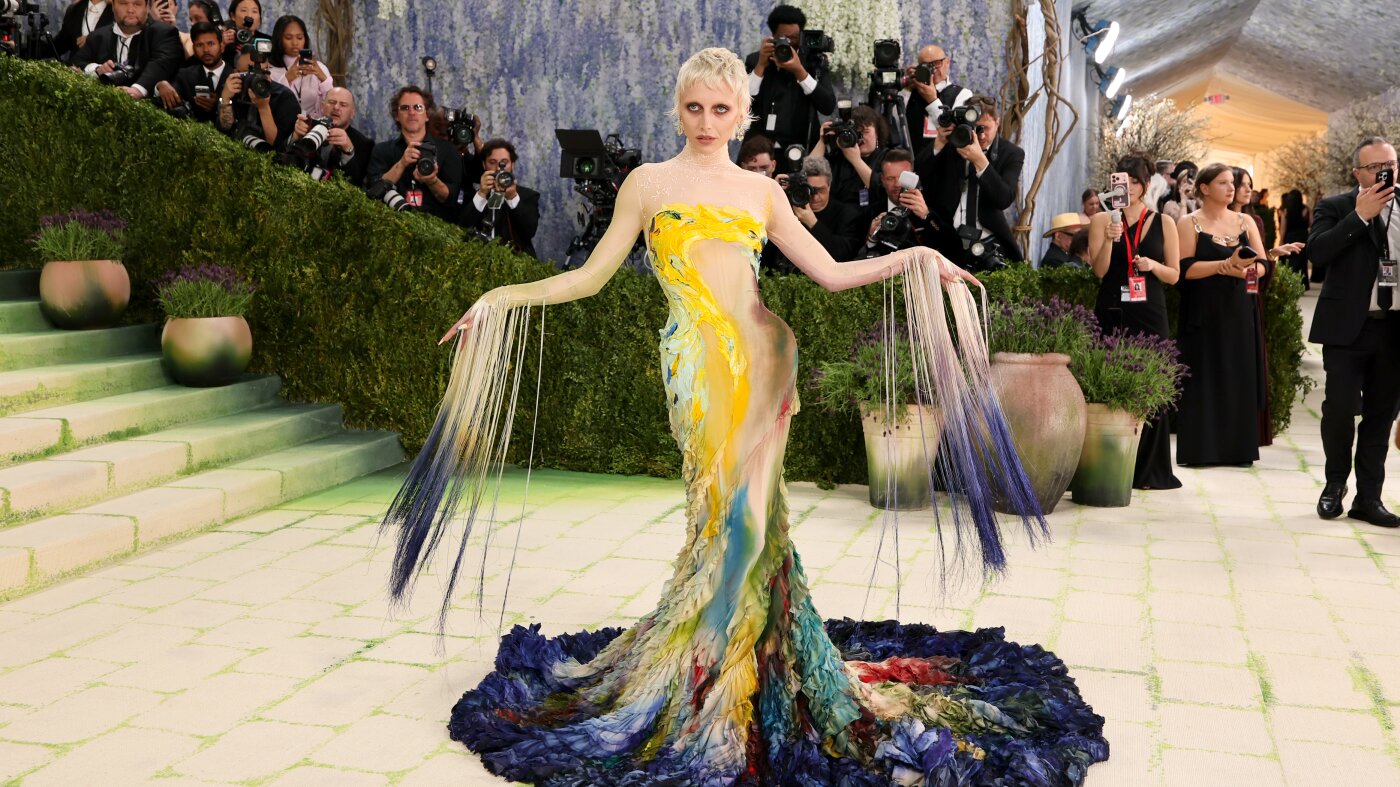
The photographs tell the story without needing a thesis attached. Open any retrospective of the Met Gala circa 2003 and the eye moves smoothly: a gown, a face, a setting. Open the 2026 coverage and the hierarchy inverts. The garment no longer sits on the body — it competes with it. On 4 May 2026, Reuters published an analysis of archival red-carpet images showing that Met Gala silhouettes have grown measurably bigger and structurally more complex over the past two decades. The data point is precise because the phenomenon is visual. Someone measured.
That measurement is also a verdict.
The Architecture of Attention
The Reuters analysis traced the shift to two interacting forces: social media and celebrity branding. The causal chain is not subtle. Instagram rewards scale and contrast. A train that fills the frame, a shoulder that doubles the silhouette's footprint, a colour palette that stops scrolling — these are engineering decisions dressed as artistic ones. When a celebrity's relevance is indexed partly by engagement metrics, the Met Gala red carpet becomes a content production floor disguised as a fundraising dinner.
The National Public Broadcasting coverage of the 2026 event described celebrities and designers moving up the famous staircase in what it called the fashion industry's biggest night. That description is accurate and largely unchanged from how the event has been characterised for decades. What has changed is the operative verb. They are not attending. They are performing. The distinction matters because it reshapes who controls the event's meaning.
Fashion historians and critics have noted the shift before, usually in the language of惋惜. The Met Gala was established to raise money for the Costume Institute and to serve as the opening-night gala for its annual exhibition. The event was always celebrity-adjacent, but the primary relationship was between living designers and living artists who could give the exhibition a public face. That relationship has been superseded. The celebrity is now the message, and the designer is a contractor.
Wearability as the First Casualty
The structural logic of viral fashion is straightforward: the more unwearable the garment, the less competition it faces on the red carpet, and the more likely the image is to circulate without context or comparison. A gown that could be worn to a formal dinner is functionally identical, in a photograph, to a dozen other formal gowns. A gown that could only exist for this one moment, requiring structural engineering and custom movement choreography, produces a unique image.
This is not a criticism of ambition in fashion design. Avant-garde fashion has always explored the boundary between garment and sculpture. The difference is intent and context. When Maison Margiela or Comme des Garçons deploy structural experimentation, the work exists within a discourse about the body, about materiality, about the relationship between clothing and movement. The Met Gala's escalating silhouette war has no equivalent discourse. The garments are not asking questions. They are answering algorithms.
The Polymarket market on whether anyone would propose at the 2026 Gala, which settled at 17% probability, tells its own story. The question itself is a measure of how the event has been reframed. A proposal at a charity gala is romantic in the abstract and awkward in the practice — it requires a second party to be present, consenting, and willing to be ambushed publicly. The existence of a market on this outcome suggests that at least some segment of the audience is treating the Met Gala less as a fashion event and more as a container for spectacle of any kind, including personal spectacle elevated to public performance. The distinction between a proposal and a stunt has thinned to nothing.
What the Event Has Lost — and What It Has Gained
It would be incomplete to write this as a pure elegy. The Met Gala in 2026 is more globally visible than it has ever been. The Reuters archival analysis is itself a form of that visibility — someone looked at twenty years of images closely enough to extract a measurable trend and published it. That is cultural attention, even if the attention is partly calibrated to spectacle. The Costume Institute exhibitions that the Gala accompanies have also grown in ambition and attendance. The underlying institution is not failing.
What has shifted is the relationship between the two functions. The exhibition used to justify the gala. Now the gala, understood as a content-production event, generates the audience for the exhibition. This is not the same thing. The exhibition's curatorial logic asks you to look at how clothing functions as culture — its history, its politics, its social grammar. The gala's content logic asks you to look at how clothing functions as signal — its visibility, its shareability, its differentiation from other signals. These are different intellectual operations, and they pull in different directions.
Fashion's own critics and practitioners have begun to name this tension. The language varies — overcommercialisation, the Instagram-ification of couture, the death of subversion — but the complaint is structurally consistent. An event that was built to support a cultural institution has become a machine for producing influencer-adjacent content, and the people inside it have adapted to the machine's requirements. A designer who produces a wearable, thoughtful gown at the Met Gala in 2026 has made a quiet political statement and a poor engagement decision. The incentives are not subtle.
The Stakes Beneath the Spectacle
The Reuters finding is worth taking seriously not because it identifies a scandal — it does not — but because it describes a structural change in how a major cultural institution relates to the public it claims to serve. The Met Gala raises money for the Costume Institute, which serves researchers, students, and general visitors interested in the history of dress. When the Gala's dominant mode becomes spectacle-production, the gap between the institution's public mission and its public face widens. The people who attend the exhibition because they are genuinely interested in fashion history encounter an event whose red carpet has been optimised for people who are not.
This is not an argument for boring clothes at galas. It is an argument for asking what an institution is actually doing when it stages an annual spectacle that it controls only partially. The Met Gala's guest list is curated, its theme is set by the Costume Institute, and its public framing is managed by a team of publicists. The escalation of the silhouette arms race has happened within those parameters, which means the escalation is at least partly a choice — a choice to prioritise the event's virality over its coherence with the institution it funds.
The 2026 Gala will be remembered, if it is remembered at all, as the year the archival data caught up with what everyone already felt. The gowns were bigger. The evening was louder. The Instagram accounts were busier. Whether the Costume Institute's exhibition, which presumably asked some genuine question about clothing and culture, received proportionate attention is a question the sources do not fully answer — and that silence is itself informative.
This publication covered the Met Gala as a cultural-institution story rather than a celebrity-fashion story. The Reuters analysis provided the empirical anchor; the NPR and Polymarket sources contextualised the event's dual function as fundraiser and content platform.
Wire provenance
This editorial synthesis draws on the following public wire/social posts:
- https://x.com/reuters/status/2051425203582857216