Monster Truck Tragedy in Colombia Exposes Safety Gaps at Rural Exhibition Events
Three people died and 38 were injured when a monster truck lost control at an exhibition in Popayán, Colombia on May 4, 2026 — an event that local observers say lacked basic safety infrastructure.
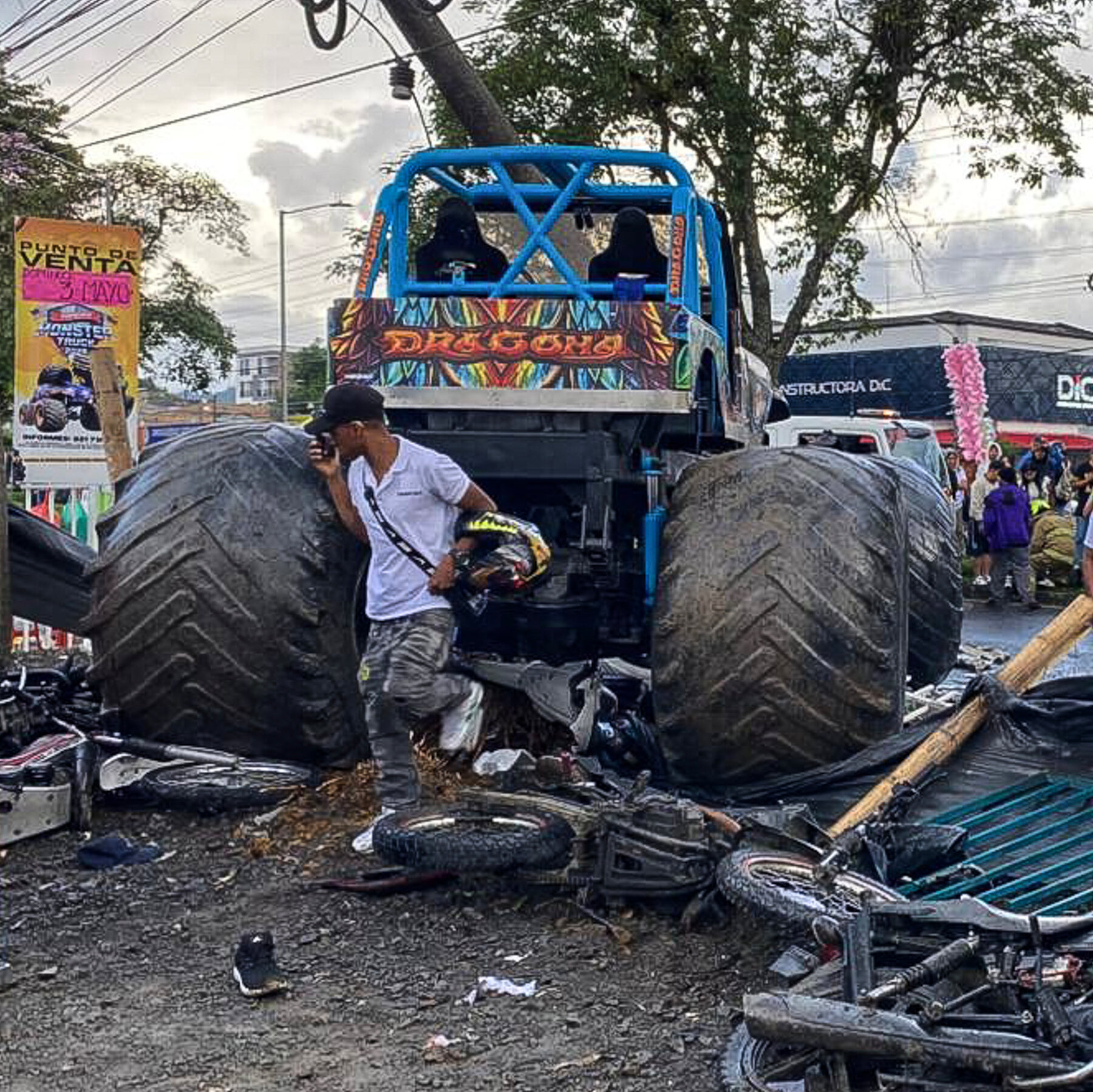
A monster truck exhibition in Popayán, the capital of Colombia's southwestern Cauca department, turned fatal on May 4, 2026, when the vehicle crashed into a crowd of spectators. Three people were killed and 38 others injured, according to reports from the scene. Among the dead was a ten-year-old child, per initial accounts. The female driver of the truck lost control and ran into the crowd at an event that local social media observers described as having no visible safety measures in place.
The incident underscores a recurring vulnerability at informal exhibition events across Latin America — large crowds gathered around heavy machinery or high-powered vehicles with minimal crowd-control infrastructure, no designated spectator zones, and limited emergency response capacity. What is known of the Popayán event fits a pattern: an under-regulated public spectacle where excitement and proximity take precedence over safety engineering.
What Happened at the Popayán Exhibition
The event took place in an outdoor setting in Popayán on the morning of May 4, 2026 UTC. Video and photographic material circulating on social media showed the moment the truck veered from its intended course and struck spectators. Local users on X described a scene of chaos, with people running from the vehicle as it moved through the crowd. Emergency services responded to the site, though the capacity of local hospitals and trauma centres in the region to handle a mass-casualty event of this scale has not been independently assessed.
Colombian authorities have not yet issued a formal statement identifying the event organiser, the insurance status of the exhibition, or what permitting process — if any — applied. The absence of that information is itself significant. Major public events in Colombia's larger cities typically require municipal permits and police coordination. Rural or semi-urban exhibitions of this kind frequently operate in a grey zone.
The Safety Record of Monster Truck Events
Monster truck exhibitions are a established entertainment format across Latin America, the United States, and Europe, typically staged at racetracks or large venues purpose-built for vehicle crowds separation. The standard safety architecture in professional settings includes concrete barriers, defined perimeter zones, and mandatory distance between the performance area and spectator seating.
The conditions described at the Popayán event — if the reports of absent safety measures are accurate — represent a radical departure from those standards. A 2019 review of live event safety protocols across a number of Latin American venues found that crowd-barrier requirements were inconsistently applied outside of major urban centres, and that liability frameworks for private exhibition events varied significantly by municipality.
The gap between the risk profile of monster truck displays — vehicles weighing several tonnes, operating at speed, in unpredictable close-quarters settings — and the regulatory oversight applied to them in smaller Colombian cities appears to be substantial. Whether the Popayán event was an outlier or representative of a broader enforcement gap is a question the available evidence cannot yet answer.
Who Bears Responsibility for Exhibition Safety
In Colombia, responsibility for event safety is nominally shared between organisers, municipal authorities, and local police. Organisers of public exhibitions involving motor vehicles are required to file safety plans with their municipal government; in practice, enforcement in smaller cities and towns is uneven. Human rights and consumer-safety advocates in the country have long argued that regulatory capacity at the local level does not match the ambition of the permitting framework.
The driver of the truck — identified in early reports only as a woman — has not been publicly named as of this writing. It is not yet clear whether criminal proceedings have been initiated against her or against any event organiser. Colombian traffic law holds drivers responsible for harm caused by vehicles under their control, but legal outcomes in mass-casualty crowd events depend heavily on evidence about whether the failure was mechanical, operator error, or the result of inadequate event design.
A counter-framing worth noting: defenders of informal exhibition culture in Colombia argue that rural communities have long organised vehicle-based entertainment with low incident rates, and that the regulatory frameworks designed for large urban venues are ill-suited to small-town contexts where the community itself is both organiser and audience. The tension between safety standardisation and community autonomy is not unique to Colombia — it shapes debates about event governance across the region — but it becomes acute when an incident produces the casualty toll seen in Popayán.
The Broader Stakes and What Comes Next
Three families in Popayán are grieving, and 38 others are managing injuries whose severity has not been disclosed. The institutional response — or lack of one — will define the aftermath. If past incidents of this kind are any guide, the Colombian Ministry of the Interior and municipal authorities in Cauca will face pressure to audit permitting practices for vehicle exhibitions. Industry groups representing motorsport and entertainment may issue voluntary safety guidelines, though without statutory force such codes are typically ignored by the lowest-cost operators.
The reputational damage to the monster truck exhibition format in Colombia will be real, if temporary. The format's appeal — spectacle, scale, proximity to danger — depends on a perception of controlled risk. When that control visibly fails, audiences recalibrate. Whether regulators use this moment to close the enforcement gap or whether the regulatory vacuum persists until the next tragedy is a question whose answer will be determined not in Popayán but in the offices of municipal administrations across the country.
This publication noted that initial English-language wire coverage of the Popayán incident was limited in the hours after the event, with social media reports from Colombia outpacing established newsroom deployment. The discrepancy between the volume of visual evidence circulating online and the pace of institutional reporting reflects a broader pattern in coverage of non-urban events in the Global South.