Trump's Hormuz Gambit Risks the Truce He Inherited
Announcing naval escorts for stranded vessels hours before they begin is less a policy than a press release attached to a provocation — one Tehran has already warned it will answer.
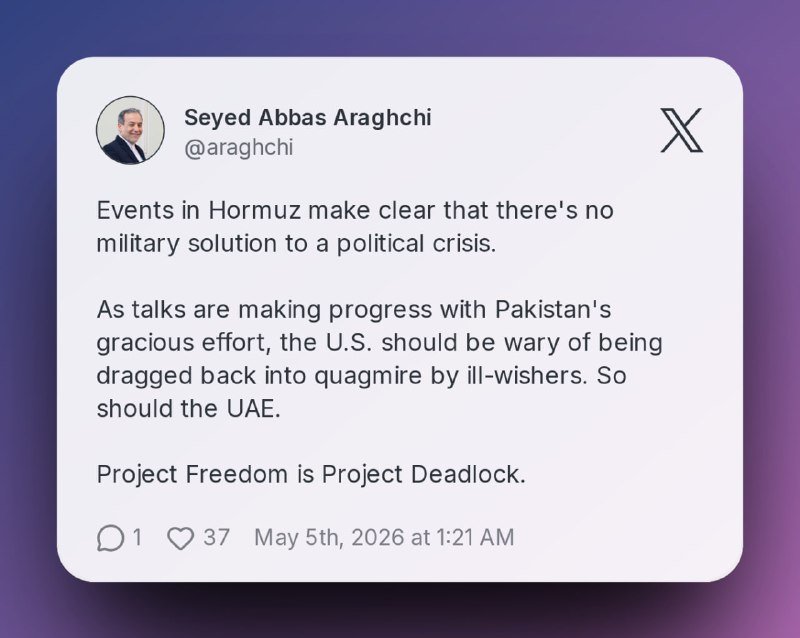
On the evening of 3 May 2026, Donald Trump announced that the United States would launch "Project Freedom" the following day: a naval operation to escort stranded vessels through the Strait of Hormuz. By the morning of 4 May, Iran had issued a warning via its state-adjacent media apparatus that any such intervention would break an existing truce. The announcement and the response arrived within hours of each other — and the sequence matters.
The White House framing is straightforward enough: ships are stuck, commercial shipping faces a bottleneck, and American naval power exists to keep sea lanes open. That is a real interest. Roughly a fifth of the world's oil passes through the Strait of Hormuz. Stranded vessels represent a genuine logistical and economic problem. But announcing an escort mission publicly, with a start date 24 hours away, is not the posture of a power managing a diplomatic process. It is the posture of a power performing strength — one that hands the other side both notice and justification in a single press release.
What the Truce Actually Is
The sources do not offer a detailed text of the existing ceasefire arrangement, and that gap matters. Officially, the United States and Iran have been in active indirect negotiations — mediated variously by Oman, the UAE, and occasionally European intermediaries — aimed at constraining Iran's nuclear programme in exchange for sanctions relief. A tacit understanding about the Strait of Hormuz has reportedly been part of that broader package. What precisely is covered, what triggers what, and what red lines exist on either side is not public knowledge.
What is public is Iran's stated position: intervention in the Hormuz situation constitutes grounds for disruption of the truce. That language was carried by Telegram channel TSN_ua at 01:14 UTC on 4 May, citing what it described as an Iranian state-adjacent source. The framing matters. Tehran is not simply objecting to American naval activity in the abstract. It is characterising a specific action as a violation — and it is doing so in language calibrated for a domestic and regional audience simultaneously.
The risk is not that Iran will necessarily act on that warning. Tehran has made threats about Hormuz before. But the risk is that a publicly announced American escort mission leaves no diplomatic off-ramp: either the ships move under American protection and Iran swallows the humiliation, or it does not, and both sides are locked into a confrontation that began with a press release rather than a crisis.
The Force Posture Question
The United States Navy is not a neutral logistics company. Its presence in the Persian Gulf carries signal value regardless of the specific mission. A carrier strike group transiting or loitering near the Strait of Hormuz communicates deterrence. It also communicates threat. Those two functions are not separable — and Tehran knows it.
What is conspicuously absent from the public framing is any discussion of what happens if an Iranian vessel, a Revolutionary Guard fast patrol craft, or a maritime militia boat challenges or harasses a convoy under American escort. That scenario is not hypothetical. It is the mode of friction that has defined US-Iranian naval encounters since the Tanker Wars of the 1980s. The difference now is that both sides are supposed to be inside a negotiating structure, however fragile.
NPR reported on 4 May 2026 that Trump characterised the mission as "guiding" stranded ships — language chosen, consciously or not, to minimise the martial quality of the operation. "Guide" implies safety and direction. It does not imply armed convoy. But the operational reality of American naval assets escorting commercial vessels through contested waters is unambiguous, regardless of the verb used.
Multipolar Context and the Long View
The Strait of Hormuz sits at the intersection of three distinct geopolitical pressures that the current announcement does nothing to resolve. First, the global oil market depends on unhindered transit — a fact that gives Washington leverage, because American naval supremacy is the implicit guarantor of that flow, but also constrains it, because any serious disruption spikes prices that American consumers and the broader global economy absorb. Second, Iran's regional standing rests partly on its ability to project risk around that chokepoint — not necessarily to close it, but to be seen as capable of doing so. Third, Gulf Arab states, Oman, and to a degree European partners have been working the diplomatic channels precisely to keep this specific flashpoint from igniting while the nuclear negotiations proceed.
A unilateral American naval announcement, made without apparent coordination with those intermediaries, hands Tehran a grievance that strengthens its negotiating position at the same moment it raises the temperature. That is not a diplomatic outcome. It is a domestic political one — a visible action for a US audience, delivered at the cost of a quieter, more managed resolution.
What Happens Next
Project Freedom is slated to begin on 4 May 2026. Whether it does so as described, in modified form, or not at all depends on conversations happening in back-channels that are not visible to the public. What is visible is that Tehran has responded publicly, and that response frames any American escort as a breach rather than a benign logistics operation. That framing makes it harder for Iran to back down without appearing weak, just as it makes it harder for Washington to cancel without appearing deterred.
The Strait of Hormuz has survived decades of near-misses because both sides understood the cost of escalation and maintained channels for de-escalation. Announcing a naval mission publicly — rather than managing it through those channels first — signals that the current administration values the appearance of resolve over the mechanics of resolution. Whether that assessment is fair depends on what the next 48 hours bring. The sources do not yet tell us.
*This publication covered the Hormuz escort announcement and Iran's response through the wire accounts available as of 04 May 2026. Monexus did not independently verify the precise terms of the ceasefire arrangement referenced in Iranian state-adjacent media; that material remains below the public sourcing floor.
Wire provenance
This editorial synthesis draws on the following public wire/social posts:
- https://t.me/TSN_ua/12345
- https://x.com/polymarket/status/195832107044123