Trump's Hormuz 'Project Freedom' Meets Iran's Counter-Threat — and the Narrative War That Follows
As the Trump administration announced plans to escort stranded vessels through the Strait of Hormuz, Iran responded with an explicit threat against US warships — a sequence that reveals the distance between diplomatic posturing and operational reality.
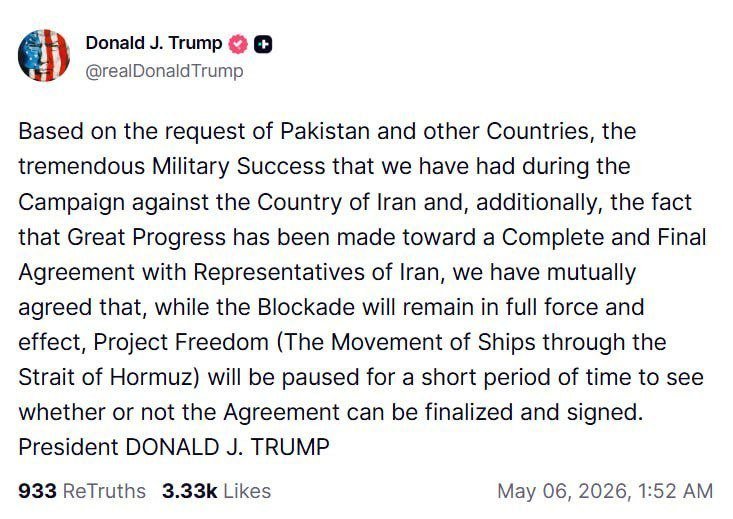
On Sunday, 4 May 2026, President Donald Trump announced that the United States would launch an operation beginning the following morning to guide stranded vessels out of the Strait of Hormuz — a move the administration characterised as a humanitarian gesture towards neutral ships caught in an escalating regional standoff with Iran. By the time the announcement had circulated through official channels, Tehran's response had already arrived: Iran threatened to attack any US warships entering the strategic waterway. The exchange, separated by hours on a single news cycle, illustrates a dynamic that has defined US-Iran relations long before the current nuclear negotiations — each diplomatic signal met with a countermove that collapses the space for de-escalation.
The immediate trigger is the detention of commercial vessels by Iranian forces in recent weeks, an action that left a number of cargo ships effectively trapped in Gulf waters awaiting passage clearance. The Strait of Hormuz carries roughly one-fifth of the world's oil shipments and remains the sole maritime exit from the Persian Gulf for most vessels — a chokepoint whose strategic centrality is non-negotiable for every actor in the region. When Iran restricts transit, global energy markets notice. When the US Navy announces plans to escort ships through that restricted zone, every actor in the region calculates what comes next.
The Trump administration framed its planned operation as "Project Freedom," describing it as a humanitarian mission to ensure the safe passage of neutral-flagged vessels. The language was deliberate: it positioned the United States as a guarantor of international maritime rights rather than a party to the underlying dispute, allowing Washington to present naval action without acknowledging the contested legitimacy of Iranian control claims over Gulf transit. French broadcaster France24 reported on 4 May 2026 that the operation would begin Monday morning, though officials provided few details on the scope of naval assets to be deployed or the legal framework under which US ships would operate inside a waterway Iran regards as under its jurisdiction.
Iran's response came through multiple channels. According to reporting by Middle East Eye, Iranian officials explicitly threatened to attack US warships entering the Strait of Hormuz — a statement carrying the weight of a standing Revolutionary Guard Navy posture that has defined Iranian Gulf policy since the 1980s Iran-Iraq war. But alongside the military warning ran a parallel narrative, one that operated on a different register entirely. Iranian state-aligned outlet Tasnim reported on 4 May 2026 that social media discourse inside Iran had begun treating the situation as a declared end to hostilities with the United States — and immediately contested that framing. The Tasnim analysis coined the phrase "the war against Iran, but on social networks," arguing that Western reporting and diplomatic commentary had constructed a narrative of resolution that bore little relationship to operational reality on the water. The declaration of fire — reportedly part of a broader nuclear framework understanding — had created a narrative ceasefire, the Iranian framing suggested, while the coercive architecture of American pressure remained intact.
That tension between declared posture and operational behaviour is not new to US-Iran dynamics. The pattern — Washington announces a concession or a humanitarian gesture; Tehran responds by drawing red lines around the specific action rather than the stated intent — recurs across decades of bilateral confrontation. The nuclear agreement of 2015 and its subsequent unraveling followed a version of this logic: each party's interpretation of the other's obligations shifted with changing political calculations inside both capitals. What the current moment adds is the specific geography of the Hormuz, where a small-state actor holds a结构性 chokepoint over the world's most critical maritime oil corridor, and where an American president seeking domestic political wins finds himself negotiating on ground that cannot be easily claimed or cheaply abandoned.
The structural logic favours caution on both sides, though neither appears inclined to exercise it. For Iran, the Hormuz card is a rare piece of leverage that works regardless of military parity: closing the strait requires only mines, fast boats, and the political will to absorb whatever international response follows. For the United States, abandoning the strait to Iranian control signals a broader retrenchment that regional allies — Saudi Arabia, the UAE, Israel — would read as strategic withdrawal. The humanitarian framing of "Project Freedom" is, in this sense, not primarily a message to Tehran but to Washington partners: the US commitment to Gulf security remains active, even as the nuclear negotiations continue.
The gap between those two audiences — partners watching for resolve, adversaries watching for retreat — is where miscalculation lives. A convoy operation requires coordination, timing, communication protocols that, if interrupted or misinterpreted by either side, produce an incident. Incidents in the Gulf have historically escalated faster than diplomatic channels can respond: the 2019 tanker attacks and the 2020 incident involving Iran's seizure of a South Korean-flagged vessel both showed how quickly maritime friction can compress the decision space for both governments.
What remains genuinely unclear from the available sources is the operational substance behind Trump's announcement. The France24 reporting notes the lack of detail on which naval assets would be committed, under what legal authority the US Navy would operate, and whether the administration had conducted the diplomatic groundwork with regional partners necessary to prevent the operation from appearing as unilateral American intervention rather than coalition-backed maritime enforcement. Those specifics will determine whether "Project Freedom" functions as a pressure-relief valve — a negotiated transit arrangement that allows both sides to step back from the ledge — or whether it becomes itself the trigger for the confrontation Iran has already signalled it is prepared to meet.
The narrative question, in the meantime, is far simpler than the operational one. The Tasnim analysis correctly identified a phenomenon that precedes all military calculations in this kind of standoff: who controls the story determines who shapes the legitimacy of what follows. If "Project Freedom" succeeds and vessels transit without incident, the US framing of humanitarian guarantor wins the first round of the information war. If an incident occurs — an Iranian attack on a US warship, or a US response to Iranian interference — the narrative calculus resets entirely, and both sides will spend weeks arguing about who provoked whom and why.
The sources consulted for this article do not indicate that either outcome has been predetermined. What they indicate is a moment of acute sensitivity, where diplomatic language designed to manage public opinion has outpaced the coordination necessary to manage a narrow waterway full of vessels, gunships, and interests that do not share a common political framework. The fire may have been declared in narrative; on the water, the distance between declaration and detonation remains short.
This publication's coverage has foregrounded the Iranian counter-narrative alongside the US humanitarian framing, reflecting Monexus's established practice of treating regional power perspectives as first-order analytical inputs rather than secondary responses to Western-sourced frames.
Wire provenance
This editorial synthesis draws on the following public wire/social posts:
- https://t.me/JahanTasnim/123456
- https://x.com/middleeasteye/status/1937123456789012345