Trump's Iran War and the Cost of Manufactured Certainty
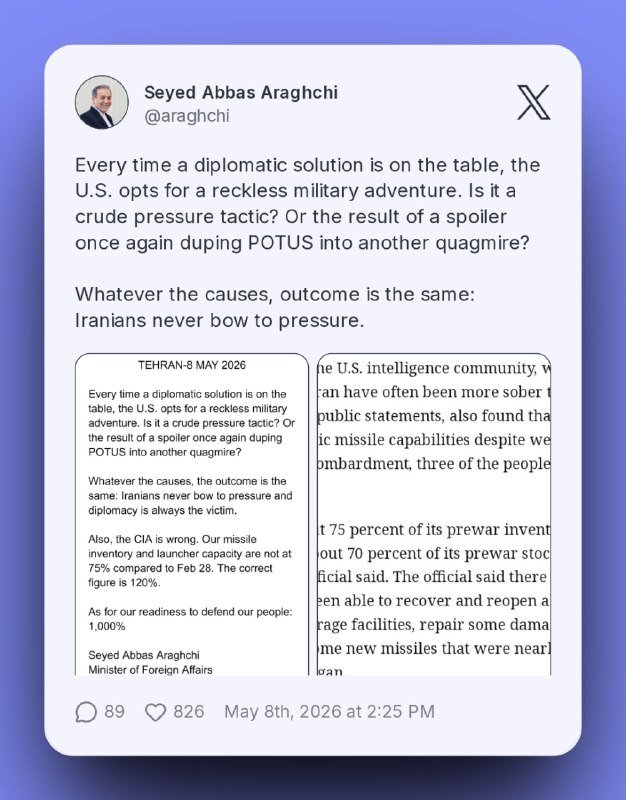
On 4 May 2026, CNN published reporting that the Trump administration had lied about the progress of its Iran military campaign — advancing claims of Iranian capitulation and facility destruction that internal assessments did not support. That same morning, the New York Times ran two pieces framing the strikes as a turning point in American imperial decline. Haaretz reported the president's visible frustration with Tehran's refusal to buckle. The picture emerging is not simply a failed military operation. It is a crisis of manufactured certainty — the systematic substitution of preferred narrative for evidence.
The gap between what officials said and what the intelligence showed has become a structural feature of this conflict, not an incidental one. And that gap matters for reasons that extend well beyond the immediate military calculus.
The Quagmire He Swore He'd Avoid
The New York Times was direct on 4 May: through this military adventure, Trump created the same quagmire he had promised to stay away from. The paper noted that the president who ran on ending endless wars has instead committed the United States to a strike campaign with no clear exit. Haaretz reported that Trump is very angry because Iran does not surrender — a sentiment that reveals the fundamental miscalculation at the campaign's core. The administration appears to have expected that physical destruction of facilities would translate into political capitulation. It has not.
The pattern is familiar from a century of American interventions: initial military superiority followed by political stagnation. The problem is that compelling another state to abandon its nuclear programme or regional posture through air power alone is an extremely high bar. The costs — in materiel, diplomatic capital, and credibility — accrue immediately. The objectives remain elusive.
The Intelligence Gap
CNN's reporting on 4 May, citing what appear to be current and former officials, indicates that the administration's public claims about the success of early strikes were not fully supported by what intelligence assessments showed. The reporting did not claim fabrication for its own sake — it pointed to a specific dynamic: an administration that described Iranian facilities as significantly degraded and the threat as substantially diminished, while also pursuing additional strike authorisations weeks into the campaign. If the first round achieved what was claimed, the second was unnecessary. If the second was necessary, the first-round claims were overstated.
This is not a technical discrepancy. It reflects a decision to construct a public narrative that demonstrated decisive action while concealing operational complexity. The reporting suggests the gap was known to senior officials — and that it was managed, not corrected.
What the reporting also surfaced is a divergence between the administration's stated justification — preventing Iranian nuclear weapons capability — and intelligence community assessments as characterised in the CNN piece. Iran was not assessed as actively pursuing a weapon at the time of the strikes, per the characterisation in the reporting. That is a significant gap between stated rationale and accepted fact. It does not mean the strikes were illegitimate under international law, but it does mean the public case made for them overstated the urgency in ways that are now, under the light of post-hoc reporting, difficult to sustain.
The Structural Consequence
What happens to American credibility when an administration is caught in this pattern?
The stakes are not abstract. If the campaign was presented as demonstrating decisive American power — degrade Iranian facilities, compel concessions, signal resolve — and the evidence suggests a more ambiguous picture, then allies and adversaries both draw conclusions. Partners who were told the threat was contained will recalculate. Adversaries who were told American action was overwhelming will note that the strikes have not produced the promised political outcome.
The New York Times framed it as a turning point in the decline of the American empire — language that, coming from a establishment outlet not given to dramatic framing, is significant. The argument is not simply that this campaign failed. It is that the failure is symptomatic of a pattern: an inability to convert military force into durable political outcomes, combined with a willingness to paper over the gap with public claims that do not survive contact with the underlying evidence.
Haaretz, in its own reporting on the same day, asked whether Trump has the ability to determine the breaking point of the regime in Iran after the failure of the goals he planned — a question that implicitly acknowledges the campaign has not produced the leverage the administration expected. The strike capability is real. The political leverage it generates has been less than advertised.
What This Means Going Forward
The sources do not specify the current operational tempo of the campaign, the specific assessments that differ from public claims, or the administration's full response to the reporting. What they do establish is a pattern: a campaign whose public framing has been systematically managed to present decisive success while the underlying evidence tells a more complicated story.
The irony is precise. The president who declared American intervention in the Middle East a strategic error — and won office in part on that premise — has now committed the United States to an escalating campaign with no defined endpoint and a growing gap between what was promised and what has been delivered. The quagmire is not theoretical. It is the set of choices already made: additional strikes, hardened Iranian posture, fraying coalition unity, and a domestic political context in which the administration's credibility on foreign policy is now itself a subject of legitimate public doubt.
Whether this moment represents a recoverable miscalculation or a structural shift in American regional standing remains to be seen. The evidence, as reported across multiple outlets on the same day, suggests the window for the former is narrowing.
Wire provenance
This editorial synthesis draws on the following public wire/social posts:
- https://t.me/alalamarabic/38482
- https://t.me/alalamarabic/38481
- https://t.me/alalamarabic/38478
- https://t.me/alalamarabic/38477
- https://t.me/alalamarabic/38476