The Hormuz Gambit: Trump's Naval Blockade and the Anatomy of Coercive Diplomacy
The U.S. blockade of Iranian ports is the most ambitious application of economic warfare since the Gulf War. Whether it produces capitulation or catastrophe depends on calculations Tehran, Washington, and the market are each making differently.
On 4 May 2026, the White House called it the greatest military maneuver in history. By the morning of 5 May, Polymarket's trading community had assigned a 28 percent probability to the blockade being lifted before the end of the month. Neither of those things can be true at once, yet both exist simultaneously in the market for risk that now defines how the world prices American foreign policy.
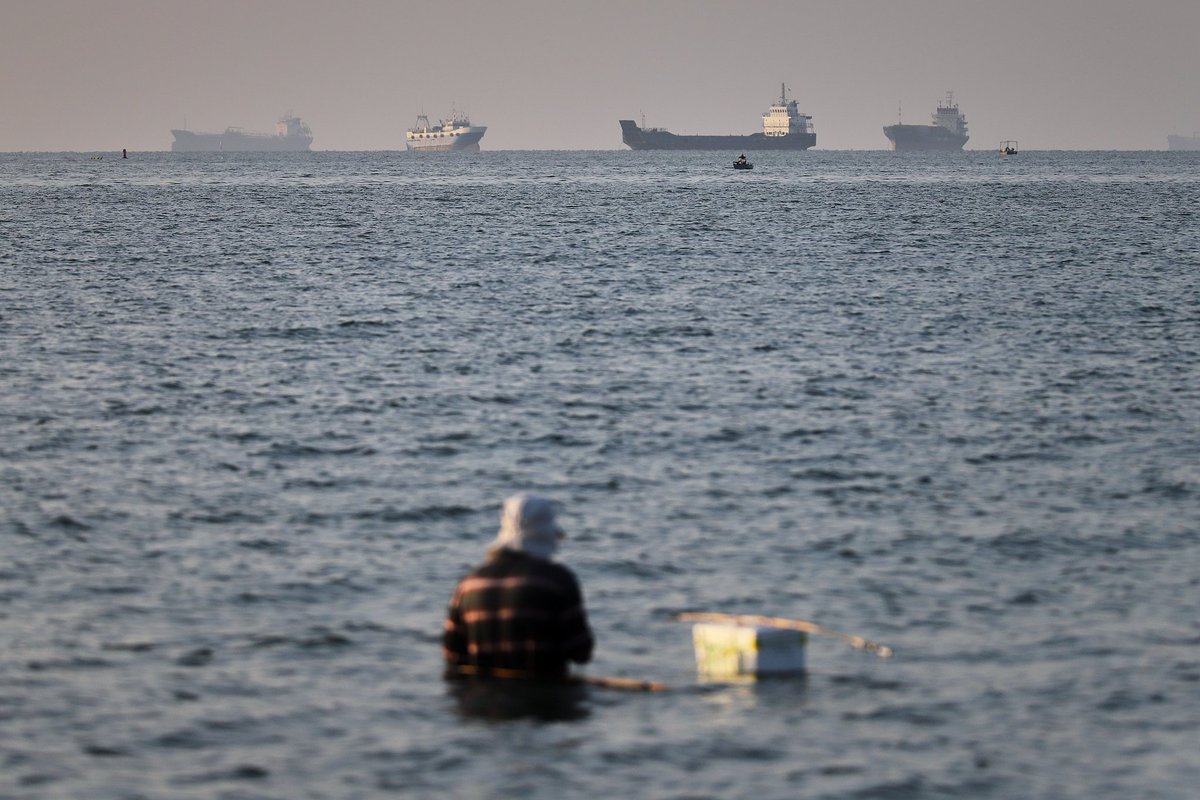
The blockade of Iranian ports — a naval posture that the Trump administration insists is not a blockade but a "maritime security operation" — has entered its third week. The Strait of Hormuz, through which roughly a fifth of the world's oil flows, remains open in strictly legal terms. Iranian vessels carrying crude face interdiction; foreign vessels carrying anything Iran might need to sustain its economy or its weapons programmes face inspection, delay, or refusal. The result is a stranglehold on import supply chains that Tehran's officials describe, in language that is not without a certain brutal accuracy, as economic warfare conducted by other means.
The stated goal, as the White House has articulated it, is to compel Iran to the negotiating table and to dismantle its nuclear programme. The implied goal, which current and former officials have described in background briefings to outlets including Axios, is to impose sufficient economic pain to trigger internal political change — what the administration calls, with a candour that is either admirably frank or troublingly naive, giving the Iranian people a chance to determine their own future. On 5 May 2026, Trump himself described that logic in explicitly kinetic terms: the Iranian people, he said, needed guns, and once they had them, they would fight as well as anyone. The comment was made at a photo opportunity and was not substantively contradicted by any official present.
Whether this constitutes a coherent strategy or a high-stakes improvisation is the question that diplomats, analysts, and markets are all trying to price in real time.
What a Blockade Actually Does to a Country
The mechanics of the current operation are not contested. U.S. naval assets in the Gulf have established what amounts to a de facto embargo on Iranian maritime commerce. Insurance companies covering cargo vessels have quietly advised clients to avoid Iranian port approaches. Shipping firms are rerouting. The result, according to commercial shipping data published by Lloyd's List and maritime intelligence services, has been a sharp reduction in tanker arrivals at Iranian terminals.
The human consequences, as with all sanctions and embargo regimes, fall unevenly. Iran's civilian population — 88 million people — depends on imported medicines, agricultural inputs, and raw materials for industries that predate the current confrontation. Sanctions regimes, even those with humanitarian carve-outs, generate shortages that do not cleanly distinguish between military and civilian supply chains. International humanitarian law treats collective economic deprivation of a civilian population as a violation of the laws of armed conflict; the Trump administration disputes this characterization, arguing that the measures target state institutions, not people.
That distinction — between targeting a government and targeting a population — is one of the oldest and most contested debates in the history of economic statecraft. The evidence from comparable cases is not encouraging. Venezuela's sanctions regime produced genuine humanitarian suffering without removing the Maduro government. North Korea's isolation has produced a nuclear-armed state. The question of whether pain imposed on a population produces political change or simply more pain is one that history has answered variously, depending on the regime's resilience and its capacity to redirect grievances inward.
Iran's clerical establishment has survived forty-six years of adversarial relations with the United States. It survived the Iran-Iraq War of the 1980s, during which the U.S. actively supported Saddam Hussein. It survived the 2015 nuclear deal and its subsequent unilateral withdrawal by the Trump administration in 2018. Whether a naval blockade constitutes a qualitatively different pressure depends on assessments of internal Iranian cohesion that outside observers cannot reliably make.
The Economics the Market Won't Ignore
The crude oil market has responded to the blockade not with panic but with a kind of studied equanimity that tells its own story. Brent crude has moved higher since the operation began, but not dramatically. The reasons are structural: global spare production capacity, the continued flow of Gulf oil through terminals that are not under Iranian control, and the partial release of strategic petroleum reserves by consumer nations. The market has priced a disruption, not a crisis.
That pricing may be premature. Iran has significant leverage within the Strait of Hormuz itself — leverage that is structurally independent of any decision to close the waterway, which would be an act of war under international law but which Tehran has previously threatened in response to what it characterizes as existential threats. The 28 percent probability on Polymarket that the blockade lifts this month reflects genuine market uncertainty, not a settled consensus. The 8 percent probability assigned to a U.S.-EU trade deal this year — a separate but related data point — suggests that transatlantic relations are also a variable in whatever diplomatic endgame the administration is designing.
The oil dimension matters because it constrains the administration's freedom of action in ways that the White House's rhetoric does not acknowledge. A sustained blockade that drives crude prices above a certain threshold activates political pressure inside Europe, inside China, and inside American swing states that depend on gasoline price stability. The administration is betting that its leverage is greater than the threshold. The market, currently assigning only a 28 percent chance of the blockade lifting within weeks, is pricing a middle ground: neither rapid capitulation nor immediate escalation, but a grinding confrontation with uncertain duration.
Two Versions of the Same Crisis
The administration's public framing presents the blockade as a clean act of deterrence backed by overwhelming force. The goal, as Trump described it in the same press appearance on 4 May, is to restore Iran to a condition that would require twenty years of rebuilding once the operation is concluded. That framing — victory is assumed; the only question is how much damage Iran absorbs before accepting terms — is internally coherent, if one accepts the premise that coercive pressure without a defined end-state is a viable diplomatic tool.
Iran's framing is necessarily harder to corroborate, given that Iranian state-adjacent media operates in an environment of severe constraints on independent reporting. But what is available through regional wires — including reporting from Al Jazeera and Iran International, which maintain correspondent access — describes a government that is under pressure but not yet destabilized. Iranian officials have characterized the blockade as an act of piracy. They have escalated rhetorical threats but have not, as of 5 May, taken kinetic action in the Strait that would cross the threshold from coercive posturing into open conflict.
The gap between those two framings — overwhelming pressure versus resilient defiance — is where the actual story lives. Neither side's public posture is designed to be a neutral description of reality. Both are instruments of communication aimed at domestic audiences, at allied governments, and at the adversary. The question of which side is more accurately describing the other's internal condition is one that neither will answer honestly in public.
What Comes Next and Who Is Already Losing
The 6 percent probability assigned on Polymarket to Trump repealing presidential term limits is a separate measure of a phenomenon that is easier to document than to analyse: the normalization of language that would have been considered outside the bounds of democratic discourse even four years ago. That number is small. But the fact that it is a live market, rather than a dismissed fringe hypothesis, reflects something genuine about the informational environment in which this blockade operates.
Looking forward, several trajectories are simultaneously possible. A negotiated outcome — some version of a revised nuclear agreement with economic relief in exchange for verifiable caps on enrichment — remains the stated preference of European signatories and, reportedly, of portions of the American national security establishment that have been sidelined during the current decision-making process. A sustained blockade producing economic deterioration inside Iran is the administration's preferred scenario, though one that requires patience and承受能力 that American administrations have historically struggled to maintain. A military confrontation triggered by an Iranian miscalculation — or by a decision in Tehran that deterrence has failed and that demonstrating resolve requires action — is the scenario that markets are underpricing.
The countries watching most anxiously are not the principals. Japan, South Korea, and several Southeast Asian economies are heavily dependent on Gulf oil and on the free passage of trade through Hormuz. Europe is watching the blockade's impact on energy prices and on the coherence of its own Iran policy, which has diverged from Washington's since the 2018 withdrawal from the Joint Comprehensive Plan of Action. China, which has significant energy interests in Iran and which has deepened its diplomatic and economic relationship with Tehran since 2018, is a variable that the current framing of this conflict largely ignores.
The blockade may yet produce the diplomatic outcome the administration seeks. It may also produce a nuclear-armed Iran with a grievance and a reason to accelerate. The market assigns a 28 percent chance of the whole thing being resolved within a month. That number reflects not an answer but an absence of consensus — which is, perhaps, the most honest description of where this situation actually stands.
This article was desked alongside wire reports from ClashReport, Euronews, and Polymarket. The broader Iran file — including ongoing nuclear talks, European diplomatic initiatives, and reporting from regional correspondents — is monitored continuously by the Monexus foreign desk.
Wire provenance
This editorial synthesis draws on the following public wire/social posts:
- https://t.me/ClashReport/
- https://t.me/euronews/
- https://x.com/realdonaldtrump/status/2051500120546394117