Iran's Hormuz Warning and the South Korean Ship Attack Expose the Limits of Western Deterrence
A South Korean-registered tanker was damaged by an explosion in the Strait of Hormuz on 5 May 2026. Tehran responded to Trump's maritime initiative with a direct warning that it has barely begun testing the waterway's status. The convergence reveals a widening gap between American deterrence commitments and the operational reality of protecting commercial shipping in contested waters.
On the morning of 5 May 2026, a South Korean-registered ship was damaged by an explosion and fire in the Strait of Hormuz. Seoul's Foreign Ministry said it had initiated an investigation. Hours earlier, Iran's lead negotiator had delivered a public warning that the Islamic Republic had "not even begun" to test the status of the waterway — a passage through which roughly a fifth of the world's oil flows. The two events, unfolding within the same news cycle, underline the deteriorating security architecture of the Persian Gulf's most critical maritime corridor.
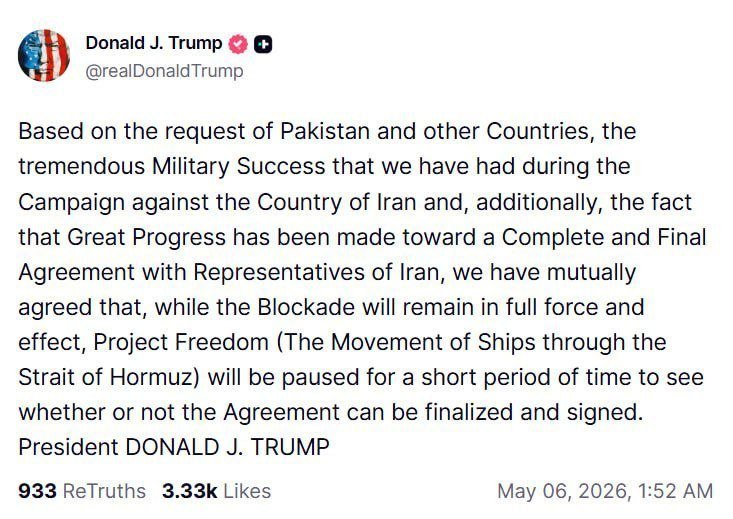
Trump had announced a new initiative the previous day aimed at protecting neutral vessels crossing the Strait, a commitment that Tehran appeared to be explicitly stress-testing less than twenty-four hours after it was announced. What followed was not an interdiction but a series of statements calibrated to raise the commercial insurance premiums that make Gulf shipping economically painful without crossing a threshold that would force an American military response. The pattern — pressure without direct confrontation, signal without an overt act — is familiar from Iranian strategic doctrine. But the vehicle this time was not a Revolutionary Guard speedboat or an unmanned drone. It was a South Korean commercial ship, caught in an incident Seoul has yet to attribute conclusively.
Seoul's Investigation and the Blast That Has Not Yet Been Explained
The South Korean Foreign Ministry confirmed on 5 May 2026 that it had opened an investigation into the damage to a Korean-registered vessel in the Strait of Hormuz. The ministry did not immediately assign responsibility. Trump, speaking from Washington, said the attack was carried out by Iran — a characterisation that preceded Seoul's own official finding and that Korean officials have so far left formally open.
The discrepancy matters. Attribution in maritime incidents of this kind is rarely a simple forensic exercise. The Strait of Hormuz is a constricted waterway with significant naval and paramilitary presence on multiple sides. Ships transiting the area carry commercial AIS transponder data, but the signals can be manipulated or switched off. Explosion forensics — whether a vessel was struck by a mine, a rocket, a missile, or damaged by an internal fault — take days or weeks to establish with confidence. Seoul's decision to conduct its own inquiry rather than accept the American characterisation immediately reflects a diplomatic posture that most regional capitals are currently navigating: how to acknowledge pressure from Washington without locking oneself into a position that forecloses de-escalation options.
Tehran's Calculus: Threat as Leverage, Not as Prelude
Iran's lead nuclear negotiator said on 5 May 2026 that his country had "not even begun" to test the status of the Strait of Hormuz. The phrasing was deliberate. It was not a threat to shut the waterway. It was a threat to accumulate leverage gradually — to establish, through incremental pressure, that the waterway cannot be treated as permanently open by the international community without an accommodation that reflects Iranian interests.
Iranian officials have consistently argued that Western sanctions constitute a form of economic warfare and that the Hormuz Strait represents a proportional counter-leverage tool. The negotiating position Tehran is building is familiar in structure: present the international community with afait accompli of gradually rising risk premiums in the oil trade, then offer to reduce those premiums in exchange for sanctions relief or diplomatic recognition. The tactic does not require actual blockage. The credible possibility of blockage is sufficient.
The negotiator's statement followed Trump's maritime initiative by approximately twenty hours — close enough in diplomatic time to read as a direct response. The White House initiative, whose specific mechanism has not been fully detailed in public filings, appears to involve some combination of naval presence coordination and commercial vessel registration protections for ships transiting the Strait. Whether that framework has the buy-in of regional partners — the Emirates, Oman, Qatar — who would need to participate in any functional escort or insurance scheme remains unclear from the available record.
Ships Rerouting and the Commercial Cost of Ambiguity
Bloomberg reported on 5 May 2026 that commercial vessels were already gathering farther from the Strait of Hormuz as Iran expanded its operational grip on the surrounding waters. Ships seeking to avoid the constricted corridor are rerouting to longer passages — either around the Horn of Africa or across the Indian Ocean to the Cape of Good Hope — incurring significantly higher fuel costs and transit times.
The rerouting is not yet a full exodus. Commercial shipping follows economics, and the Hormuz shortcut remains the cheapest path for Gulf-origin oil exports. But insurance underwriters, who price risk against the probability of hull damage, are the first to move. Lloyd's of London and the major P&I clubs have begun revising risk assessments for Gulf transits, and the cost of covering a voyage through the Strait has risen measurably since the South Korean incident. Each percentage-point rise in insurance premium translates directly into landed costs for Asian refiners who buy Gulf crude — costs that, in a competitive market, ultimately reduce the volume of oil that Gulf producers can sell profitably.
The rerouting dynamic is the mechanism through which Iranian pressure becomes economic effect without a single mine being laid. The Islamic Republic understands this. The question Western capitals are now working through is whether there exists any diplomatic or security architecture capable of restoring the confidence premium that made the Strait a reliable corridor for three decades of relatively frictionless commerce.
What Western Strategy Has Not Answered
The core problem is not that Western capitals lack a position on Gulf shipping. It is that the positions they have articulated — naval escorts, sanctions enforcement, diplomatic isolation of Iran — do not add up to a credible operational response to a threat that is itself ambiguous and deniable.
American naval assets in the Gulf are formidable. But carrier groups are expensive to maintain on station, and the political cost of firing on Iranian vessels in international waters — even in response to an interdiction — is significant. Regional partners, who would need to co-sponsor any visible escort scheme, have shown consistent reluctance to put their own naval assets in direct line of Iranian fire. Oman and the Emirates have strong economic relationships with Iran and have not publicly committed to any American-led security framework that would make them targets.
The result is an asymmetry: Iran can raise the cost of the Strait's use incrementally, through statements and low-level incidents, at a political cost close to zero. Western capitals must either escalate visibly — committing naval forces that will be held to account if the confrontation turns lethal — or accept a gradual erosion of the commercial conditions that make the Strait valuable. Neither option is attractive. The gap between them is where the current crisis is playing out.
What Remains Uncertain
The South Korean Foreign Ministry investigation has not concluded. The cause of the blast has not been independently confirmed. The Korean government's own attribution position remains formally open, which means the diplomatic and legal consequences — whether the incident triggers insurance claims, UN consultations, or a formal complaint under maritime law — have not yet crystallised. Whether Iran's negotiators intended the statements around 5 May as a direct response to Trump's initiative, or whether they constitute a parallel but independent escalation, is also not yet established from the available record. What is clear is that the Hormuz Strait has moved from a background risk variable to the centre of the diplomatic exchange between Washington and Tehran — and that the commercial shipping industry is drawing its own conclusions faster than either government is moving to address them.
This publication led with the South Korean vessel incident and Tehran's explicit statement that it had not yet begun to test the Strait's status — framing the story as an emerging security crisis rather than primarily as a diplomatic development. The wire services treated the Trump initiative as the lead; Monexus placed the maritime reality on the ground first.
Wire provenance
This editorial synthesis draws on the following public wire/social posts:
- https://t.me/alalamarabic/112233
- https://x.com/sprinterpress/status/1934567890123456789