Mamata Banerjee's Gambit: Bengal's Fractured Mandate and the Politics of Refusal
Mamata Banerjee is refusing to concede defeat in West Bengal's state election, declaring her Trinamool Congress the moral victor despite winning fewer seats than the BJP. The gambit tests the limits of democratic norms in India's most contested state.
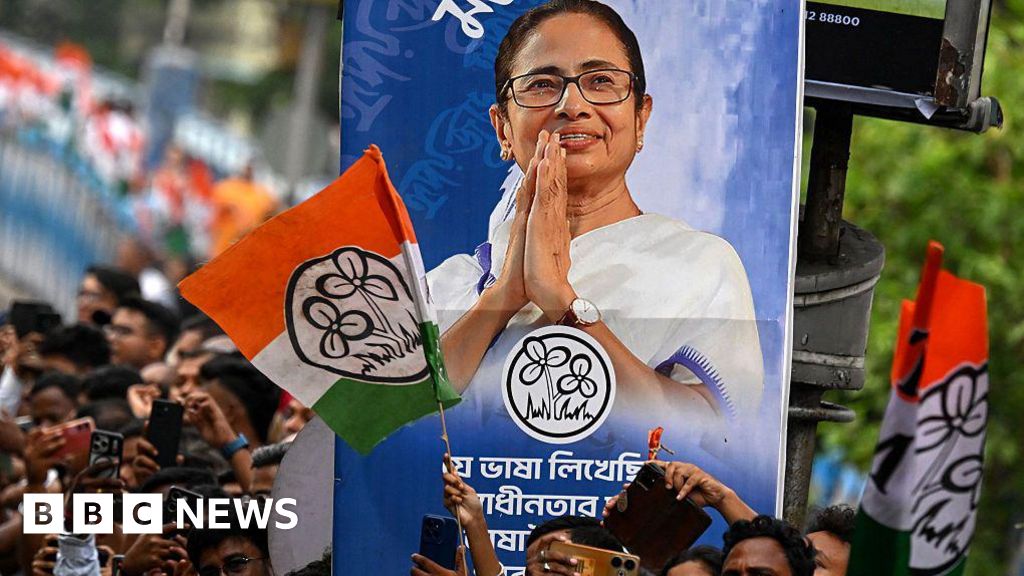
On May 5, 2026, Mamata Banerjee stood before cameras in Kolkata and delivered a one-line answer to every question about her future: "Why should I resign?" The defiance was complete, unhedged, and immediately parsed by political observers as something more than rhetorical bluster. The woman who has governed West Bengal for fourteen years was refusing to acknowledge that her party had lost.
The election results, tallied across the previous forty-eight hours, told a complicated story. The Bharatiya Janata Party emerged as the single largest formation with 125 seats in the 294-member legislative assembly, according to preliminary counts. Trinamool Congress, Banerjee's party, had won 111 seats. By any conventional reading of parliamentary democracy, the larger bloc forms government. But Banerjee was having none of the convention. Speaking to reporters on May 5, she described the outcome as an "attempt to defeat" her party and declared that TMC had "morally won" the election. She instructed her legislators to remain steadfast.
The claim is legally and democratically hollow. A moral victory is not a seat count, and 111 legislators do not constitute a governing majority regardless of how the result is framed. Yet the gambit speaks to something deeper about the texture of Indian federal politics, where the gap between legal procedure and political reality often runs wide enough to park ambitions.
The Arithmetic of Disappointment
To understand what happened, look at the numbers as they emerged through the night of May 4 and into the morning of May 5. The BJP had invested heavily in West Bengal, treating a TMC defeat as essential to its broader project of cultural and political dominance in the eastern states. Prime Minister Modi had campaigned aggressively; Amit Shah had made Bengal a personal priority. The BJP's 125 seats represent a genuine advance on the party's 2021 performance, when it won 77 seats in an election TMC still managed to win outright.
But the BJP fell short of the 148 seats required for a majority. It will need coalition partners to form a stable government — a prospect that introduces its own instabilities into a state where political violence has historically accompanied transitions of power. TMC's 111 seats, meanwhile, constitutes a significant opposition bloc, one large enough to paralyze a minority government.
Banerjee is calculating that a minority BJP administration will be unworkable. She is also betting that her party's legal challenges to specific seat allocations — a tactic TMC deployed in 2021 and which resulted in several successful petitions — will erode the BJP's position further in the coming weeks. Whether that calculation is politically shrewd or delusionally optimistic depends on who you ask.
The Norms Test
There is something quietly extraordinary about a sitting chief minister publicly contesting an election result she lost. The precedent exists, of course — political figures worldwide have refused to accept unfavorable outcomes, and the language of moral victory is not unknown in democratic politics. But the speed and sharpness of Banerjee's refusal sets this moment apart. She did not wait for a formal count to be certified. She did not grant a graceful transition period. She went to the microphones within thirty-six hours of the final trends becoming clear and made her position unmistakable.
The move places institutional actors in an awkward position. Governor CV Ramananda Bose — whose own appointment has been a subject of legal dispute between the state legislature and the central government — must decide whether to invite the single largest party to form government or to entertain Banerjee's claim that TMC, despite fewer seats, retains some other form of legitimacy. Constitutional scholars are already circulating legal opinions on both sides. The governor's office has not issued a formal statement as of this publication.
India's opposition parties have offered muted responses. Regional outfits that might have served as coalition partners to either side are calculating their own positions. The silence from Congress and the CPI(M) — parties with historical ties to Bengali electoral politics but diminished present relevance — has been notable. They appear to be watching to see whether the BJP can actually assemble a working majority before committing.
The Structural Logic
What Banerjee is doing, stripped of its personality, is refusing to accept that her party has been relegated to opposition status. She is arguing — without quite saying so explicitly — that TMC's continued electoral relevance, its vote share, and the scale of the BJP's failure to win a majority together constitute a form of ongoing mandate that supersedes raw seat counts.
That argument is, constitutionally speaking, incorrect. But the reason it resonates is that it touches a genuine structural tension in how Indian federalism distributes power. State election results are formally separate from central government decisions, but New Delhi's growing appetite for gubernatorial intervention in state legislatures has made that separation increasingly theoretical. Banerjee's office has been fighting legal battles with the central government for years over appointments, transfers, and the deployment of central security forces during elections. The idea that the governor's decision is a purely technocratic one, untainted by federal political calculations, is a fiction most experienced Bengal observers have stopped pretending to believe.
The BJP's challenge now is practical and political. A minority government in West Bengal, facing a hostile TMC with 111 seats, a legal challenge operation, and a restive civil society in Kolkata's civic institutions, would govern at constant risk of collapse. The alternative — a fresh election — would be expensive, logistically daunting, and would carry the implicit admission that the current results are unworkable.
What Happens Next
The next ten days will determine whether Banerjee's gambit has any institutional purchase. If the governor invites the BJP to form government and if that government proves stable, the moral-victory rhetoric will become a footnote — the desperate framing of a defeated politician. If, however, the BJP struggles to assemble a coalition, if legal challenges chip away at its seat total, and if the political atmosphere in Kolkata remains febrile, Banerjee's refusal may look less like delusion and more like a canny calculation that the real contest has not yet begun.
She remains, whatever the seat arithmetic says, the most recognizable political figure in West Bengal. Her party holds more than a third of the assembly seats. And she has just demonstrated, in public and without ambiguity, that she does not intend to go quietly.
Sources for this article: Scroll.in (May 5, 2026) and Hindustan Times (May 5, 2026) reporting on Mamata Banerjee's public statements from Kolkata.