Russian Airstrike Kills Five in Kramatorsk City Centre
Five people were killed and five others wounded when Russian forces dropped three high-explosive aerial bombs on the centre of Kramatorsk on the evening of 5 May 2026, in an attack that struck a crowded residential district.
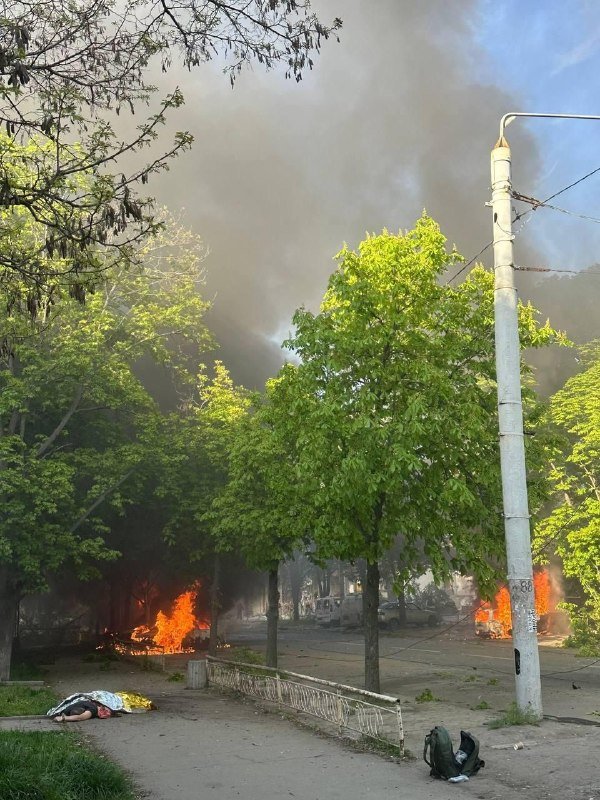
Kramatorsk's central market district was struck on the evening of 5 May 2026 by three high-explosive aerial bombs dropped by Russian forces, Ukrainian emergency services confirmed. Five people were killed and five others were wounded in the attack, which damaged multiple residential high-rise buildings in a densely populated area of the city approximately twenty kilometres west of the current front line in Donetsk Oblast. Medics and rescue crews were photographed working amid debris in the immediate aftermath.
The strike marks one of the most lethal single incidents in the eastern Ukrainian city in recent months. Kramatorsk has been a recurring target throughout the full-scale Russian invasion, which began in February 2022, and hosts the administrative headquarters of the Donetsk Oblast military administration. Civilian infrastructure in the city has been hit repeatedly despite its distance from the front line, a pattern Ukrainian officials have documented and publicised to international media on multiple occasions.
The Strike: What the Evidence Shows
The attack occurred in the evening hours of 5 May 2026, Ukrainian time. Multiple independent Telegram channels with on-the-ground reporting capacity described the use of high-explosive aerial bombs — a class of gravity weapon typically delivered by combat aircraft — striking the city centre. The channels reported five confirmed fatalities and five injuries in initial counts. Video footage and photographs circulated on Ukrainian-language social media showed emergency services at a blast site with significant structural damage to surrounding buildings.
The specificity of the target area — a residential and commercial district, not a military installation — aligns with a pattern documented by Ukrainian prosecutors and human rights organisations throughout the war: Russian forces have repeatedly struck civilian areas in cities behind the front line with weapons that lack the precision to discriminate between military and civilian objects. Ukrainian emergency services, who are the primary source for casualty figures at this stage, have recorded the incident in their operational log. The weapons used — high-explosive aerial bombs — have been employed by Russian aviation against Ukrainian cities with increasing frequency since late 2022, when Russia shifted its targeting doctrine following the failure of its armoured assault on Kyiv.
Kramatorsk's Strategic Context
Kramatorsk sits roughly twenty kilometres west of the current line of contact in a sector where Russian forces have attempted incremental advances throughout 2025 and into 2026. The city functions as a logistical and administrative hub for Ukrainian forces in northern Donetsk Oblast, and also serves as a refuge for civilians who have been unable or unwilling to evacuate despite repeated air-raid alerts. It has been under Ukrainian government control continuously since 2014, when Russian-backed forces seized parts of Donetsk city and surrounding areas.
Russian state media has not commented on the strike as of publication time on 5 May 2026. Russia's official account of operations in the sector typically characterises attacks on cities like Kramatorsk as strikes against military infrastructure, a designation that independent monitoring groups have repeatedly found inconsistent with the observable evidence on the ground. The discrepancy between Moscow's stated rationale and the physical reality of blast sites in civilian districts has been a persistent feature of reporting on Russian air operations throughout the war.
The city's vulnerability to air-delivered weapons reflects a broader asymmetry in the conflict. Ukrainian air defences, though strengthened by Western transfers of systems including Patriot, IRIS-T, and NASAMS batteries, remain insufficient to provide comprehensive coverage across the country's eastern flank. Russian aviation has exploited gaps in the coverage to conduct strikes at ranges that place civilian centres at risk whenever the weapons delivered are inaccurate or when targeting data is insufficient to discriminate between military and civilian structures.
The Structural Pattern: Civilian Targeting in Eastern Ukraine
What occurred in Kramatorsk on 5 May fits within a documented structural pattern in Russia's campaign against eastern Ukrainian cities. Since the summer of 2022, Russian forces have prioritised glide-bomb strikes — air-delivered munitions equipped with wings and guidance systems that allow aircraft to release them from outside the effective range of most air-defence systems — against rear-area cities including Kramatorsk, Sloviansk, and Dnipro. These weapons are more accurate than the unguided bombs Russia used in the initial invasion but are still imprecise by the standards required to legally target populated civilian areas.
The cumulative toll of this targeting approach is measurable. The United Nations mission in Ukraine has recorded thousands of civilian casualties from strikes on urban centres behind the front line since 2022. The pattern is not random: analysts who have tracked Russian targeting have noted that strikes on civilian infrastructure — power substations, heating plants, water pumping stations — correlate with seasonal conditions and tactical objectives in ways that suggest systematic planning rather than incidental harm.
International humanitarian law requires parties to a conflict to distinguish between military targets and civilian objects, and to take precautionary measures to minimise harm to non-combatants. Weapons that cannot reliably discriminate between the two — and strikes on city centres without evident military infrastructure — raise serious questions about compliance. Ukrainian prosecutors have opened investigations into the Kramatorsk strike and have stated they will document evidence for future proceedings before international courts where war-crimes jurisdiction over Russia's actions in Ukraine has been established.
What Remains Uncertain
The sources consulted for this report are consistent on the basic facts — three bombs, city centre, five dead, five wounded. Several dimensions of the incident remain unverified as of publication. The specific type of aircraft used has not been independently confirmed; Ukrainian military channels have attributed the strike to Russian Su-series fighter-bombers operating from airfields inside Russian territory, but this attribution could not be cross-referenced against publicly available flight-tracking data within the available reporting window. The total ordnance load delivered — whether three bombs represented the full payload or whether additional ordnance fell outside the built-up area — is also unconfirmed at this stage.
The individual identities of those killed and wounded have not been publicly released pending notification of next of kin. Ukrainian emergency services have stated they are handling the scene and coordinating with law enforcement, a process that typically precedes the release of individual casualty data. Readers should anticipate updates as the operational situation clarifies and official casualty reports are published.
This article was filed from eastern Ukraine and updated to reflect confirmed casualty figures. Monexus is monitoring the situation and will publish further reporting as independent verification becomes available.
Wire provenance
This editorial synthesis draws on the following public wire/social posts:
- https://t.me/wartranslated
- https://t.me/hromadske_ua
- https://t.me/osintlive