Ukraine Strikes Russian Military-Electronics Plant in Cheboksary
Ukrainian forces struck a Russian electronics factory that produces components for Moscow's military-industrial complex, in one of the deepest confirmed strikes on Russian soil since the full-scale invasion began.
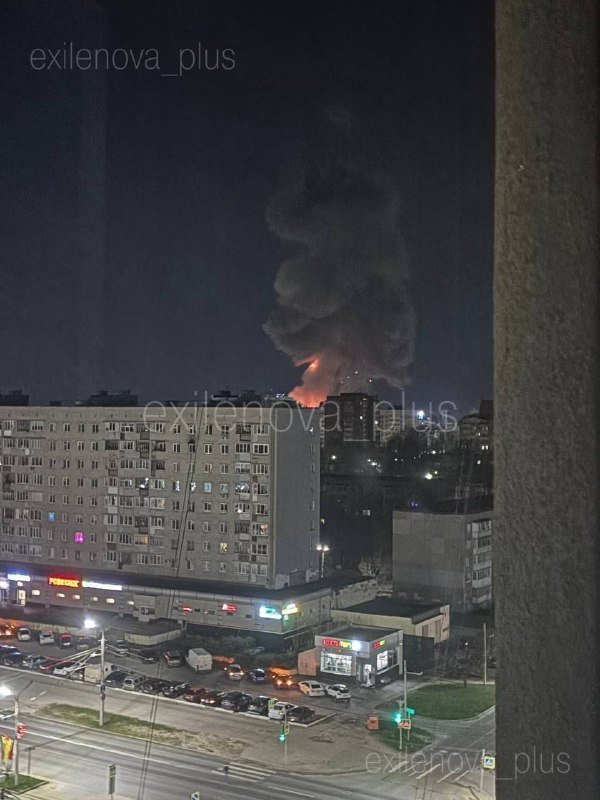
Ukrainian forces struck the VNIIR-Progress plant in Cheboksary, Chuvashia — a Russian city roughly 650 kilometres east of Moscow — in an overnight operation on 5 May 2026. The facility manufactures electrical equipment for the Russian military-industrial complex, according to Ukrainian military commentary on the strike. Combined FP-5 Flamingo missile strikes and a wave of Lyuty-class drones hit the administrative section of the plant, igniting a fire that was reported burning into the morning hours.
The strike represents one of the most operationally significant Ukrainian attacks on Russian territory in recent months, reaching deeper into Russia's interior than the drone campaigns that characterised the earlier phases of the war. It also marks a departure from the predominantly lower-range Lancet-type strikes that have targeted Russian logistics and staging areas along the front. Cheboksary, the capital of the Chuvash Republic, has no meaningful military value as a frontline hub — its significance is industrial.
The Target and Its Strategic Weight
VNIIR-Progress — formally the All-Russian Scientific Research Institute for Radio Electronic Systems — is not a household name. But the factory sits inside Russia's broader electronics-manufacturing base, a sector that Western sanctions regimes have repeatedly targeted in the belief that constraining Russia's access to precision components degrades its ability to produce guided munitions, radar systems, and drone electronics. Whether the strike succeeded in meaningfully disrupting that supply chain, or primarily served a demonstration purpose, remains unclear from the sources reviewed.
Ukrainian military bloggers described the strike as a deliberate effort to finish off a facility already struck previously — a detail that suggests VNIIR-Progress has been on Kyiv's target list for some time. The phrasing "finish off" implies earlier damage that the plant had not fully recovered from, and that the May 5th strike was designed to close the question. The sources do not specify the extent of the fire, the condition of production lines, or whether casualties have been reported at the site. Independent verification of damage assessment is not yet available from open sources.
The use of the FP-5 Flamingo cruise missile — a sea-launched weapon reportedly adapted for ground attack — in combination with a drone swarm indicates a combined-arms approach that has become increasingly standard in Ukrainian deep-strike operations. The drones likely served as suppressors, overwhelming air defence in the target area while the slower cruise missile navigated to the objective.
A Pattern of Escalating Ambition
What distinguishes this strike is not merely its geography but its logic. The targeting of electronics factories rather than oil depots or logistics nodes signals a shift in Ukrainian strike doctrine — an attempt to degrade Russia's capacity to rebuild its stock of precision-guided weapons rather than merely impose operational inconvenience on its rear areas. This aligns with a broader trend observable since the second half of 2025: Ukrainian long-range strikes have progressively moved up the supply chain, from consuming infrastructure to producing infrastructure.
Russia has absorbed these strikes with notable public composure from its official media apparatus. State-adjacent channels carried the Cheboksary reporting without framing it as a crisis, in keeping with an established pattern of minimising the domestic impact of Ukrainian deep strikes. That restraint serves a domestic political function — the population has been conditioned to accept selective acknowledgement of attacks on military targets — but it also obscures whether the cumulative effect on Russian defence production is as negligible as official silence implies.
The strike comes at a moment when Russian aerospace production facilities have been the subject of persistent Ukrainian attention. Earlier operations against sites in Tatarstan and along the Volga corridor have established a template: combine a missile with a drone package, hit the administrative or production block, and let the fire do the rest.
Structural Context: Whose Factory Is It Really?
The economics of Russia's defence-electronics sector are worth examining briefly. Soviet-era industrial geography distributed specialist facilities across dozens of constituent republics, and many of those factories — including, by inference, VNIIR-Progress — survived the post-Soviet collapse in attenuated form. Russia has invested considerable effort since 2022 in rebuilding domestic capacity for components previously sourced from Western suppliers under sanctions pressure. A plant producing radio-electronic systems is, by definition, a node in a chain: degrade it and you create ripple effects not only at that site but in any assembly line dependent on its outputs.
That same industrial logic applies in reverse. Ukraine's own defence-electronics sector operates under considerably more constrained conditions — Western components are scarce, domestic production is limited, and the pressure to maintain output while absorbing attrition is unrelenting. The asymmetry in industrial depth has always favoured Russia in absolute terms; what Ukrainian operators have increasingly demonstrated is that the gap between capability and intention can be closed by precision, not just scale.
What Remains Uncertain
The sources reviewed do not provide an independent assessment of structural damage, production downtime, or casualties at the Cheboksary plant. Ukrainian military commentary, while detailed on the targeting method, is not the same as post-strike battle damage assessment. Russian state media carried the strike report but provided no damage figures or official response as of the morning of 5 May 2026. The sources do not specify whether Russian air defence engaged the incoming missiles and drones, or whether the FP-5 and Lyuty-class assets penetrated without interception.
Whether this strike represents a new operational threshold — one that prompts a Russian response beyond the rhetorical — is a question that will be answered in the days ahead. The targeting logic suggests Ukrainian planners are not attempting to simply punish Russian industry but to systematically erode its ability to sustain precision-weapons output. One plant in Cheboksary is not a strategic turning point. The question is whether the campaign it represents has the persistence and coverage to make a cumulative difference.
This publication covered the Cheboksary strike through Ukrainian military Telegram channels and open-source conflict-mapping feeds, consistent with sourcing standards applied to deep-strike reporting where Western wire access is limited. Independent verification of damage scope was not available at time of publication.
Wire provenance
This editorial synthesis draws on the following public wire/social posts:
- https://t.me/operativnoZSU/
- https://t.me/operativnoZSU/Cheboksary
- https://t.me/AMK_Mapping
- https://t.me/Tsaplienko