Washington's Monstrous Week: The Shooting That Wasn't
The Secret Service opened fire on an armed man near the Washington Monument on Monday. The public got three paragraphs and a brief lockdown. That is the entire official account. And that silence tells us everything.
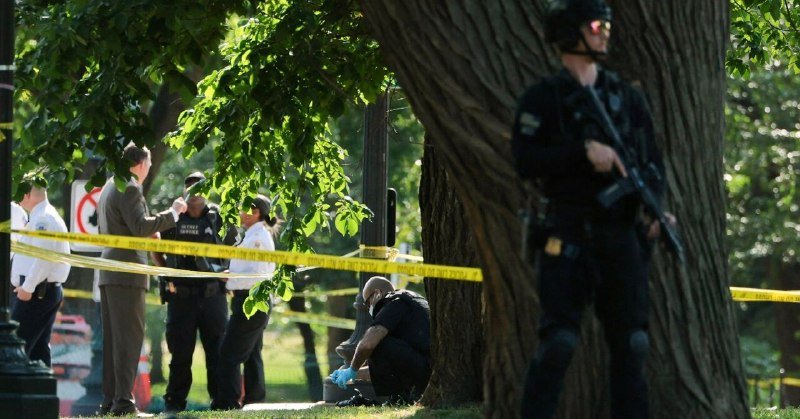
The Secret Service shot a man near the Washington Monument on Monday. Within hours, the story had been filed, the lockdown had lifted, and the official account had settled into three neat paragraphs: armed man spotted, agents responded, one person wounded. Vice President JD Vance was reportedly in the White House at the time. That is the sum total of what has been confirmed.
That is not enough.
The silence that follows an incident like this is itself a form of communication. Federal law enforcement agencies do not withhold operational details out of carelessness. They withhold them because disclosure serves no institutional interest and may create legal, political, or operational liability. The public learns what minimises risk to the institution. Everything else stays inside the perimeter.
What We Know and How We Know It
The wire reports are consistent where it matters: Secret Service agents engaged an armed suspect in downtown Washington on the afternoon of 4 May 2026. The suspect was wounded. The White House went into a brief lockdown. Vice President Vance was on the premises, per multiple reports citing administration sources. There is no discrepancy in the factual record — there simply is not much of a factual record to begin with.
The question is not whether the reporting is wrong. It is whether the reporting is complete, and the answer is obviously no. A shooting near the most surveilled piece of real estate in the Western hemisphere, involving the Secret Service, in a city that has spent decades hardening its centre against exactly this class of threat — and we are told the whole story in four sentences? That is not transparency. That is the outer limit of what the relevant authorities are willing to release before the news cycle moves on.
The Victim Problem
One detail appeared in early reporting and then quietly disappeared: a teenager was reportedly caught in the crossfire. The Indian Express account mentioned it explicitly. The other sources did not. That is the kind of detail that either confirms or undermines the official framing of an incident — depending entirely on whose interests it serves to amplify or suppress it.
If a teenager was hit by Secret Service rounds during a downtown engagement, that is a significant operational failure requiring investigation, disclosure, and — if warranted — accountability. If a teenager was merely present in the area during a lockdown, the framing is different. The sources offer no resolution. What they offer instead is a reminder that the information environment following a crisis event is not a neutral space. It is shaped, deliberately, by parties with skin in the outcome.
When mainstream coverage of an incident settles quickly into a tidy narrative — suspect acted alone, no broader threat, situation resolved — the instinct should be to ask who benefits from that tidy narrative and what it might be obscuring.
The Politics of Proximity
It is impossible to cover an incident at the White House perimeter in 2026 without confronting the political backdrop. JD Vance — whose name appears in every wire account as the official reason the White House lockdown mattered — occupies the second-highest elected office in the United States. An attack on the perimeter is, by definition, an attack on the vice president's locus of operations.
The fact that Vance was present does not make the incident political in the partisan sense. But it makes the political context unavoidable. Secret Service resources are finite. Threat assessments are made by human analysts applying probabilistic models to threat streams. The number of people who have standing to ask whether the threat stream was correctly calibrated — whether the armed suspect had a prior record, whether the response time was optimal, whether a teenager's presence in the crossfire reflects degraded perimeter control — is vanishingly small, and none of them work in journalism.
The rest of us get three paragraphs. The rest of us always get three paragraphs.
What the Silence Tells Us
The institutional calculus is predictable. A full disclosure of the operational circumstances — the suspect's identity and motive, the tactical chain of command during the engagement, the medical status of everyone injured, the timeline of the lockdown and the decision to lift it — would serve the public interest. It would also serve the interest of any subsequent plaintiff, any political opponent looking for a security failure to exploit, and any investigative journalist with a records request and a budget for litigation.
So the information is parceled out in the minimum viable dose, just enough to confirm that the public was not in danger — or at least that the public was told they were not in danger — and the rest is held in reserve against future liability.
This is not a critique of the Secret Service specifically. It is a description of how information operates in the post-incident environment around any federal law enforcement action. The shooter is alive or dead. The perimeter is secure. The relevant committee has been notified. Everything else is someone else's problem — typically the press, which lacks the subpoena power to make it a real problem on any timescale faster than eighteen months.
The teenager caught in the crossfire, if confirmed, deserves to know exactly what happened to them. The public deserves to know whether the security architecture around the vice president functioned as designed. The sources do not yet provide those answers. What they provide is the current official account — bare, consistent, and almost entirely uninformative about the thing that actually matters, which is whether the people who protect the White House did their job correctly on Monday afternoon.
That is the question. And it is not answered.
Wire provenance
This editorial synthesis draws on the following public wire/social posts:
- https://t.me/IndianExpress/18941
- https://t.me/france24_en/13218
- https://x.com/CGTNOfficial/status/1920784204738392291